

Mutating the Mind Flayer

Fun Fact
The term Mind Flayer is not in the SRD, it is the intellectual property of Wizards of the Coast. Which means nothing unless you want to publish your version professionally outside of the Dungeon Master's Guild.
The 13th Age RPG calls its squid-head the Soul Flenser. I'll call my version the Tarsiss, in case this ends up in a future project.
Inspirations
Besides the mind flayer, the khepri: bugs that lived on human bodies from Perdido Street Station and of course, Mi-go brain cylinders.
Mind Flayer
Everyone, from D&D players to Stranger Things fans, loves a mind flayer. Here's the first mind flayer I ever saw, from the original Dungeons and Dragons white box supplement II Blackmoor by Dave Arneson. 1975!
Mutation Station
Let's mix it up, creating a new creature, inspired by the mind flayer -- one that players won't know all about. For this example, let's use the Cypher System, as stat blocks are easy. If we like it we can make a 5th Edition or a 13th Age version. (Edit: the 13th Age version is here.)
What do I like about mind flayers I want to keep?
- Squid head, humanoid body
- Super smart
- Mental attack
- Eats brains
The Tarsiss
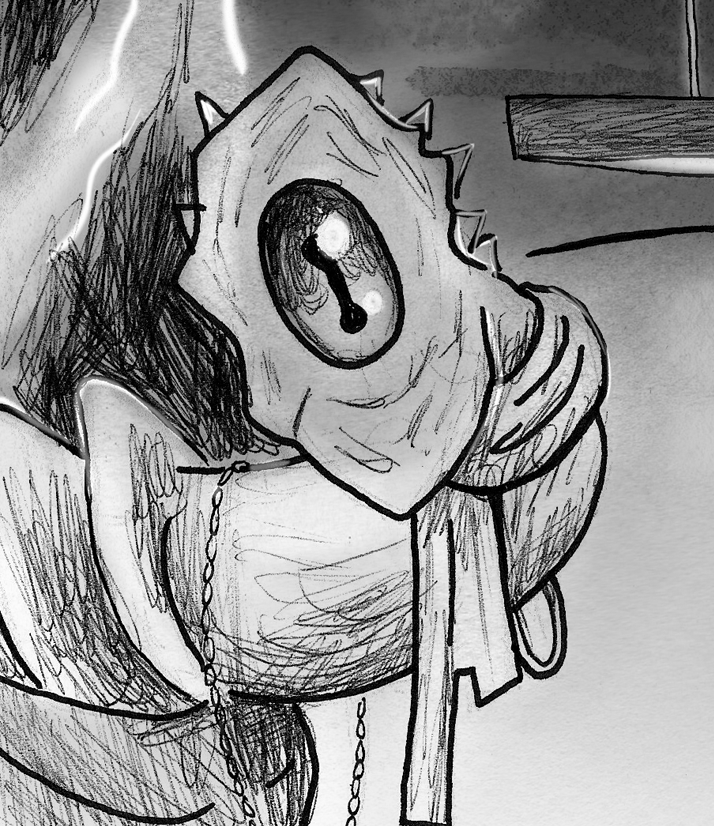
I love the fact that these creatures have humanoid bodies and squid heads. My creatures (the Tarsiss) are squidlings that take a human body, cut off the useless head, and replace the head with their own squid like body. They are super smart, use bizarre technology, and are practiced in dimensional travel. When not using weird tech weapons, they have a psychic attack.
And of course, they eat brains. They don't mind canned food, so they keep humanoid brains alive in weird devices that look like fat thermoses with ports for connecting to other weird devices. Captives in these brain-jars can be made to run machinery. Imagine the fun when the players find a Tarsiss outpost staffed by human brains in jars!
Tarsiss
Level 7 (21)
Armor 2 (force field, works against Intellect attacks as well)
Lightning gun: 7 damage, long range, (depletion 1 in 1d6) level 7 artifact
Psychic blast: Short range Intellect attack that does 7 damage (ignores armor) and causes target to make a Might Defense roll or take 5 Speed damage.
GM Intrusion: The tarsiss attacks up to five targets within short range with its psychic blast attack.
Danger: This creature is more dangerous than a typical 7th level creature. That's the way we like it. Tone it down if you and your players prefer easy fights.


Races in Numenera & the Cypher System

I love Numenera, but using a descriptor for your race bothers me. It keeps non-humans from having "regular" descriptors like charming, rugged, or lonely. And if they really want to lean into their race, they lose their choice of focus, like murders or masters insects. What can you do?
Don't use the Racial Descriptor
This is the "Doctor it hurts when I do this," "Then stop," solution and the one found in the Cypher System rulebook. You're PC is a varjellen because you say they are, and you get to use any descriptor you want. You don't get the varjellen abilities in the core book, you just use your descriptor powers.
I like this for Numenera if you make it optional, and you let your players use racial foci without the descriptor. Some players like to lean into their race.
For the Cypher System, it's fine if it works for you, but if a player wants to really embody a race, I'll have to look elsewhere.
Two Descriptors
I've heard Monte Cook and others say, "just use two descriptors for each player." The idea is everyone gets two, and now you can be that lonely mutant you've always pined for. After all, real people have more than one adjective.
I like this simple change. I don't think this makes PC's too powerful. The descriptor does not scale with tier, so the worst effect would be a little more resilient 1st-tier PCs, not a bad thing at all.
Racial Flavors
You use flavors, from the Cypher System rulebook, to represent a race. This lets a player really lean into their golthiar character. A flavor lets the player choose to add a flavor ability, instead of a standard type ability. Just like type abilities, flavor abilities become available by tier. A player could choose to be a little more golthiarish, and a little bit less glaivish. Those are words.
The character can have access to regular descriptors and foci, yet still be cool because of their race. This allows the player to choose how much they lean into their race. One player might have one race flavor ability, the other three.
The downside is this is work. Unlike the other two solutions we talked about here, you need to come up with a few new abilities for each tier. You can always use type abilities from a variety of types.
I've seen a great example of using flavors for races for Cypher System fantasy in Megan Tolentino's Fantasy Ancestries.

I put in a racial descriptor and foci in The Sun Below: Sleeping Lady. Maybe I'll put in a racial flavor in The Sun Below: That's How the Light Gets In. No promises, but I'm kind of excited to do one.

Piggybacking Part II

Before we steal Piggybacking from GUMSHOE, check out how it works there in Piggybacking Part I.
The Noisy Cleric Problem
The problem piggybacking solves can be found in all sorts of roleplaying games with all sorts of skills, but the example that comes to mind is sneaking into a castle in a fantasy game like Dungeons and Dragons. In fantasy books and movies, the heroes sneaking into places is a staple of the genre. In D&D games, sneaking is left to the rogue and the ranger for scouting. Once the GM tells the entire table to roll dice to see if they sneak into the castle, somebody always misses, and the exciting infiltration turns into a frontal assault.
GUMSHOE Roots
In games like TimeWatch, Nights Black Agents, or Trail of Cthulhu, the whole spend resources to piggyback fits perfectly, since they are all GUMSHOE games. Most of my players have points to spend in Infiltration, but some have zeros. Every general skill is like that. You aren't giving the party something for free, they are spending resources they might need later to succeed now.
Let's look at other systems. I haven't tested these, but I will.
Cypher System Piggybacking
In games like Numenera, Predation, and The Strange, GUMSHOE style piggybacking is easy, since you're already spending the resources of Might, Speed, and Intellect to do anything.
The expert spends from their pool as normal, but the difficulty is harder because they are pulling the rest of the party with them. For a sneak into the castle test, the expert has their difficulty raised (+2 sounds good, +1 for less than 3 followers) and uses Speed. While the expert can use their Edge to lower their costs, the followers can not. They each spend one point, no discount.
If the expert succeeds, everyone sneaks in. Move on with the adventure.
Nothing to Spend Piggybacking
In games as varied as Call of Cthulhu, 13th Age, and Dungeons and Dragons, you don't have resources to spend to sneak into castles or climb up icy cliffs. You've got hit points, and while spending those might make sense in a few cases, usually not. Same with Sanity, Recoveries, or Spell Slots. These games are not about spending resources on skill tests, so it seems wrong to try and force them do that just for piggybacking.
In these games I'd boost the difficulty for the expert (+5 for d20, +25% for Call of Cthulhu), but then I'd require the rest of the party to roll just to assist. And if someone fumbles, well then, we're right back where we started from. That's the cost right there, the more players rolling, the greater the chance of a fumble. :)