
Evil Minions are the Best Minions
The fantasy: Conan wades through a sea of cultists, taking them down and looking good. He must take them down, because their shear numbers will overwhelm him if he doesn’t.
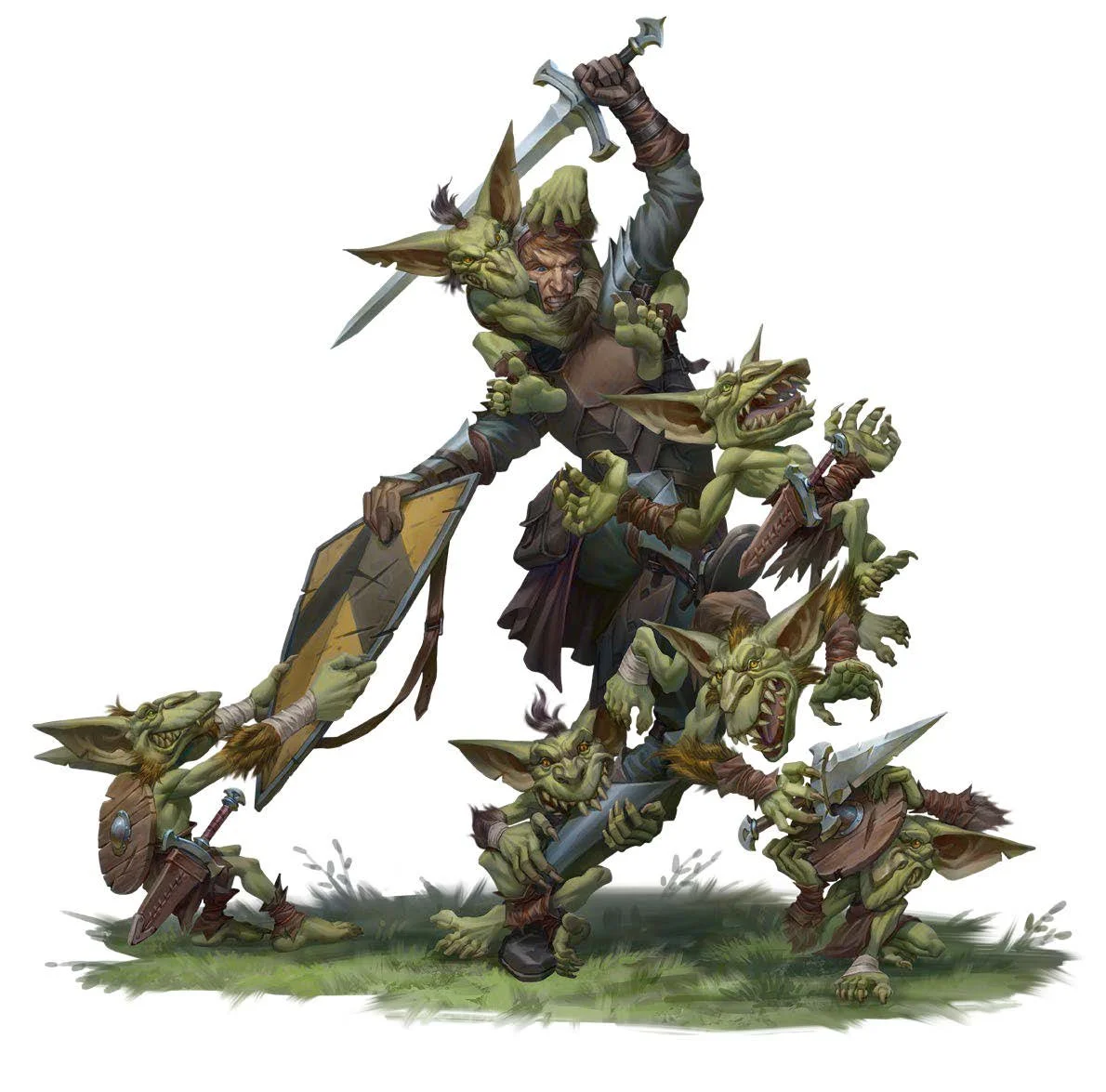
Goblin Minions
Flea, Mortals! delivers that fantasy with minions. I’ll tell you how to use them. First I’ll explain why they are needed.
5E has a game design concept called bounded accuracy that was supposed deliver that fantasy. It doesn’t work.
Try It, You’ll Hate It
Throw a dozen low CR creatures into one of your combat encounters vs. a level 8 party. Say the standard orc, 1/2 CR, 15 hp, +5 to hit, does 9 damage. Your twilight cleric is giving everyone an average of 11 temporary hit points per turn. And is concentrating on spirit guardians, maybe upcast to 4th level to do an average of 14 (7 on a save) points of damage to all nearby enemies each round.
So you roll a dozen saving throws, miss most, and the orcs try and hit. The fighter in plate and shield has AC 20, and has found one of the many ways to get the shield spell, just in case AC 25 is called for. And is likely to have more temporary hit points than the orc’s damage output, should they ever hit.
Lots of bookkeeping for the GM, negligible effect except for slowing the encounter to a crawl and boring everyone. Great job!
Flee, Mortals! to the Rescue!
You can see Flee, Mortals! minion rules in the free preview, so you can check it out before you buy. I like that.
These minions are different than those in 4th Edtion, or the mooks in 13th Age, but the goal is the same. To support the fantasy of jumping into hoards of foes, and fighting hard to take them down before their numbers overwhelm you.
Group Attacks: Less Work, More Threat
Minions have group attacks, where the DM rolls one die for a group. Saves time. The more minions in the group, the more dangerous the attack. A group of 5 CR 4 mummy rotwraps have +10 to hit and do 20 damage plus some special effects. This may get the PC’s attention.
One Point of Damage
One point is all it takes to drop a minion. Touch one and they go down. But look at the sample. The Goblin Minion (called the Goblin Lackey in the book) has 6, not 1, hit points. What’s up with that?
Overkill
The DM uses the listed hit points to see if multiple minions die from one attack. If a goblin minion with 6 hp takes 7 points of damage, there is one point left over. If there is a nearby other goblin minion, that one dies! If the first minion took 13 points, the first 6 would kill the first, the 2nd 6 would kill a second, and the 1 left over would take down a third. There’s the fantasy.
Save for No Damage (Sometimes)
What about half damage from spirit guardians or fireball? If half damage is equal to or greater than their hit points, they go down. If not, they take zero damage. A goblin minion who would take 6 or more damage on a successful save is just dead, no reason to roll.
Shockingly, fire giant minions have more hit points than goblin minions. Minion hit points scale.
Use ‘em!
I like these minions. They deliver the fantasy, are less work, and most of my players like them.
Most. I have seen players who dislike minions for not behaving like standard (Wizards of the Coast) monsters.
Have you tried these minions? Or other 5E minion rules? How did it work out?

Fun Monsters for 5E from Flee, Mortals!
Flee, Mortals! is the new monster book for 5th Edition Dungeons and Dragons by MCDM. The monsters are amazing, super fun to use, but they required me to engage my brain in new ways to use. Which I didn’t do the first times I used them. So learn from my mistakes.

This is a high-crunch book made for tactical combat. Which adds some complexity to the DM’s plate. For me, the increase in fun makes it worth it. I will say 13th Age, which is D&D adjacent, has monsters that are just as fun as those in Flee, Mortals! but are easier to run.
There’s a free preview, I’ll use monsters from the preview so you can follow along if you don’t have the full book.
Note: If you’ve watched Matt Colville play D&D on YouTube, you probably noticed two things: 1. Matt is infectiously gleeful in monster combat and would be a blast to play with. 2. Matt is blissfully unconcerned with the finer points of Fifth Edition D&D and regularly mixes in rules from previous editions and his homebrew inventions.
If the latter had you worried that this book wouldn’t work well with 5th Edition D&D, fear not. Matt has people for 5E compatibility. Like James Introcaso, the lead designer. James and company have given us a real 5E product. This is by far my favorite 5E monster book.
Bonus Actions and Reactions
As a player in 5E, you are probably used to cool bonus actions and reactions for your PC. As a DM, you know that few monsters get bonus actions and almost none get reactions outside of the global attack of opportunity. This book turns that on it’s head. Almost all Flee Mortals! monsters have one of these, and many have both.
What’s cool about this is that monsters aren’t boring piles of hit points. They do things, not just their single attack action.
In this post, I’ll look how deal with this slight bump in complexity.
Bonus Actions
Bonus actions aren’t hard, I just had to train myself to look for them. They are right there on the stat block I’m looking at while I’m running the monster. Some bonus actions are better used before the monster’s attack, others after. Look at the actions and bonus actions together and decide what will happen in what order.
About half the monsters here have bonus actions, so look.
Check out the goblin assassin, they get the bonus action sneak.
Sneak. The assassin takes the hide action.
Other bonus actions in the book are fun things like stay down.
Stay Down. The knave kicks one prone creature within 5 feet of them. The target must succeed on a DC 14 Constitution saving throw or their speed is reduced to 0 until the end of their next turn.
Reactions
Reactions are where I messed up at first. As a DM, I’m used to looking at the monsters defenses and hit points while it’s a PC’s turn. I often ignore the rest of the stat block. No, no, no! Look for reactions. More importantly, monster A might want to use their reaction while a PC attacks monster B.
What I do now is list out the reactions of all the monsters in a battle in one place. Copy and paste from the PDF, and have it there so I have all the reactions for an entire combat encounter.
If you look at the reaction of goblin queen Bargnot, she has No Dying!
No Dying! When a willing creature Queen Bargnot can see within 30 feet of her is reduced to 0 hit points, she can choose to have them reduced to 1 hit point instead.
If the target is a goblin warrior, it doesn’t help to be looking at the warrior’s stat block when they get hit. The reaction you might want is in the queen’s stat block. That’s why I keep my list of reactions for all the monsters in the fight.
Other reactions in the book include the charming reptilian escape.
Reptilian Escape (1/Day). If the scaletooth fails a Strength or Dexterity saving throw, they lose their tail and succeed instead. They regrow their tail when they finish a long rest.
Steal This Hack!
Once you get used to this, letting most monsters have bonus actions and reactions is a lot of fun. It also makes the creature an interesting opponent for the players. So next time you make your own monster, give it a bonus action, a reaction, or both. If you can’t think of great new ones, Flee, Mortals! has a lot to steal.
Next time, I’ll go into minions, a great monster type in Flee, Mortals!
Happy gaming!
Is Cypher System Rules Lite?
I see lots of folks who love the Cypher System, like I do, call it rules lite. That’s crazy talk. I’ll explain why.
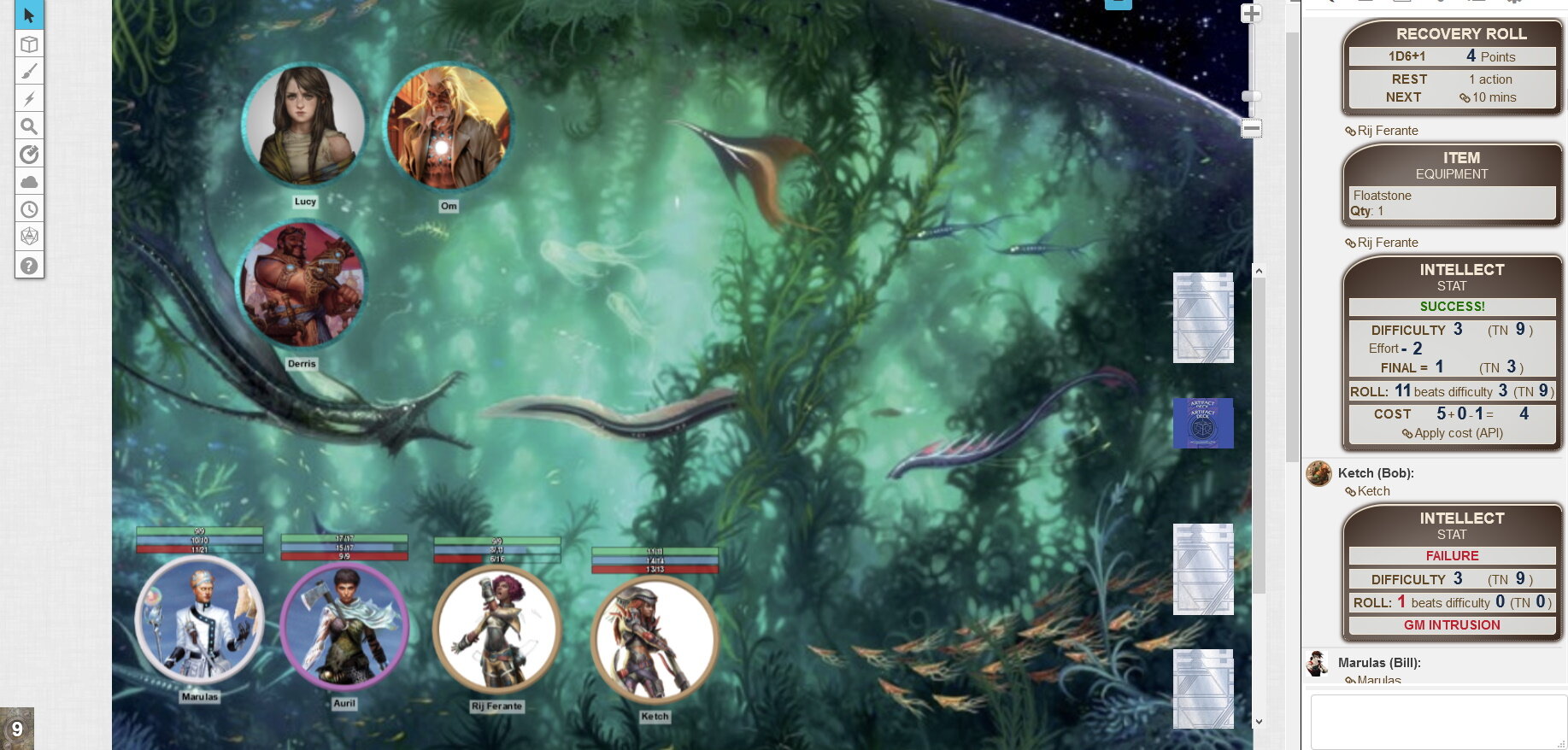
Numenera, a Cypher System game in Roll20
BTW, I’m not saying rules light is better or worse. That’s personal preference.
Note: Crunch means complicated rules. Rules lite would be low crunch.
Lite-ish?
There are plenty of ways Cypher System rules are easier to use than many games, including Dungeons and Dragons (any edition).
Monster stat blocks.
Say you are the GM, and your players do something unexpected, and you need a monster. Or NPC. Now!
Cypher System stat blocks can be as simple as one number, typically from 1 to 10. Say, 4. 4 can be a full stat block.
If a PC tries to attack it, dodge it, hide from it, flirt with it, or any other kind of interaction with it they need to succeed on a difficulty 4 task. Easy!
Most Cypher System creatures are a bit more interesting than that, but when it’s time to improvise on the fly, one number is all you need.
Easy to Adjudicate
Instead of a rule for everything, a Cypher System GM picks a difficulty from 1 to 10 to rule on anything the players come up with. That one number is used for how easy it is to open a lock, pilot a starship, whatever. Easy!
Narrative Actions
Player and GM Intrusions can change what’s going at any time. Rules fully support player and GM improvisation. Experienced Cypher System GMs pretty much agree that “whatever fits the story best” is what should happen.
Not That Lite
So, Cypher System is more rules lite many other games.
But compared to FATE, GUMSHOE, Powered by the Apocalypse, Dread, or Fiasco? Cypher System is way more complicated. Read on.
Complex/Rich Player Characters
Cypher System is level based, like D&D. And just like in D&D, as your character progresses they get ever more complicated to play.
A starting character typically has six special abilities to manage. After they level up, it can exceed 20. Way more complex than characters in many other games.
Some abilities are pretty easy to manage, like Blameless.
Blameless: You are trained in one of the following: deception, stealth, or disguise. Enabler.
Others are complex, like Call Through Time.
Call Through Time (6+ Intellect points): You call a creature or person of up to level 3 from the recent past, and it appears next to you. You can choose a creature that you’ve previously encountered (even if it is now dead), or (no more than once per day) you can allow the GM to determine the creature randomly. If you call a random creature, it has a 10 percent chance of being a creature of up to level 5. The creature has no memory of anything before being called by you, though it can speak and has the general knowledge a creature of its type should possess. The time-shifted creature does your bidding for as long as you concentrate on it, but you must use your action each turn to direct it; otherwise it returns to the past.
In addition to the normal options for using Effort, you can choose to use Effort to call a more powerful creature; each level of Effort used in this way increases the creature’s level by 1. For example, applying one level of Effort calls a specific creature of up to level 4 or a random creature with a 10 percent chance of being up to level 6. Action.
Using Effort isn’t Simple
You know those difficulty numbers I talked about? A really cool thing about the Cypher System is that the players can spend points to lower the number, making it easier to succeed. Personally, I think it works great, but I have encountered many players who struggle with it.
You spend N levels of effort, each level lowers the difficulty number by one. The first level costs 3, the rest cost 2. You can get a discount (called an edge). You can spend effort to do two things (like making it easier to attack and also causing extra damage), but you can’t use your discount on both. Got that?
I’ve seen players struggle with effort after playing for a year.
The Three Times Table
If I give you a difficulty number, you have to roll that number times three or less on a d20 to succeed. This may shock you, but some people struggle with multiplying by three. This may more a problem of our education system than game design.
Bottom Line: Medium Crunch
Cypher System is easier to learn and run than many, but not all, games. It’s designed to let the GM improvise with ease.
Where is Cypher System on the Crunch-O-Meter? I’d say more complex than Call of Cthulhu, another medium complex game. And way more than GUMSHOE or FATE, games I consider rules lite. Cypher is less crunchy than D&D and its siblings, games I consider rules heavy. Your Crunch-O-Meter may vary.
Low complexity and ease of improvisation also means less prep-work for the GM. So if you find 5E prep stressing you out, but want a level based system with some heft to it, try Cypher System. Middle-weight games might be your Goldilocks Zone.
But if you want to ditch the heft, and really slim down, try an actual rules lite game. There are a lot. I’m a big fan of FATE, GUMSHOE, Cthulhu Dark, and Monster of the Week. FATE Accelerated is simpler than standard FATE. There are super-lite games with the entire rules set on one or two pages like Deathbringer.
How much crunch do you like?

The Sun Below: That’s How the Light Gets In
a Cypher System adventure for Numenera.
Get your medium crunch adventures right here!

Steal This Hack: PC Connections
Stealing a hack from Pirates of Atlantis and using it in your own campaign to tie your PCs and players to your plot and setting.
Connections to Adventure
One way to immerse your PCs to your campaign is to give them a connection at character creation, and make it important during the campaign. I’m going to use my adventure Pirates of Atlantis as an example, but you can steal this hack for your own campaign.
Pirates of Atlantis (for 5E D&D and 13th Age) is a 10 level campaign that features adventure on ships, the sea, other planes, and Atlantis. The story revolves around stopping Fangos, an evil pirate who wants to become a god. Every player character has a PC Connection to the adventure, which helps motivate PCs (and hopefully their players) to engage with the setting and NPCs.
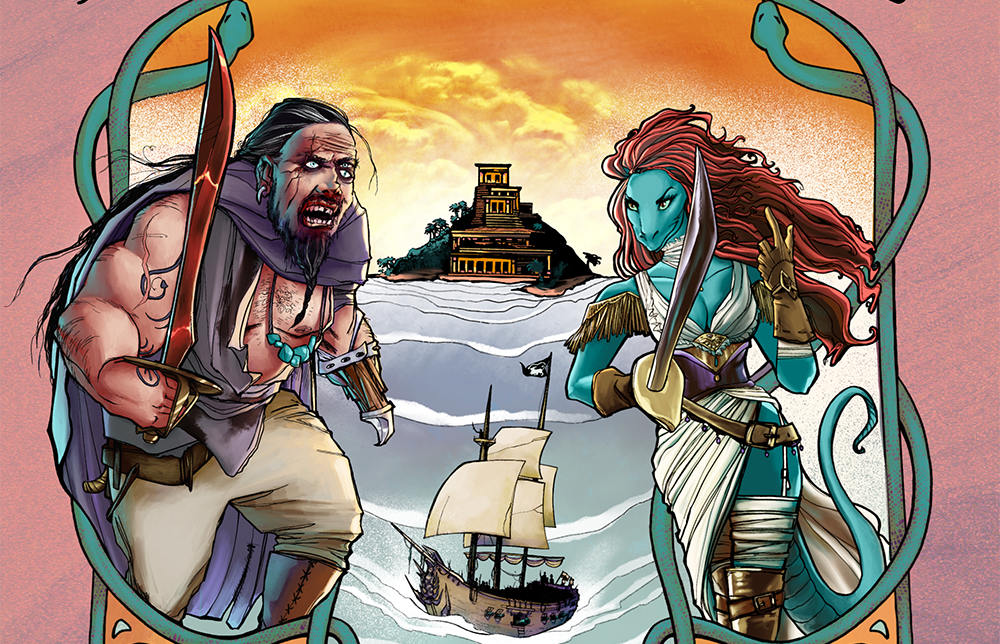
The adventure supplies ten connections, and the GM is encouraged to make more if they wish. These can connect the PC to Mistport (the starting location), Atlantis, Fangos, parts of the setting, or just the spirit of adventure. Let’s pick the first connection and dig into it.
Example
1. I was a crewmember on the pirate ship Quicksilver. When the first mate, Fangos, mutinied, I was marooned on Earthforge Isle with the former captain, Captain Olos. The captain died of his wounds, but I survived and eventually found my way to Mistport.
This is a fine choice. It creates conflict with the main antagonist Fangos, and brings the PC to the starting location. It also foreshadows chapter 7: Earthforge Isle, allows the player to have knowledge of that isle, and brings in one of Fangos’ victims, Captain Olos.
In Chapter 6: Finding Atlantis, a PC with this connection to adventure will gain a personal quest to find the bones of Captain Olos and bury them. The reward is substantial, an ability score increase or a new feat.
Grand Theft Connecto
OK, great for Pirates of Atlantis, but how do you steal it? As an example, take our connection and make it generic.
1. I was a <member of an organization>. When the <main antagonist of the adventure>, <did something dramatic in that organization>, I was <punished> on/in/at <a location that will come into play later in this adventure> with <another victim>. The <other victim> died of their wounds, but I survived and eventually found my way to <the location where the campaign begins>.
Later, but before the party visits the foreshadowed location where the PC had been punished, give them a quest to <memorialize the other victim> for a big reward (like an ability score increase or a feat). When the PCs get to the location, allow the PC knowledge of that setting, maybe give them an informational handout and/or a map. Make sure they know they can ask questions about features of the location. They might not know everything, but they now a lot more than PCs who chose a different connection to adventure.
Hopefully you can see how this makes a player feel connected to your adventure, how it makes them useful to the party in a special way, and how it rewards them for interacting with the story of your adventure. That’s the goal. Each connection to adventure should do that.
Happy stealing!
John

Tactical, the Most Popular RPG Style
Why tactical tabletop rollplaying games are popular, and what are the costs?
People talk about different kinds of tabletop roleplaying games: story based games, investigative games, and tactical games, to name three. For as long as the hobby has existed, tactical games have remained the most popular.
Why? What are the strengths and weaknesses of tactical games?
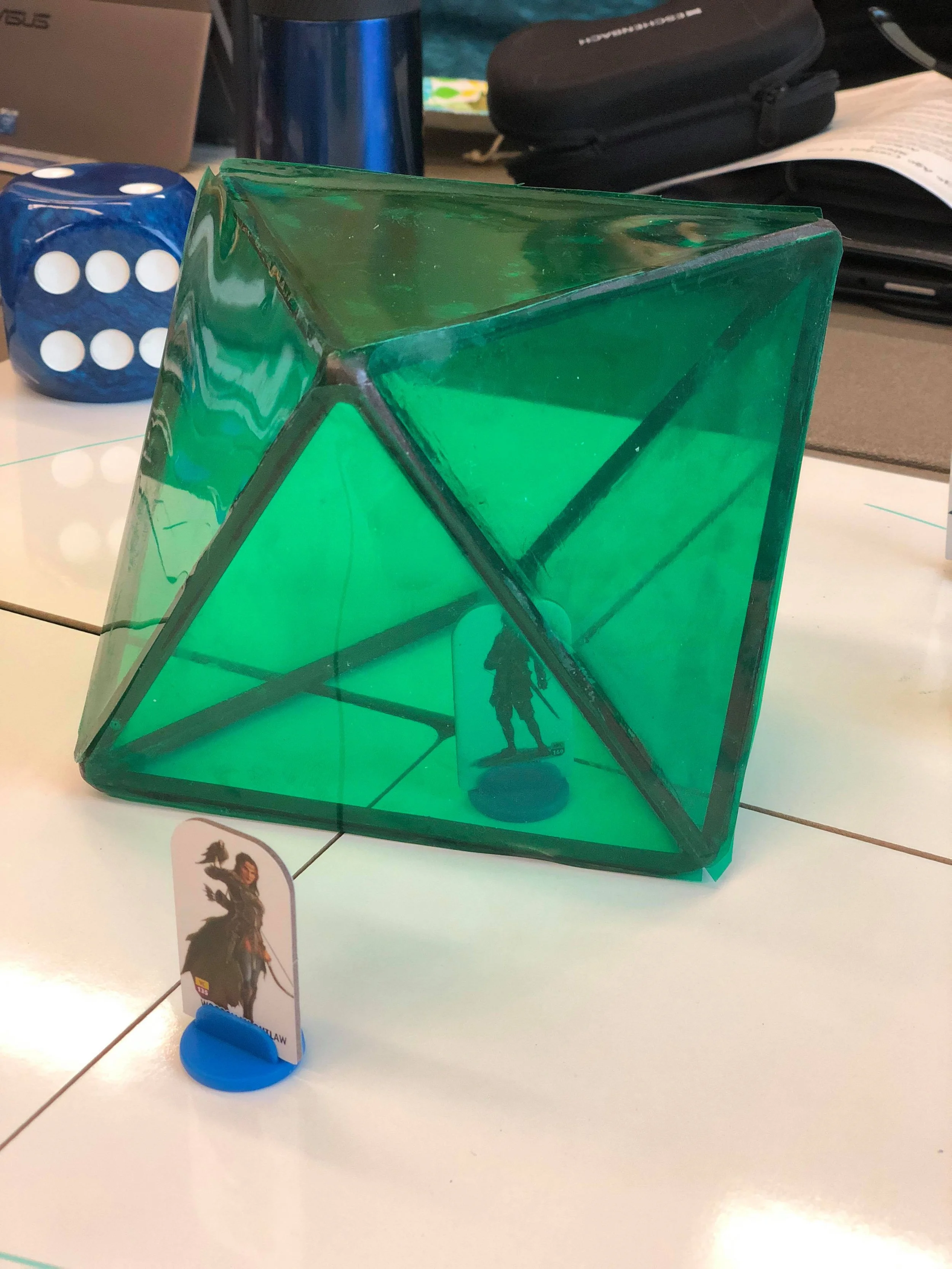
Rogue/Necromancer in a gelatinous octahedron.
Tactical?
A tactical tabletop roleplaying game is a game centered around a robust set of rules that focuses on combat. Combat with lots of options. Support for groups who want to play on a map of some kind, from a dry-erase battle-mat to a pricey but beautiful set of Dwarven Forge terrain. I’m talking D&D, Pathfinder, 13th Age, OSR, … the list goes on.
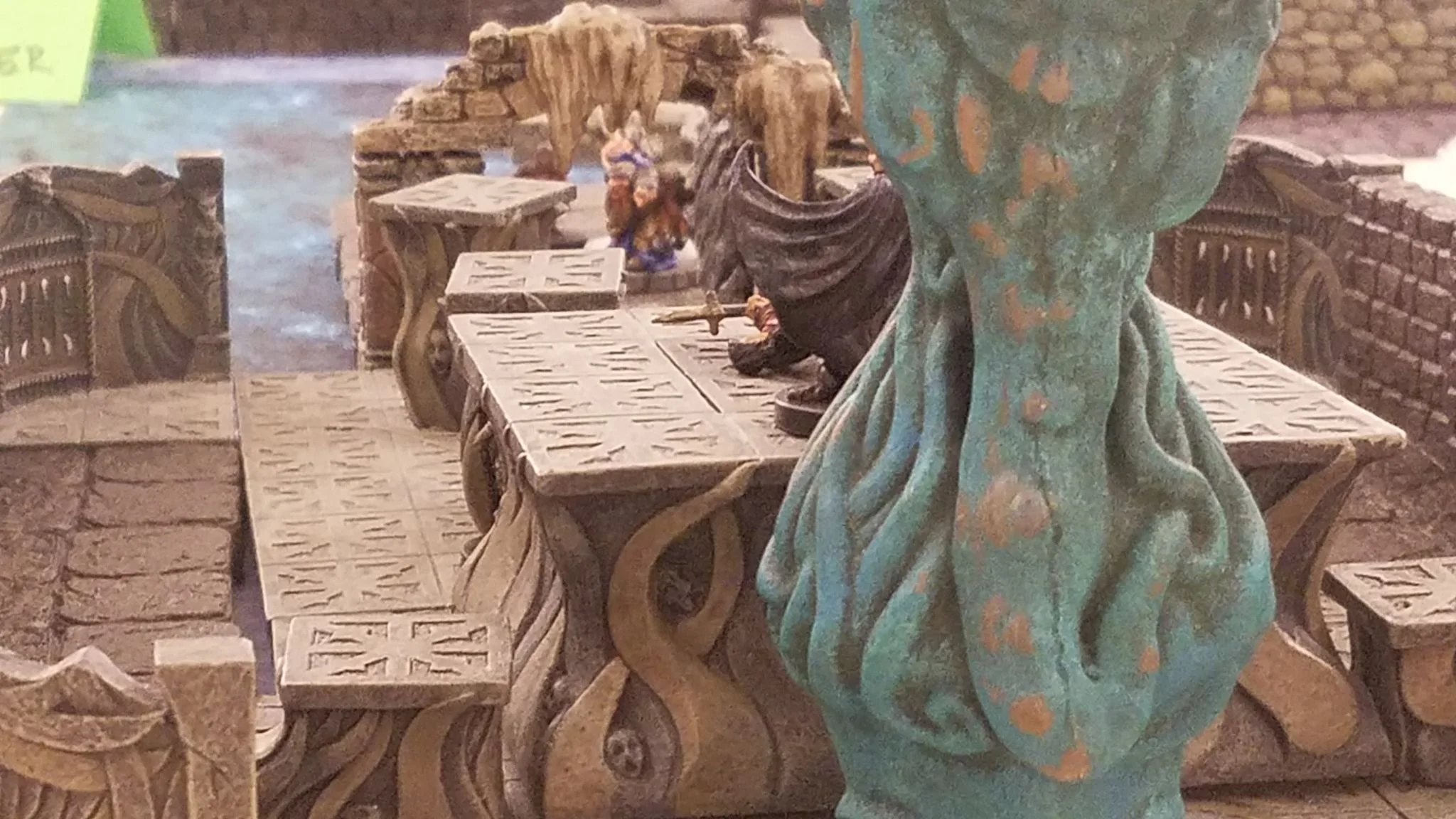
Evil Temples are fun
Tactical gaming means the players have a menu of choices for their character in combat. Where they move, what weapon or spell they use, how they use terrain to the best advantage. Players look for combinations of character powers that work best in any given situation.
Why So Popular?
The idea of heroic combat is exciting. Books, movies, and TV shows feature heroes doing heroic deeds in combat. Riding dragons, fighting monsters, using magic swords or Jedi lightsabers. Not realistic, but cinematic combat, is the fantasy. These games let everyone at the table take part in the excitement.
Players enjoy feeling a mastery of their character powers and the rules of combat. They take pride in how good they get. And the constant power-ups characters get in these games means they are always looking forward to being ever more effective combatants.
These cinematic fights assume the player characters win fight after fight. Sure it might seem dangerous for a bit, but they somehow always seem to come out on top. The rules are stacked in the player characters favor, enabling story-telling via a string of fights, much like a Marvel movie. A power fantasy.
The Cost
Nothing comes for free. Tactical games can be a load of fun, but there are downsides.
Outside of combat, the games can feel lackluster, making it hard to create stories based on anything but nonstop violence. Look at the amount of space on a D&D character sheet devoted to combat.
GM prep time is higher in tactical games than in other styles of roleplaying. Monster stat blocks are complicated, creating balance is hard, players expect tactical combat for most encounters, and there are minis and battle maps to prepare.
Managing fight after fight after fight can wear at a GM. Players can focus on just their one character, but the GM has to run a slew of monsters, all with their own quirks. Learning one monster often doesn’t help learn the another.
GM burnout. Many GMs get tired of the same old same old long before their players do.
Keeping the Fun Going
Every table is different, but these techniques work for many gamers. See what works for you.
Mix it up. Play a non-tactical RPG sometimes: Numenera, Call of Cthulhu, Vampire the Masquerade, Monster of the Week, Blades in the Dark, … Steal ideas from these and bring them back to your next tactical game.
Let someone else be GM for a while.
Go theater of the mind for the small fights, save the terrain and minis for the set pieces.
Embrace the excitement! When you are GMing a tactical game, go for it! Make combats as exciting as possible.
Use terrain that matters in combat.
Front load the badies. They don’t last long, so make them hit hard and fast.
When things turn into a slog, have the baddies surrender, run away, or just narrate the ending.
There’s a whole blog I should do on making combats spicy. Maybe two!
What do you think? Do you love tactical games? Hate them? Discus in the comments below.

Darkest House App at the Table
The Darkest House app was meant to run online. I say it works best in person, at the table. And I’m always right. ;)
What is It?
It’s a haunted house for any rpg, as it has a conversion from whatever system you are running, 5E, Cypher, Pathfinder, …, or anything, to the House System. Then you throw your PCs into the House, and the House Hates Them. Very spooky. I’ve run a bunch of haunted houses: D&D, Call of Cthulhu, Bluebeard’s Bride, and so on. Many were great. The Darkest House was the greatest.
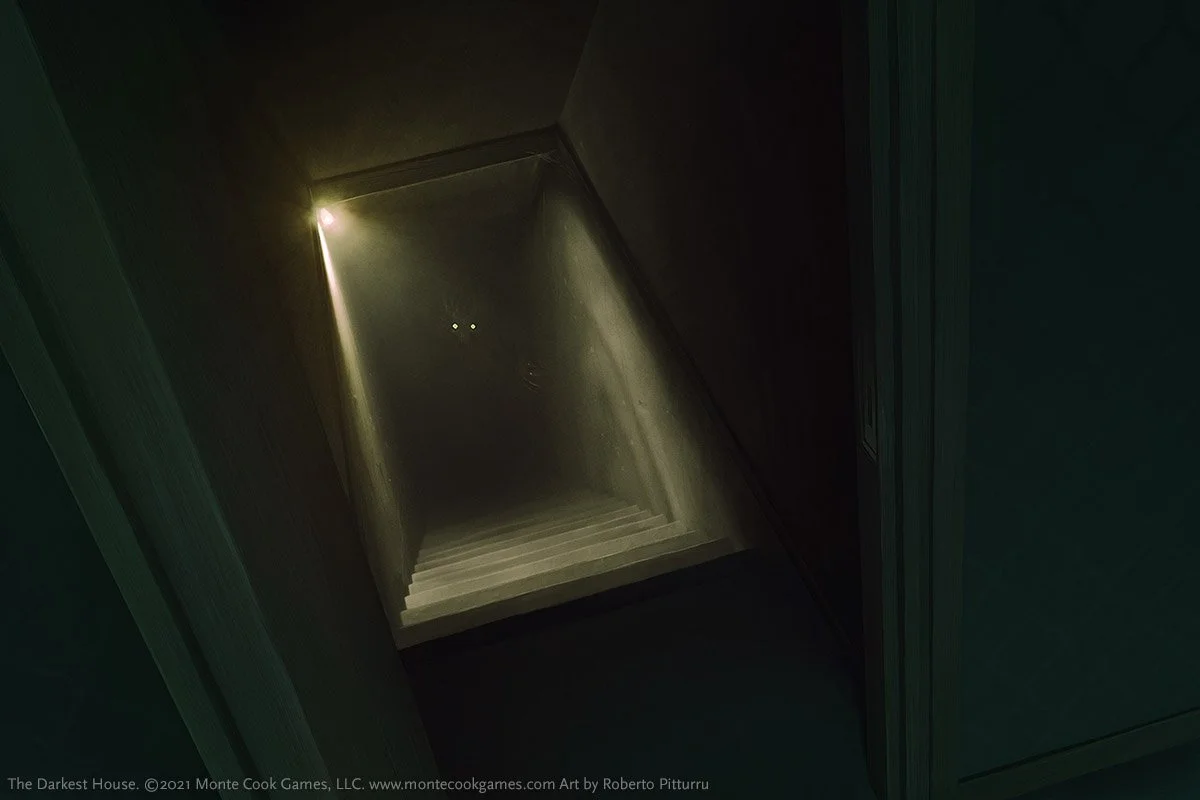
Everything’s fine.
No, What is the App?
The app runs on Windows or Mac, and is hyperlinked to go to any room in the house. Each room gives you, the Gamemaster, what you need to run it. And images to share. Sometimes audio as well.
Each room page gives you an overview, what the PCs experience when they enter. Plus secret things they can discover and links to all exits. The house is decidedly non-Euclidean.
For example: The Music Room
This grand chamber has sweeping, arched ceilings and decorative wood panels. A grand piano dominates the room, although several other instruments can be found, as well as music stands and a few other furnishings. There’s an aura of practice and punishment here.
Then there are links to subsections: the instruments, the exits, and what happens if the local spook (the “Sister”) shows up here. And what happens if the PCs linger. Nothing good.

The Sister will see you now. The House Hates You.
If any exit needs a key, that is spelled out.
There is also an image of the floor plan and a first person view of the room that a PC might see. Above each image are two choices: “Copy Link” and “Download.” If there is audio, the same two choices appear.
The Setup
I brought my laptop and cellphone. I ran the app on my laptop. We played by candlelight at the table in a darkened room. Everyone had Discord running on their phone or tablet. I would copy the link, paste it into our Discord channel, and wait for the reactions. Typically creeped out.
For audio I put it on my phone and held it up and played it for them. Very immersive. If I had put it in Discord, they might have all played it at different times, out of synch, so I waited until after a session to share the audio links there.
Jump Scare
After many deliciously terrible encounters in the house, I looked over our host’s shoulder into his darkened living room. “Mike, I didn’t know you had a black cat.” Of course he had no such pet, this freaked him out which spread to everyone else. I pretended it had been a trick of the light. Nervous laughter all around.
Mission Accomplished.
The Format
Ever run the Darkest House app? Would you like to see other RPG material presented this way? What would it be?

Fixing Scarlet Citadel
Before I say terrible things about Scarlet Citadel and why it needs fixing, I need to say Kobold Press does great work. Midgard Worldbook is my favorite 5E world book. Love their monster books, and their pawns. Pirates of Atlantis uses OGL Kobold Press monsters.
Players, read no further. Spoilers ahead!
Image from the cover.
There are great things in Scarlet Citadel, things that make it worth saving. Great maps, including an amazing map pack. If you get it, get the map pack! Some amazing locations and encounters. If your group only cares about encounters and doesn’t need motivation or story, you are good to go.
What to fix?
Motivation. There is only one reason for your PCs to enter the Scarlet Citadel as written, and that is loot. While the loot is OKish, it’s not great or even good as a motivator. The danger in this dungeon crawl is high, very high. There are many places where the book tells you how to kill PCs, and it’s not kidding. High risk, medium loot, zero motivation, story, or long term tension. If you have other adventures and allow your PCs to go elsewhere, they should.
There is no threat to the surrounding lands, no one asking for help, and the most boring villain (Gellert the Gruesome) I’ve ever seen. You could replace him with a turnip and the adventure wouldn’t change. He does nothing, threatens nothing, and is a passive lump. All the level bosses are supposed to report to him, but to what purpose? They all have their own unconnected projects that don’t feed into his work. If the PCs abandon Scarlet Citadel, the world would not be harmed in any way. Instead of high stakes, there are no stakes.
Any dungeon crawl can become a dungeon grind, despite the great encounters. Many players start to pine for the wider world. The book does recommend sending the PCs on occasional side quests, with no suggestions as to what they might be.
My Fixes
Consider these example fixes, you can probably improve on them to fit your table.
Ley Lines
A villain has to be up to something that makes your players care about thwarting them. Mike Shea, over in his Sly Flourish YouTube videos about preping for Scarlet Citadel sessions, ran into the motivation problem and came up with one answer: change the ley lines that are described throughout the book to actually have a purpose. Let the players know that Gellert is binding them up in such a way as to fuel his magic at the risk of creating a catastrophic event that would cause the surrounding lands to turn into something like the Western Wastes of Midgard. The stakes? Replacing civilization with uninhabitable ruins and Cthulhuish-Kaiju. Great motivation.
Many of the set piece encounters in the dungeon should be tied to the ley line madness, so it gives a reason for the PCs to do those set pieces. I stole this from Mike, and you can too.
MacGuffin
To get the ball rolling I wanted a MacGuffin deep down in the dungeon for the PCs to quest for. I asked the PCs what they could be looking for, and before you knew it they were searching for an ancient elven waffle maker made of mithril. If you want something more serious, maybe come up with it yourself, or at least don’t ask my players. Once that was settled, I had the alchemical furnace make syrup as well as oozes, and we were off to the races.
Syrup and Ooze Furnace.
My PCs call themselves the Waffle Stompers.
Mixing It Up
To break up the dungeon crawl, I’m sprinkling in adventures in the Shadow Realms from Tales from the Shadows (adventures) and the Book of Ebon Tides (dark fey setting). These Kobold Press short adventures are fun and come complete with motivation. And the Shadow Realms is amazing.
Back in Scarlet Citadel, I noticed down in the ruins of the dwarven barracks, the trollkin were mercenaries and organized as a military unit. That gave me the opportunity to have Gellert order then to sack the town the PCs stay in, Redtower. Time for a mass battle! I wrote all about it here.
Patrons

Dacka Dola, daughter of Baba Yaga
A patron is always nice, two nicer. These give your campaign people that care if the PCs succeed and can lend help, especially with intelligence. I had an uneasy alliance of elves from the summer lands and the shadow realms send them off for the waffle iron.
My side adventures to the Shadow Realms introduced followers of Baba Yaga, so to explain the fight to save the lands from ley line apocalypse, I created a daughter of Baba Yaga who communicates through a magic mail pouch. “You’ve got mail.”
A Dungeon of Secrets
The subtitle of Scarlet Citadel is A Dungeon of Secrets. And there is a lot of interesting history and secrets sprinkled throughout the book, but no obvious way for the players to uncover them. I do the same thing Mike Shea does, I look ahead, note down the fun secrets, and then dole them out whenever the PCs are doing something that might reveal them: reading a book or old inscription, interrogating a prisoner, getting advice from a patron, and so on.
Some games call these floating clues, in Cypher System they are called keys, but no matter what you call them, they are information your PCs can learn whenever they go looking for information. Sometimes I just volunteer the information. For example when the trollkins tried to surrender they called out “We know things about Scarlet Citadel that you don’t. We’ll tell you if you let us withdraw in peace.”
Zobek
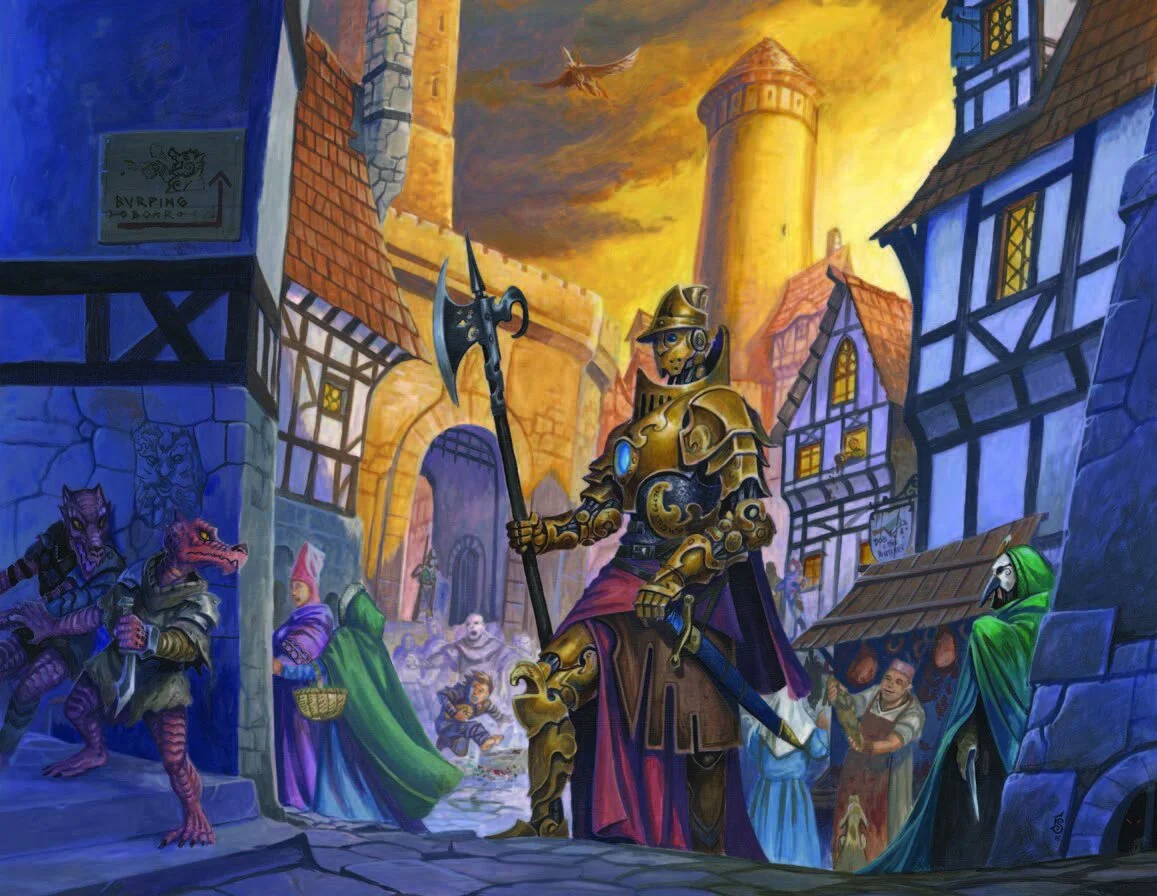
Zobek, the Clockwork City
Zobek is a cool city with revolution, gearforged, and shadow fey, has its own book, and is close to Scarlet Citadel, so I’m bringing that in as well. My elven patrons meet there.
Scarlet Citadel by Kobold Press is a dungeon crawl adventure for 5E D&D that spans 10 levels of play. The adventure includes a town setting, a multi-level dungeon, new monsters, spells, items, and traps, and a map folio with poster maps and overlays. It is set in the Midgard campaign setting, but can be adapted to any fantasy world.
You can copy these fixes, or use them as inspiration for your own. Our Scarlet Citadel game became a lot more fun once I decided to fix it. Have you tried Scarlet Citadel? How did it go?

Conquer Your Enemies with Kingdoms and Warfare
Mixing it Up Time!
I’m running Kobold Press’ Scarlet Citadel (5E D&D) for one of my groups. I’m also a sucker for big fantasy battles, so mixed in MCDM’s Kingdoms and Warfare. Highly recommended!

The Battle of Redtower
Kingdoms and Warfare by MCDM is a D&D 5E supplement that allows players to run their own domain and go to war against various enemies. It introduces new rules for domain intrigue and warfare, as well as new action-oriented monsters, magic items, and a complete adventure.
Scarlet Citadel by Kobold Press is a dungeon crawl adventure for 5E D&D that spans 10 levels of play. The adventure includes a town setting, a multi-level dungeon, new monsters, spells, items, and traps, and a map folio with poster maps and overlays. It is set in the Midgard campaign setting, but can be adapted to any fantasy world. It’s both a great and highly flawed adventure, but that’s for the Fixing Scarlet Citadel post here.

The books
Many DMs prefer to keep the big battles as narrative backdrop and just describe them while player characters do PC things. Some of us like to play to see what happens. I’m in the later group, but I don’t want a six hour Avalon Hill style battle, I want something abstract and with concepts easy for a 5E player to grasp.
That’s Kingdoms and Warfare’s sweet spot.
I only used the Warfare chapter, and hand-waved the Kingdom part. Might use that later.
Deep inside the ruins of Scarlet Citadel a group of trollkin mercenaries hang out in the ruins of an old dwarven barracks, basically doing nothing but waiting for the PCs to come and fight them. However, according to the book, they long to be out and about assaulting good folk, raiding, and being warlike jerks.
So after my PCs had trashed the upper levels of the dungeon, I had the boss (Gellert the Gruesome) send the trollkins out to raid the town the PCs had set up shop in, Redtower. A small town with a wooden wall and a nice big red tower.
MCDM didn’t provide trollkin units (trollkin being a Kobold Press creation), but not to worry. I took hobgoblin units and added regeneration and changed their name. Done. And used the trained owlbear unit from the Special Unit Deck. The battlefield is not a map, but an abstraction, but it does support walls and towers. And mud. I used mud for the small stream by Redtower.
Since this was our first Warfare game, each player only controlled one unit. At least until round three when the cavalry (the Knights of Khors for you Midgard fans) showed up. We started with just archers and infantry, including some peasant levies bolstered by druid magic.
Every PC uses extra powers from their class to buff their unit. Our fighter gave extra damage to their infantry. The warlock gave a wand of acid (great vs. regenerating foes) to their unit. The bard made the enemy afraid, and so on.
My trollkins assaulted the walls, my owl bears turned from infantry to calvary for one round and attacked the flank, but alas, the PCs held the line. Attacks use a d20, and are very swingy. A string of bad rolls on my part put the baddies on the back foot. In hindsight I could have added harpies to the mix, but that’s hindsight for you. While the PCs’ peasant levy was mauled, the trollkins ended up loosing at the end of round 3, and retreated on round 4. .
Then we cut to the PCs who had come to challenge the trollkin leaders face to face. That combat took place after the battle at our table, but simultaneously with it in the fiction. At the end of round 3, the trollkins know they lost the battle and the PCs get huge morale boosts with extra actions. A trollkin shaman raised their hands “We fought with honor, but we lost. Allow us to withdraw to the northlands and never trouble you again.”
The PCs agreed, and ended game night with a double victory.
If that sounds fun to you, check out Kingdoms and Warfare. You can add it to your campaign. You could add it to Pirates of Atlantis, maybe on Earthforge Isle! Kingdoms and Warfare is meant for 5E, but you could use it for any fantasy d20 game, like Pathfinder or 13th Age, with little or no work.
More about Scarlet Citadel soon.
You can get Kingdoms and Warfare here.
Have you ever run a mass fantasy battle in the middle of a roleplaying game? What rules did you use? How did it work out?

Pirates of Atlantis: Connections

We’ve got something new for 5th Edition DnD and the 13th Age roleplaying game: Pirates of Atlantis! Kickstarting in September.
In this upcoming adventure and source book, we wanted to give the players and Game Master tools to tie character stories to both the adventure and each other. One of the ways we support this is connections. When the players create their characters, they also create connections.
Connection to the Adventure
Players are given a list of suggested connections to the adventure and can choose one, roll randomly on the list, combine a few of them, or make their own with the assistance of their Game Master. Connections include:
My family is descended from the survivors of Atlantis. We had a collection of Atlantean antiques passed down from generation to generation. One dark night brigands forced their way into our house, kidnapped members of my family, and took our heirlooms. The leader was the pirate captain Fangos. I need to rescue my family.
I was a crew member on the pirate ship Quicksilver. When the first mate, Fangos, mutinied, I was marooned on Earthforge Isle with the former captain, Captain Olas. The captain died of his wounds, but I survived and eventually found my way to Mistport.
I’m a bit obsessed with the legends of Atlantis. I’m always looking for Atlantean ruins to explore and new bits of lore about the people who thought they could challenge the gods, and then were brought down.
Connection to other PCs
Also at character creation, going around the table, each player makes a connection with the characters played by the players to their left and right. Both players should agree with the connection. If they disagree, choose another connection.
Again, they can pick, roll from a list, or create custom connections with the help of the Game Master. Connections include:
·We have the same connection to the adventure and know each other from that connection.
We are family. Siblings, cousins, adopted or blood. Family connections makes for great storytelling.
Happy family, great relationship between us.
Terrible family, but still a great relationship.
Happy family, except for our relationship.
Terrible family, what do you expect but a messed-up relationship.
The house I grew up in had an Atlantean statue that looked just like this other PC.
More Pirates of Atlantis news soon!
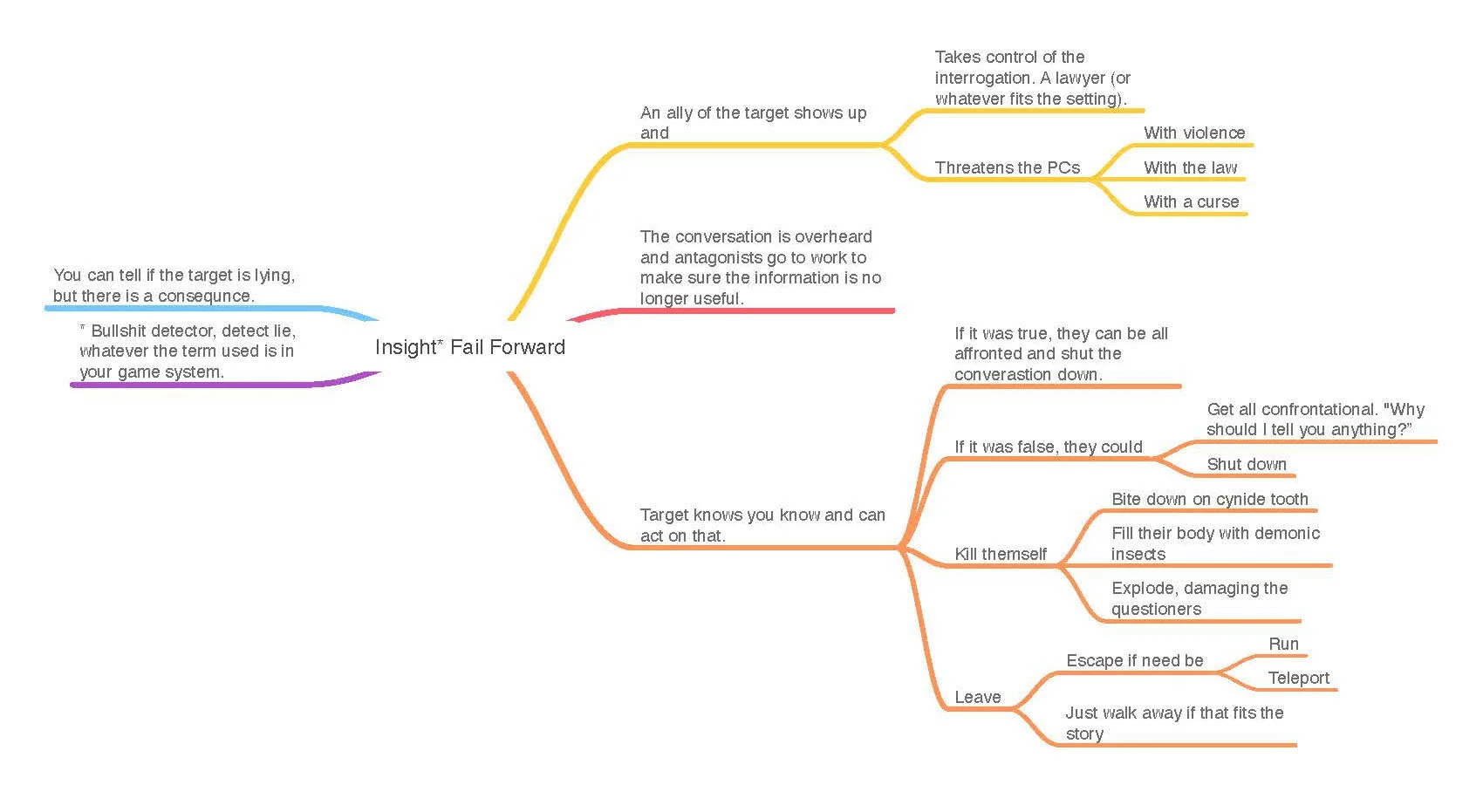
Insight Fail Forward

When playtesting the 5th Edition DnD version of Pirates of Atlantis, I ran into a number of Insight* checks that were just not interesting or fun if the player rolled bad. And we got a lot of 3s. So I started brainstorming: how can an Insight check fail forward**?
RPG Jargon
*Insight is basically a detect lie skill. My favorite name is from GUMSHOE: bullshit detector. Of course, GUMSHOE being GUMSHOE, bullshit detector can’t fail if the information would be a core clue.
**Failing forward is when a bad role doesn’t mean the attempt failed. The attempt succeeded in a way that complicates the PC’s life.
Making Maps for Online Adventure
Make A Map
Sometimes you know just what you want, and finding a map isn’t working. Time to make your own. Luckily, there are some great tools out there.
DungeonFog
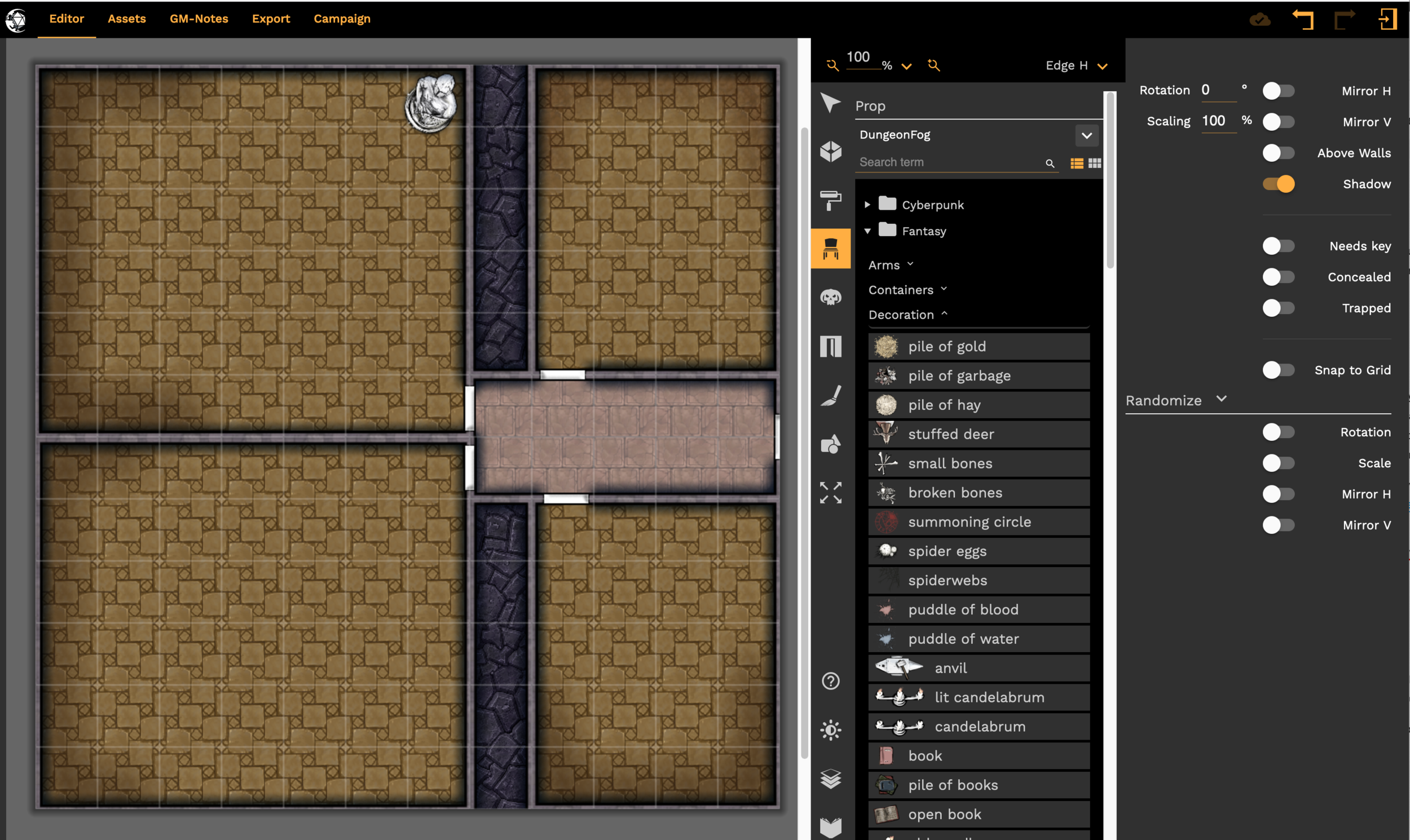
This is my favorite tool. I find it easy to use, and it keeps getting better. At this writing, we’re on version 5. You can start from scratch or load an existing image, like a castle floor-plan from a history book, and trace over it. There’s a free version, a subscription (with tons of additional content), and a publisher version. This is a web-based tool and works on my Windows laptop and my Mac desktop.
I used DungeonFog to make many of the maps for the Numenera adventure: The Sun Below: That’s How the Light Gets In. https://www.drivethrurpg.com/product/320528/The-Sun-Below-Thats-How-the-Light-Gets-In
My orthogonal dungeon maps for VTTs, coming soon, are made with Dungeon Fog.
WonderDraft

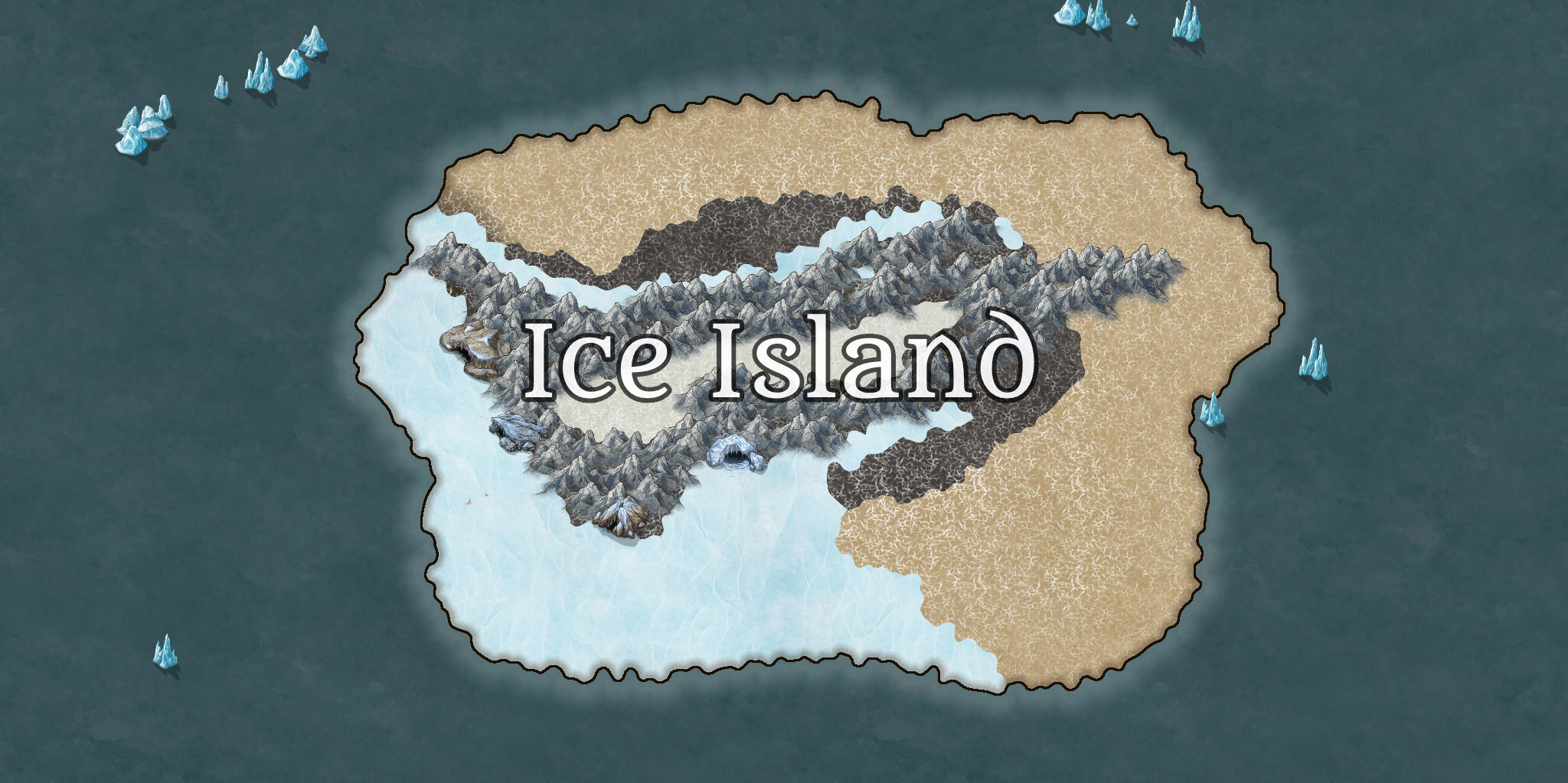
I’ve just started playing around with this, but it seems like it can do a lot. Use this for worlds, continents, regions. There is no subscription, just buy it once. I like the coastlines it makes.
The default UI was unusable on my big Retina display. I pumped up the font size to maximum and can read the menus now. Also, my Mac thinks this is malware, they didn’t register the application which I don’t like.
DungeonDraft
This produces great battlemaps and many people love it. DungeonDraft has the same installation and usability issues as WonderDraft. It is a buy once program instead of a subscription, which is nice.
Inkarnate

Another web-based mapper that works on my Windows and my Mac computers. Free and subscription versions. They have robust world, continent, city, and town map support, and have a battemap version in Beta at this time. I’m far from an expert with this tool, but I like it.
Campaign Cartographer
An oldie, but a lot of folks use it, especially professionals. This is an app I’ve wanted to like, and kept on buying different versions of for decades, and it just does not work with my workflow. However, your mileage may vary. If you use CAD (Computer Aided Design) at work, this is probably a good choice for you. The verb-oriented (vs. object-oriented) user interface just grates on my poor brain. Again, YMMV.
Hexographer

You want hexes? Get your hex maps here. Great for hex crawls, lots of options. It doesn’t produce the prettiest maps, but it produces very gameable ones.
There is a great feature for creating hex maps of Icosahedral maps, as used in Traveller for planetary mapping. If you are a Traveller GM, check this out. They’re also great for any planet hopping game. I’ve printed these maps out on card stock and folded them into twenty sided planets, taped them together, and handed them out when players reached a new world.
Atlas Architect

Early access at this point, it’s the new kid on the block. A fun 3d world builder, I can spend hours doodling with this. It’s fairly light on features and fine control, and I wish it had a Mac version, but it’s so much fun to create by doodling around.
Photoshop (and other art programs)
https://www.adobe.com/products/photoshop.html
Many professional game cartographers do everything in art programs like Photoshop. Others start with a mapping tool, then touch it up in an art program.
You may want to check out 25 Quick & Dirty Map Tutorials by Michael Tumey.
No time to make your own? Be sure to read Finding Maps for Online Adventure.

Finding Maps for Online Adventure
How do you show the setting for a scene in your game? In many RPGs, that’s a map. Some games don’t need maps, see Roll20 for Non-Tactical Games. But many do!
Find a Map
A great way to get a map is to just find one and use it. And if you can’t find the right map for free, there are plenty of great maps for sale. Support your friendly cartographer!
Google, DuckDuckGo, Pinterest
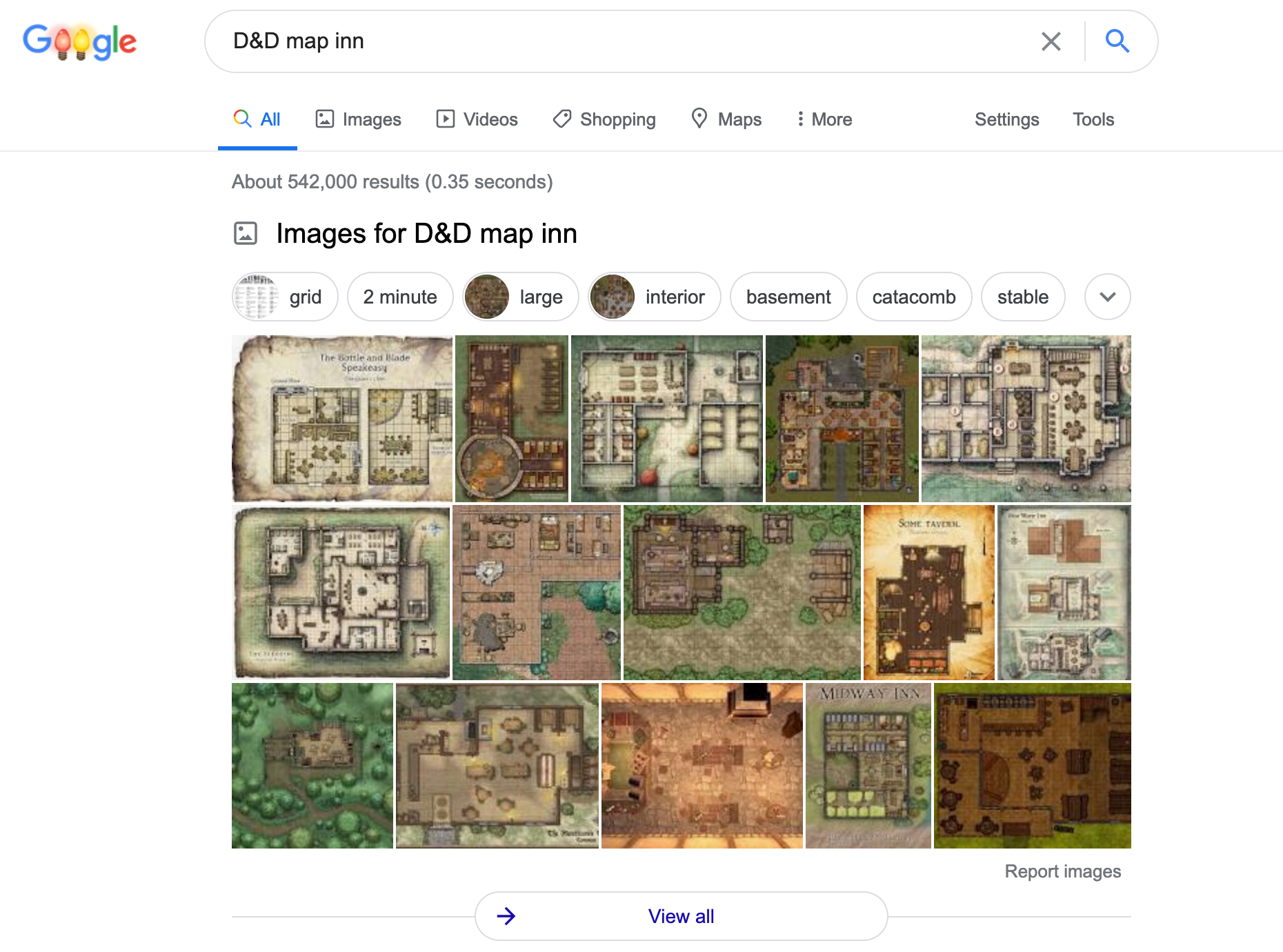
Just do a search. Even if you’re playing another game, adding D&D to your search will often find great battlemaps.
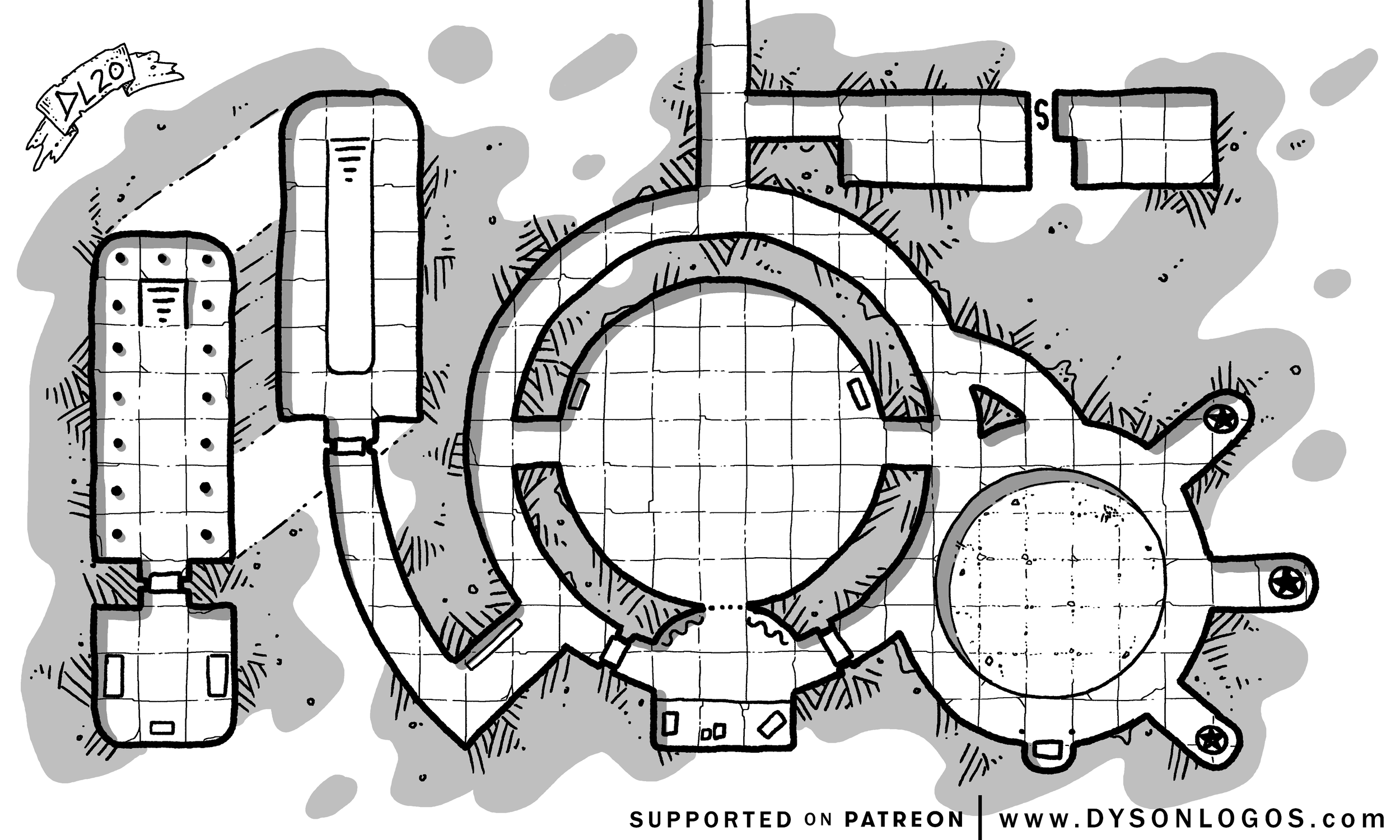
Dyson Logos
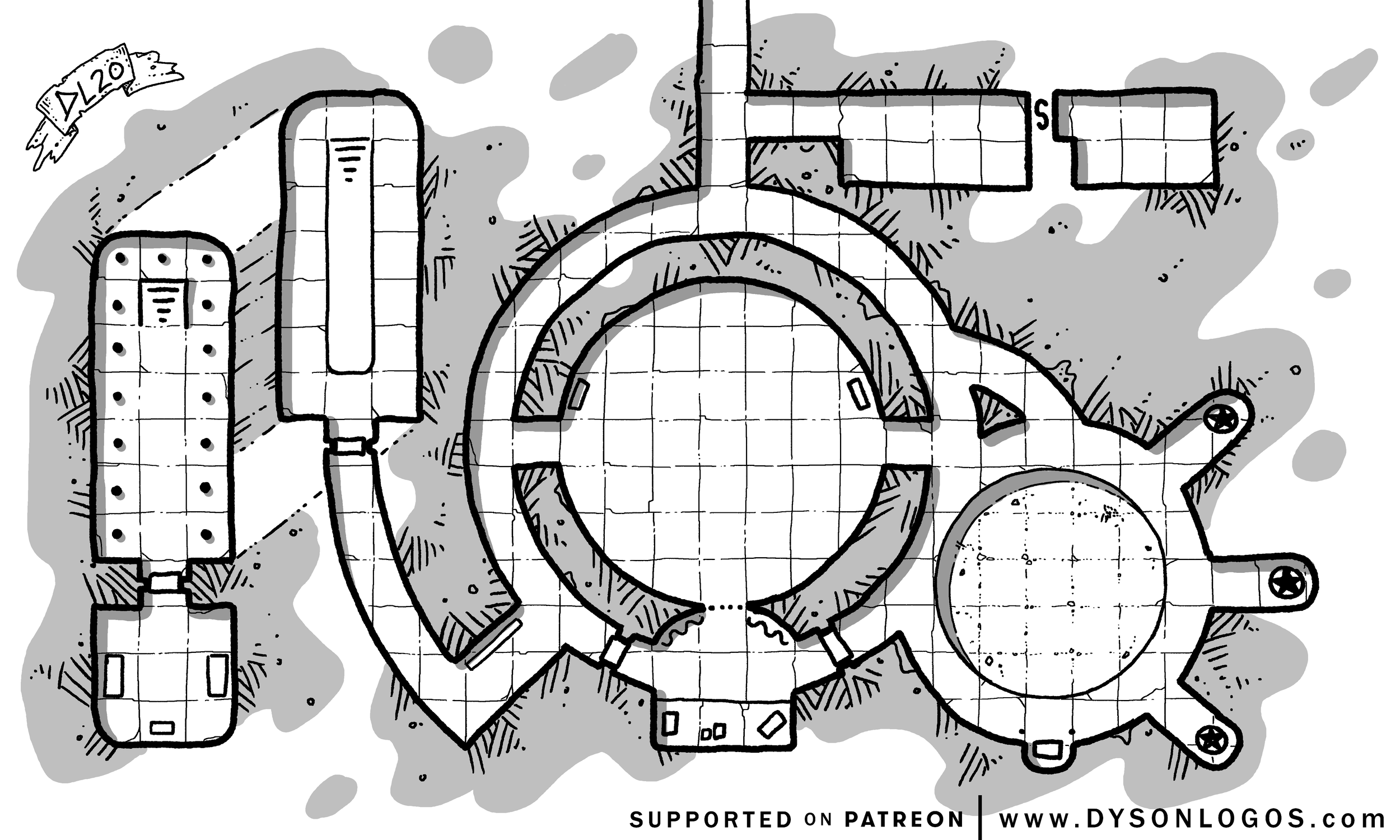
So many maps, Dyson Logos maps show up in games and game products all over the world. Maybe your VTT can use some too.
Want to share the love? Consider supporting more maps on https://www.patreon.com/dysonlogos/posts
Need color? Pro Tip: Trace over a black and white map to add color in DungeonFog or DungeonDraft (see Make a Map, below).
Justin Andrew Mason
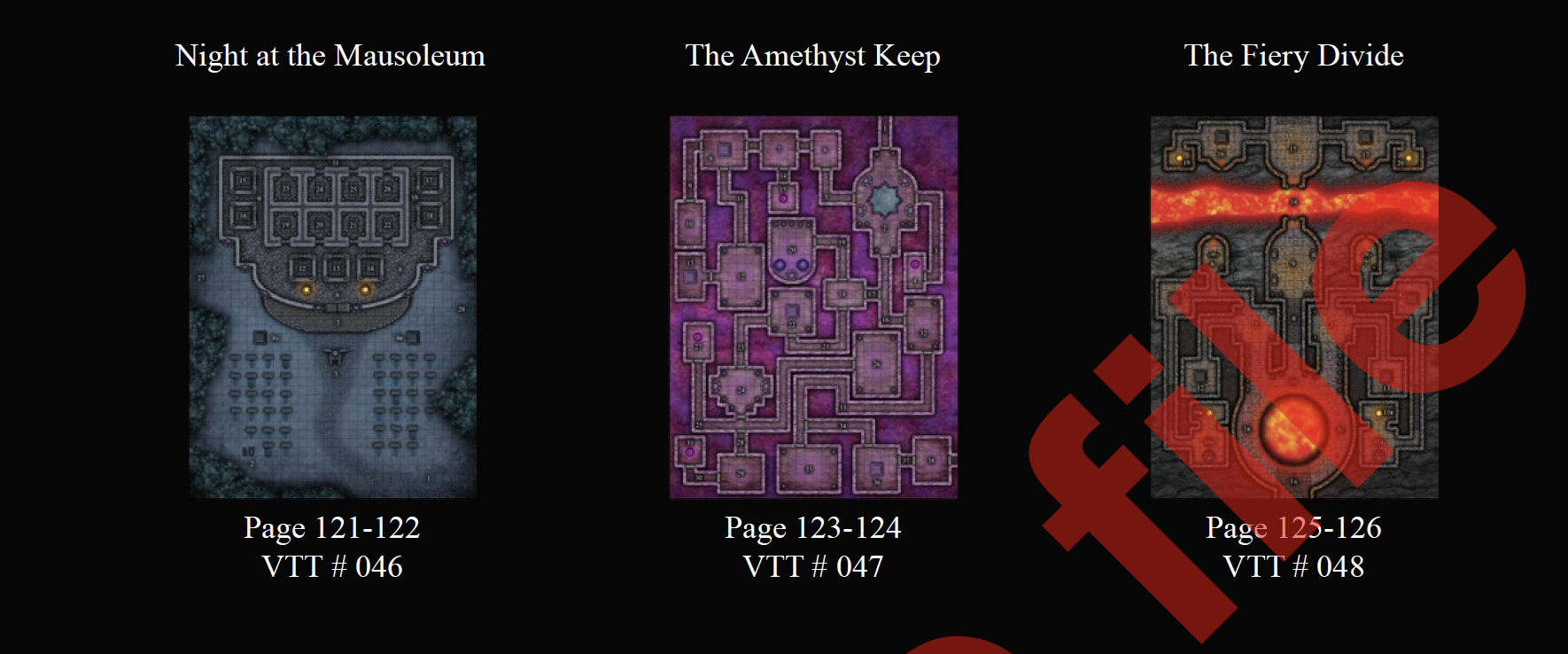
Justin makes an sells giant map collections. Check out his Big Book of Maps.
Miska Fredman

Some of the best things in life come from Finland. Including great maps! Fantasy maps, science fiction maps, so many maps. Some free, some you can buy at DriveThruRPG, Roll20, Foundry, and Astral.
DriveThruRPG
So many maps!

Over 24,000 hits on this search!
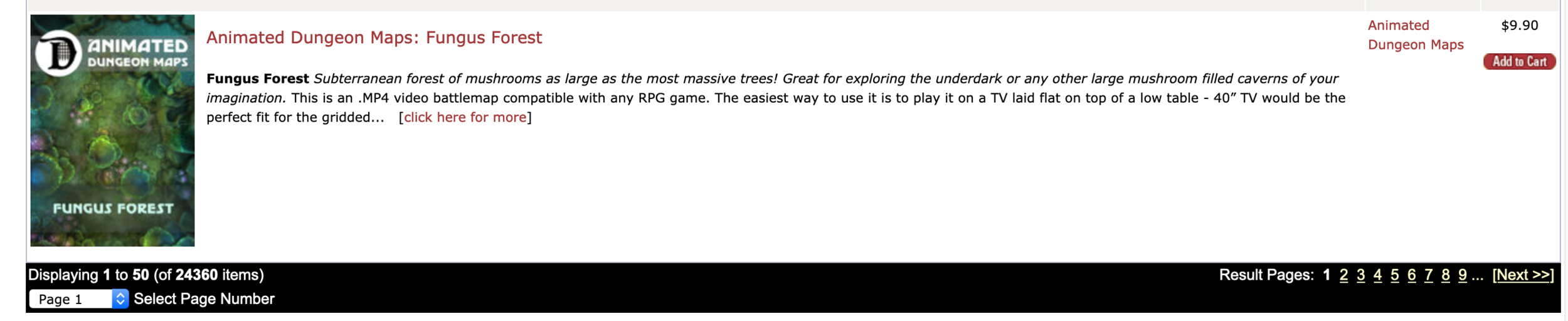
I have a collection of orthogonal dungeon maps coming soon to DriveThru.
Now check out how to Make Your Own Map.
Virtual TableTops (VTTs)
You want to play, but need to play remotely. But how? Depending on your needs, playing remotely might mean playing on a Virtual TableTop (VTT).
I’m going to call out D&D 5E support in each VTT, because that’s the most popular gaming system, and that’s what most of you want to know about. I’ve also had great times playing 13th Age, Bluebeard’s Bride, GUMSHOE, FATE, Hillfolk, Numenera, and other games on VTTs. Just make sure the VTT supports the game you want to play.
Read more sage wisdom and advice about VTTs here: https://www.dreadunicorngames.com/blog/category/VTTs
VTTs have maps for tactical combat, dice rollers, text chat, and more. Most folks I know use a VTT with Discord for voice. (More on that here.)
I find all the VTTs a bit cumbersome and slow. Like many folks, I tried Roll20 first. I thought “how cumbersome and slow!” so I tried others. So far, my dream VTT isn’t out there. But I’ve had great fun playing on VTTs, so what exists works.
Roll20


Pro: Free version, most popular VTT so more players know it and has great publisher support. More systems supported than any other VTT. Great support for D&D 5E and many other game systems (I’m really impressed with the support for FATE and other Evil Hat games). Most of my experience as a player or GM online is through Roll20.
Con: Cumbersome user interface. New features seem to take forever to deliver, so I suspect an aging codebase that is hard to work with. Lags out a lot. Door support is terrible. Most of my experience with other VTTs is trying to find something better than Roll20.
Fantasy Grounds

Pro: More automated than Roll20. For example, casting D&D 5E faerie fire on a target causes all subsequent attacks to have advantage automatically, no remembering required. Second most popular VTT on the market, lots of players and systems. Great D&D 5E support. Brand new codebase on the Unity platform. Matt Colville raves about it and Jen Page works there.
Con: High learning curve, no free version (there is a free demo). Your game system might not be supported, or under supported. Example: 13th Age has support for only half the classes in the game (not an issue with D&D 5E).
Foundry

Pro: Feels like what Roll20 should have been. Very smooth and responsive in comparison. Support for a massive number of systems. Buy once, play forever.
Con: No free version. No publisher support yet, so the system support is broad but basic. One-person company.
Astral

Pro: Free version. Nice looking, with some great special effects built in, for example, make it rain or snow on the characters with the click of a button. Large number of game systems supported. Sounds are built in. 3rd party material available on DriveThruRPG.com. Drag and drop creatures from the D&D 5E SRD onto the map. Great doors. Nice tutorials on YouTube.
Con: Fine, but not great D&D 5E support. For example, you can’t buy a Wizards of the Coast adventure like you can on Roll20 and Fantasy Grounds. Performance issues (that keep getting better every time I try the system).
Role

Pro: Most intuitive UI in any VTT I’ve tried. Audio and video built in. Lots of building blocks to build your own stuff.
Con: Early access, lots more to come. You need to use those building blocks to build anything, including character sheets.
And There’s More!
While these are the five that are on my radar at the moment, there are a lot more VTTs out there. Do you use one I didn’t mention? Or one or more that I did? Tell us what you think in the comments below.
More resources for playing remotely:
Online Communication for Roleplaying Games
Next Up: Maps for Remote Play

Online Communication for Roleplaying Games
Let’s Play! (Remotely)
Tabletop roleplaying is all about communication. If you are playing remotely, you need to talk and share handouts. Here’s some tools you can use.
Discord
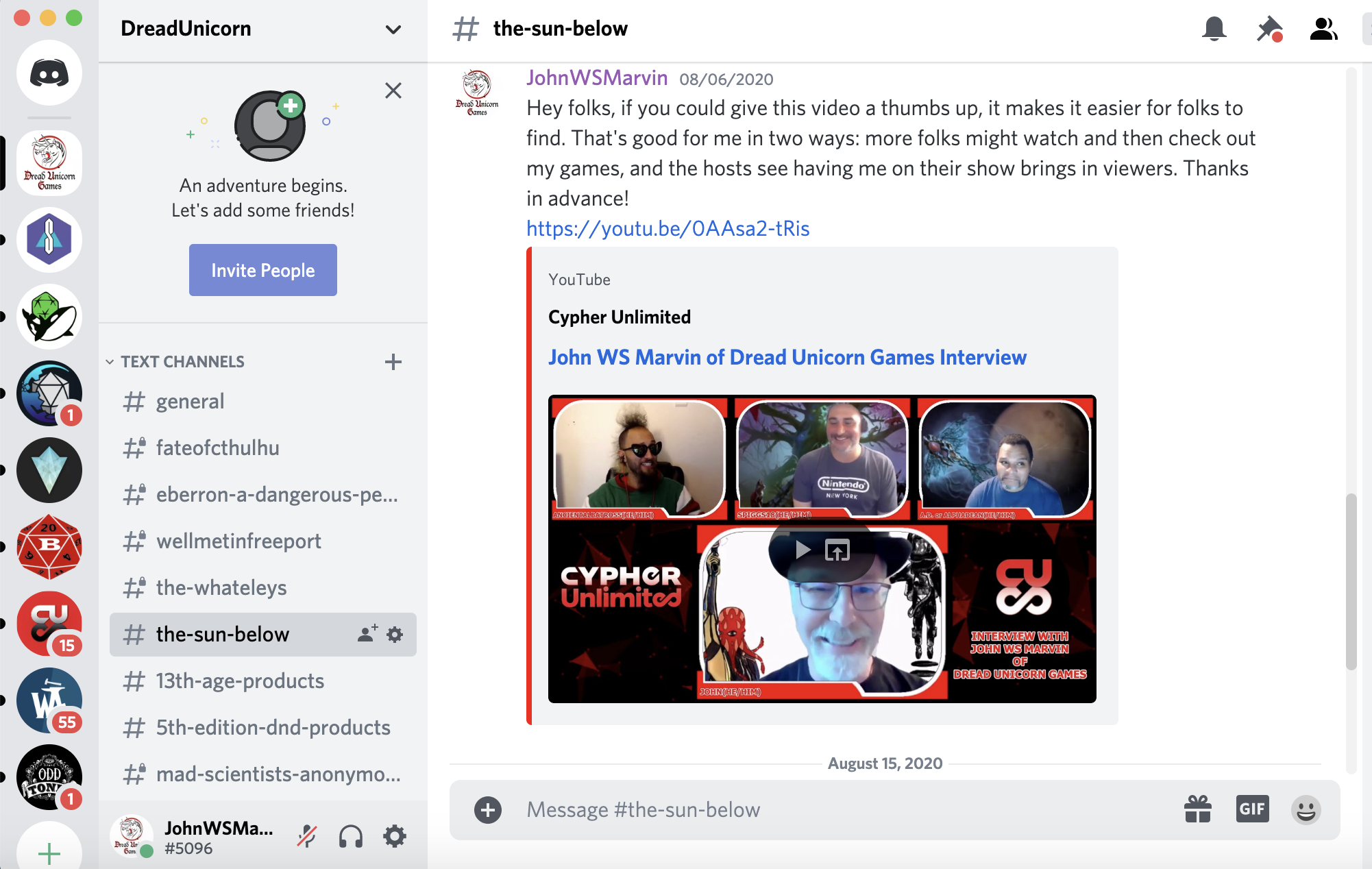
Share handouts, chat in text, voice, and video, all in Discord
The most popular communication tool among gamers, discord allows text chat, voice chat, and video chat. And it’s free for all features a gamer is likely to need.
And join us to talk about gaming on the Dread Unicorn discord server: https://discord.gg/2SHyATG62d
Slack
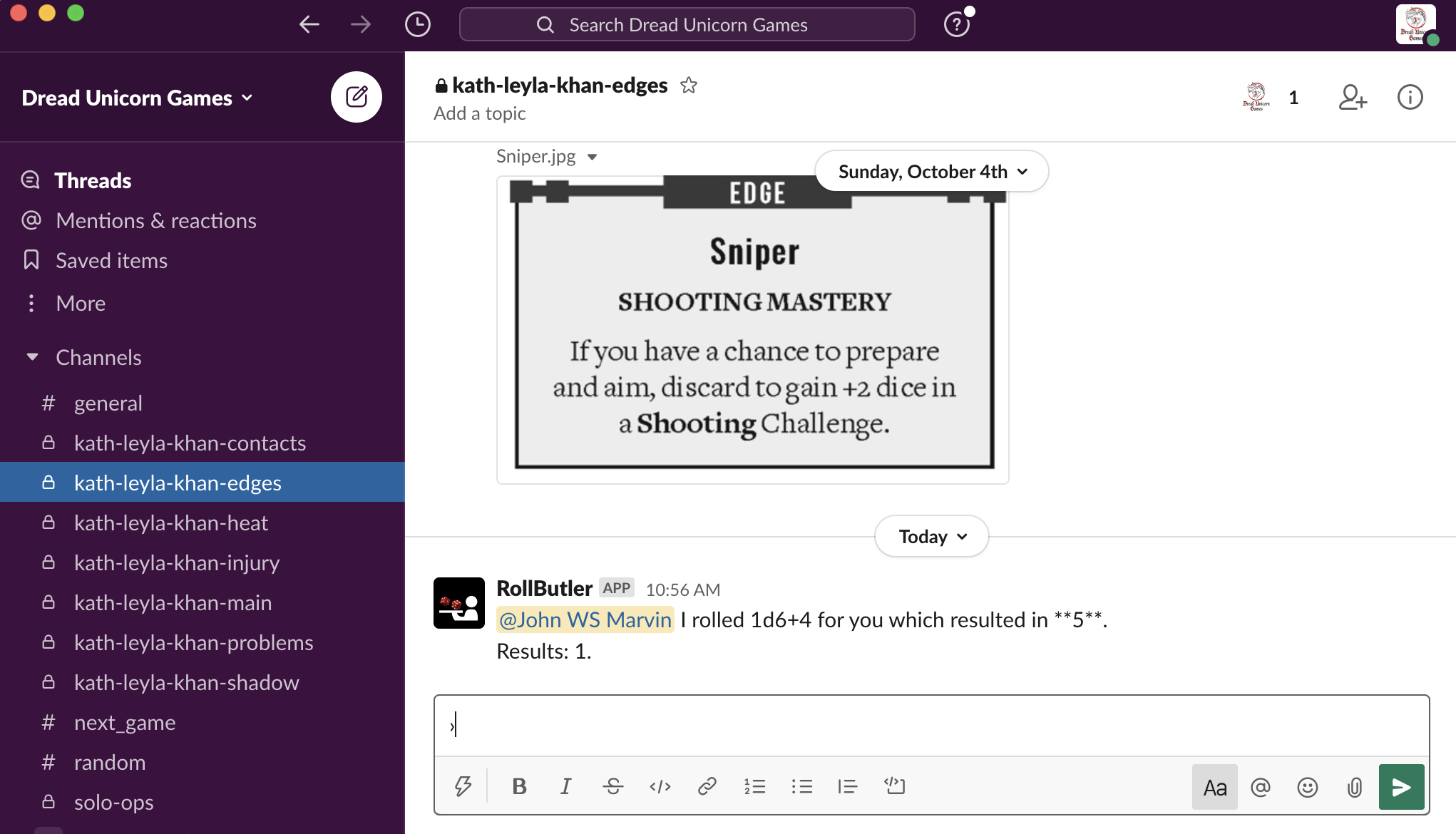
Got my Solo Ops cards all arranged and using RollButler on slack to roll those d6s.
If I have a lot of fiddly handouts, like the cards used in Night’s Black Agents: Solo Ops, I find Slack an easier platform than a big bad virtual tabletop. Super easy to use and teach, wish their UI designers made a VTT. And free.
Zoom

Zoom is everywhere now. Video chat for 45 minutes free, so someone will have to pay to get a game going, or be prepared to set up a new session every 45 minutes. Lots of YouTubers use Zoom for their videos.
Meet

Google Hangouts died, which was sad to many gamers. The new Google video chat, Meet, works much like Zoom. And like Zoom it doesn’t have a zillion add-ons for gamers like Hangouts used to. The best part of Meet is the price: free.
What about you? Use a communication tool not listed here? Leave us a note in the comments below.
More resources for playing remotely:

Roll20 for non-Tactical Games

There are plenty of articles about using virtual tabletops like Roll20 to do tactical gaming like D&D and its many offspring. This isn’t one of them. We’re talking about when you play more narrative games like Blades in the Dark, Call of Cthulhu, FATE, GUMSHOE, Numenera, and the like.
Hate Virtual Tabletops? You’re in Luck!
For those that have never clicked with virtual tabletops, you don’t need them to run narrative games. Discord or some similar service to do voice and share images is all you need. People who do D&D theater of the mind can go this route too.
Why Use a VTT?
There are many reasons to use a virtual tabletop for narrative games.
You are already comfortable with one (or more). Maybe you’ve been playing tactical games on a VTT and switch systems. Most or all your players are also comfortable there. Why move?
Automated character sheets. Tired of teaching new Numenera players how to spend effort? The Cypher Systems by Roll20 character sheet will walk the players through it. Automated sheets take some of the work off the GM’s and players shoulders.
Integrated dice rollers. You can add dice bots to Discord, but I’ve found some players have a hard time without a graphical interface.
Built in organization for game components. Roll20 has support for handouts, cards, and graphics. Once you’ve shared a handout with players, they always have access to it.
Lots of publisher support. I’m particularly impressed with Evil Hat’s offerings on Roll20. I have also had good experiences with Pelgrane Press and Monte Cook Games wares for Roll20. I’m sure theres many more I don’t yet know about.

FATE of Cthulhu Character sheet
Why Roll20?
It’s the most popular VTT, has a free version, and supports more narrative based games than any other VTT I know. Most of what I say here applies to Astral, Fantasy Grounds, Foundry, and the others.
Mapless Map Layer
You can use the Roll20 map layer for a lot more than gridded tactical maps. For narrative games, think of it as a background image. Turn the grid off, and load in an image that works well with your game. Use the images from the PDF of your game. Or, an internet search will come up with images of almost anything gameable you can think of. Pinterest is great as well.
The image could set the tone, convey information about the scene, or just look cool. Sometimes all three.
Tokens
I use tokens to do things like show hit points or similar PC resources. For example, in Numenera, I make all three bars visible, and use Bar 1 for Might, Bar 2 for Speed, and Bar 3 for Intellect. This gives all players a quick visual take on the condition of the party. Anyone need healing? Should we take a rest? A half second scan of the tokens is perfect for this.
Playmat
Build (or purchase) a playmat that has all the information your players need to play. Keep the GM secrets on the GM layer. Check out this playmat from Evil Hat for their Fate of Cthulhu game.

Return of the Map
Whenever you want, you can bring back the map, gridded or gridless. Using a map with dynamic lighting is great for chills and thrills in horror roleplaying. What’s around that corner? Move your token and roll for a shattered psyche.

From the upcoming Ashen Stars adventure, Dark Entanglement, where the PCs investigate a derelict starship oosing with corruption.
Have you used a VTT for a narative roleplaying game? What worked well for you? What didn’t? Let me know in the comments below.

Two Sleeping Ladies
Recently we went on a road trip (to pick up our new car), and on the way back, spent some nice socially distanced downtime at a cabin at the Sleeping Lady resort.
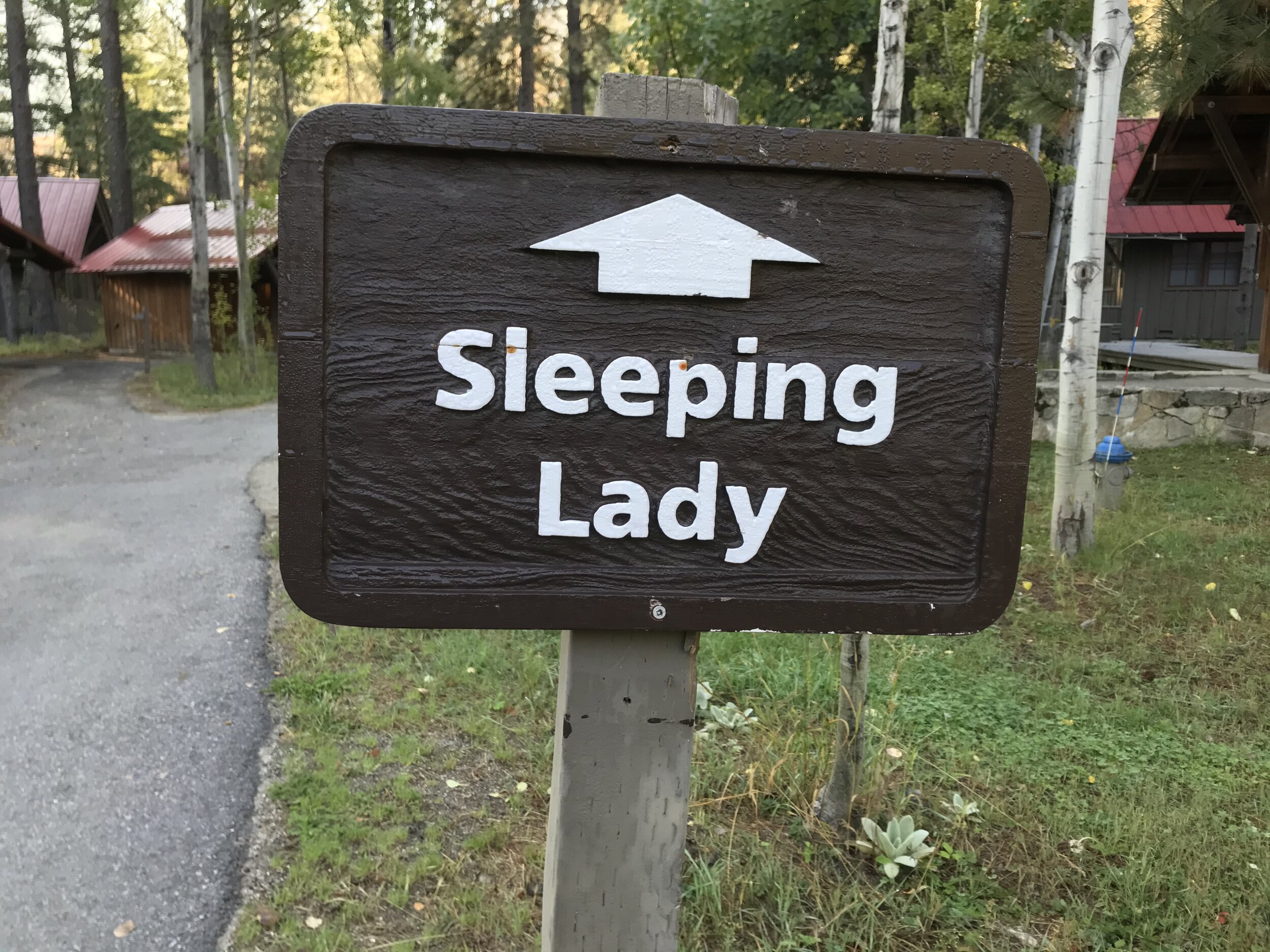
Of course, that made us think of another Sleeping Lady.
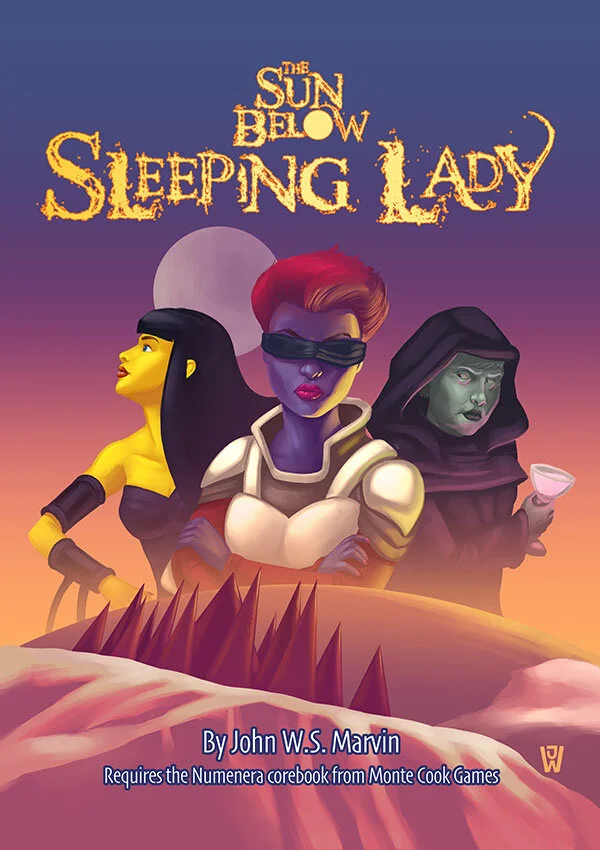
Still a fan favorite! Check it out here!
Meanwhile, exploring the art around Sleep Lady Resort, we came upon this…
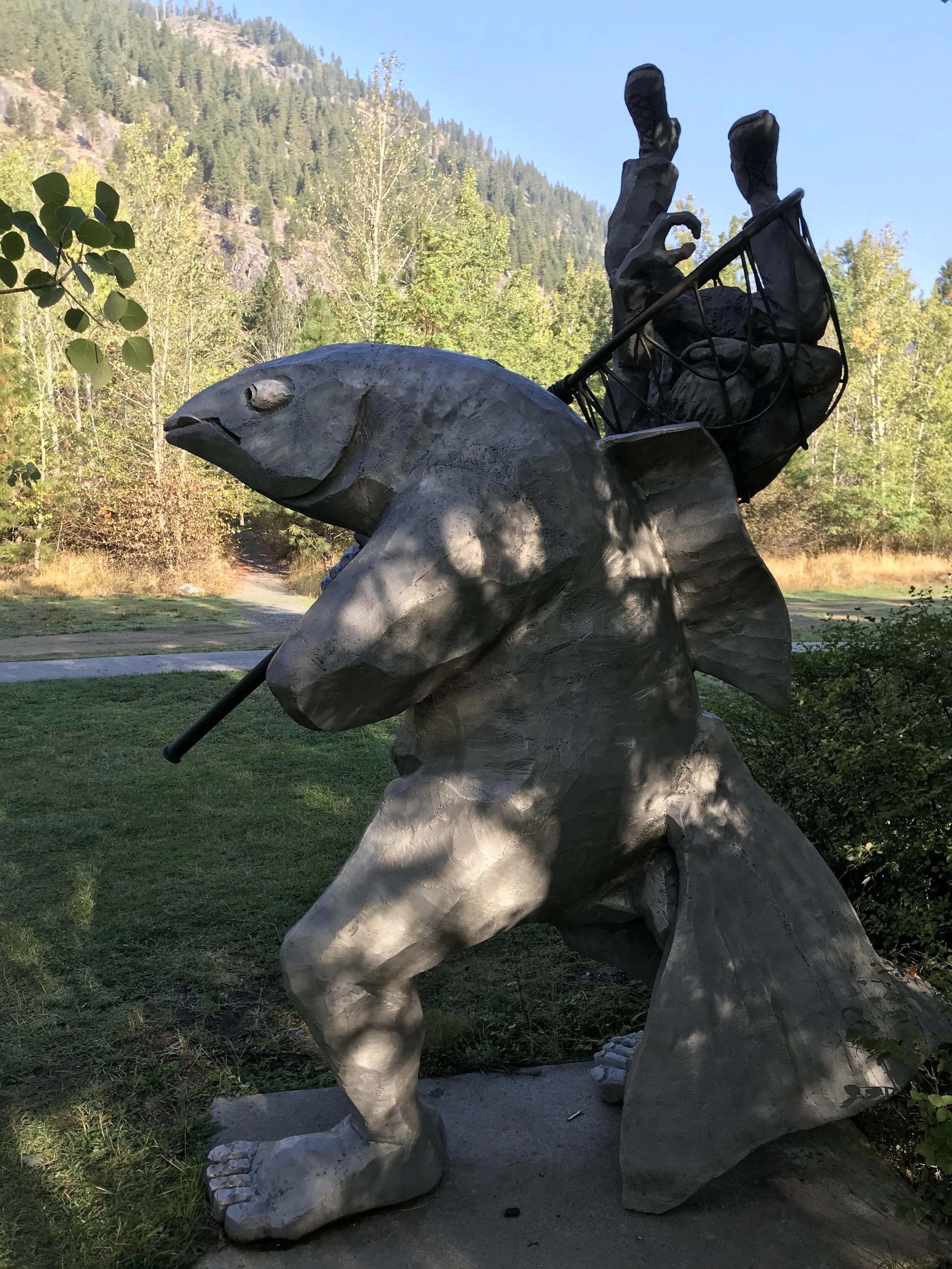
I call it Fish Folks’ Revenge
Stay safe, and happy gaming

Roll20: Combat Tokens
First you might want to check out Roll20: Maps, Tokens, and Lighting.
Today I want to talk about games where you want to use Roll20 with a map and tokens in place of miniatures on a table. I am still learning myself, so please comment with your own suggestions.
Make a Monster Token
Enter a game you where you are a GM.
Token Art
On the upper right side, click on the Art Library icon. There are two ways to get the art.
One: You Already Have Art
If you have art on your computer you want to use, click My Library then Upload. Square images look best. And check out TokenStamp, which takes your image, and makes square or round tokens for you. (A round token is really a square image with transparent pixels outside the circle.)
Two: You Need Art
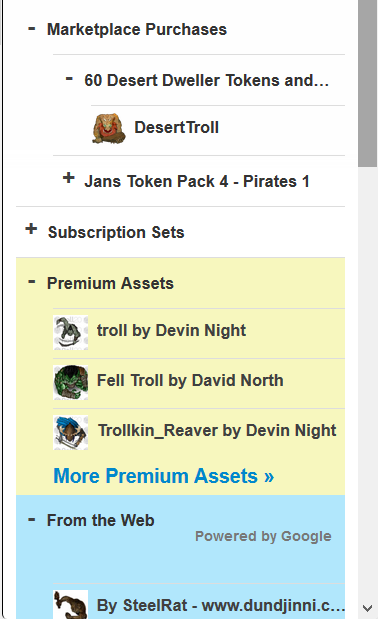
In the search box, enter the monster name (for example, troll) and hit return. If you already have some troll artwork added to your account, that art will show up first with a white background. Next, with a yellow background, are the Premium Assets—art you can buy. Under that, with a blue background, is free art from the web. Mouse over the tiny icon to see a bigger version of the image.
Drag It
Make sure you are on the Objects & Tokens layer. Layers is the second box on the left side of your screen.
Then drag your token onto your map. Let the mouse button go and you have created a token. To size a token, drag a corner. For example if you want your troll to cover 2 x 2 squares, drag the corner out so you have large troll. You can move it around, rotate it, and just have fun.
Stats
At this point you could just run the monster token as a miniature and be done with it. I like to attach at least minimal stats to it.
The Hard Way
Lots of new Roll20 GMs go through the work of creating an NPC sheet for each monster and filling it in by hand. This is tedious and will take years. Don’t do this.
Minimal Effort, Great Results
This works for every game system, takes minimal time, and works great. Select the token, then click the gear icon.

For Bar 1 enter the monster’s hit points (called health in some systems) in both the numerator and denominator box. During combat, if your monster takes 10 hit points of damage you can select the token, then click the green bubble and type “-10” and hit return. Roll20 will do the math and now the bubble will show you the current hit points. The players won’t see the bubble.
For Bar 2 enter the armor class or armor value in the numerator. During combat, you can click on a token to see its armor.
Bar 3 is optional. You can use the numerator for any other number you’d like to see. For Dungeons and Dragons, some folks put passive perception there, I tend to leave it blank.
Click the Advanced Tab and fill in the See checkbox by Bar 1. Now all the players will see a green life-bar over the monster, but they won’t see the numbers.
For everything else just use the book, your notes, wherever you got the monster from, just like at a real table.
Compendium Monsters
This trick only works if your game system has a Roll20 compendium and your monster is in it. Some of my favorite games don’t have compendiums, but many do.
Start by making a token using the Minimal Effort, Great Results method above, for example a troll.
Go to a page your players will never see. For example, I always make one called Players and Monsters.
Go to your Compendium, search for your monster. For example, in Dungeons and Dragons 5th Edition, type troll and search. If a bunch of hits show up, you want the one under Monsters. Drag the word Troll under Monsters over to your map. It will add a default token you will never need.
Now you have Troll as a character in your journal. I like to edit that character to give it the tag “Monster.” That way I can search for all my characters that are monsters.
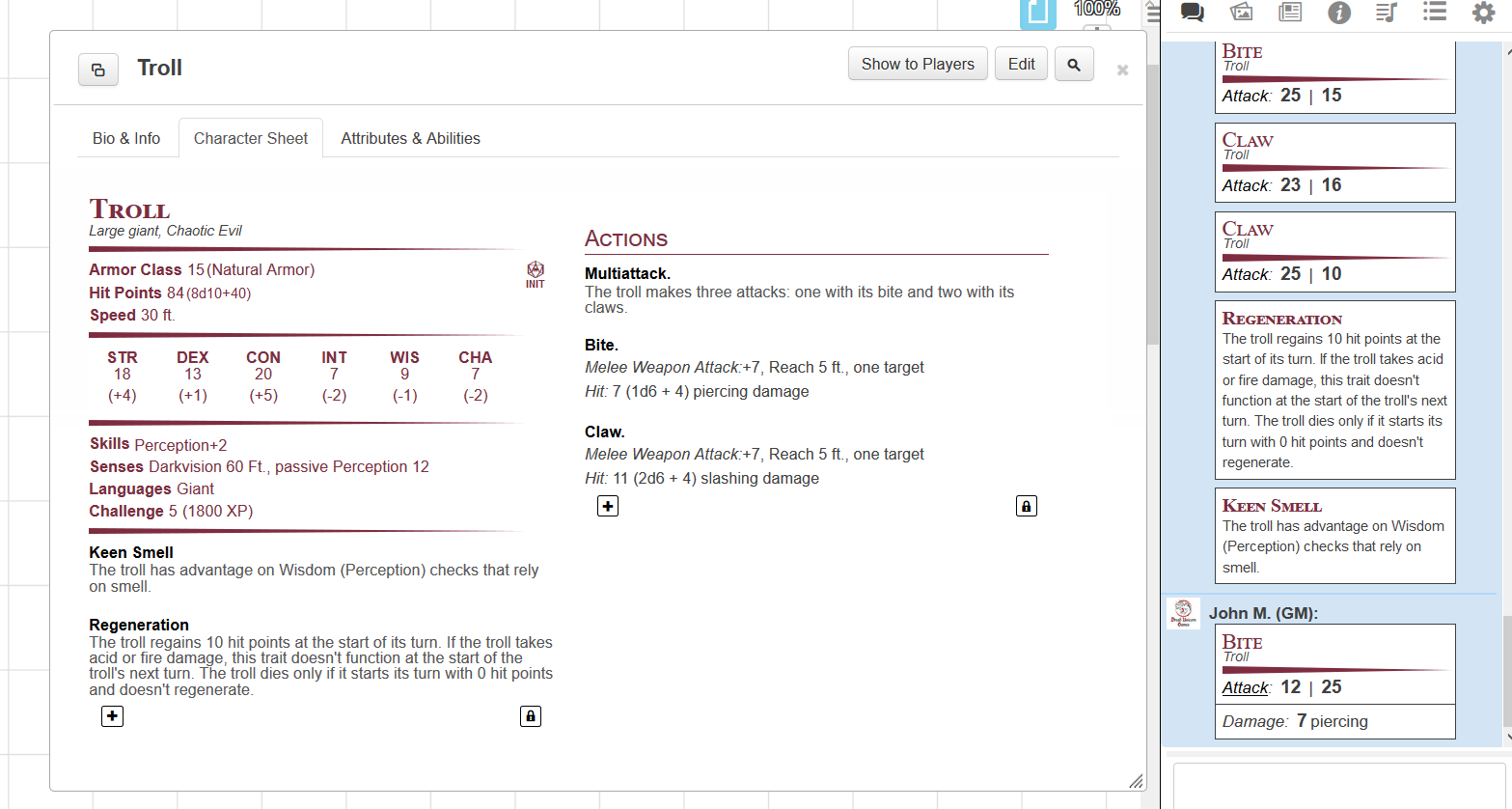
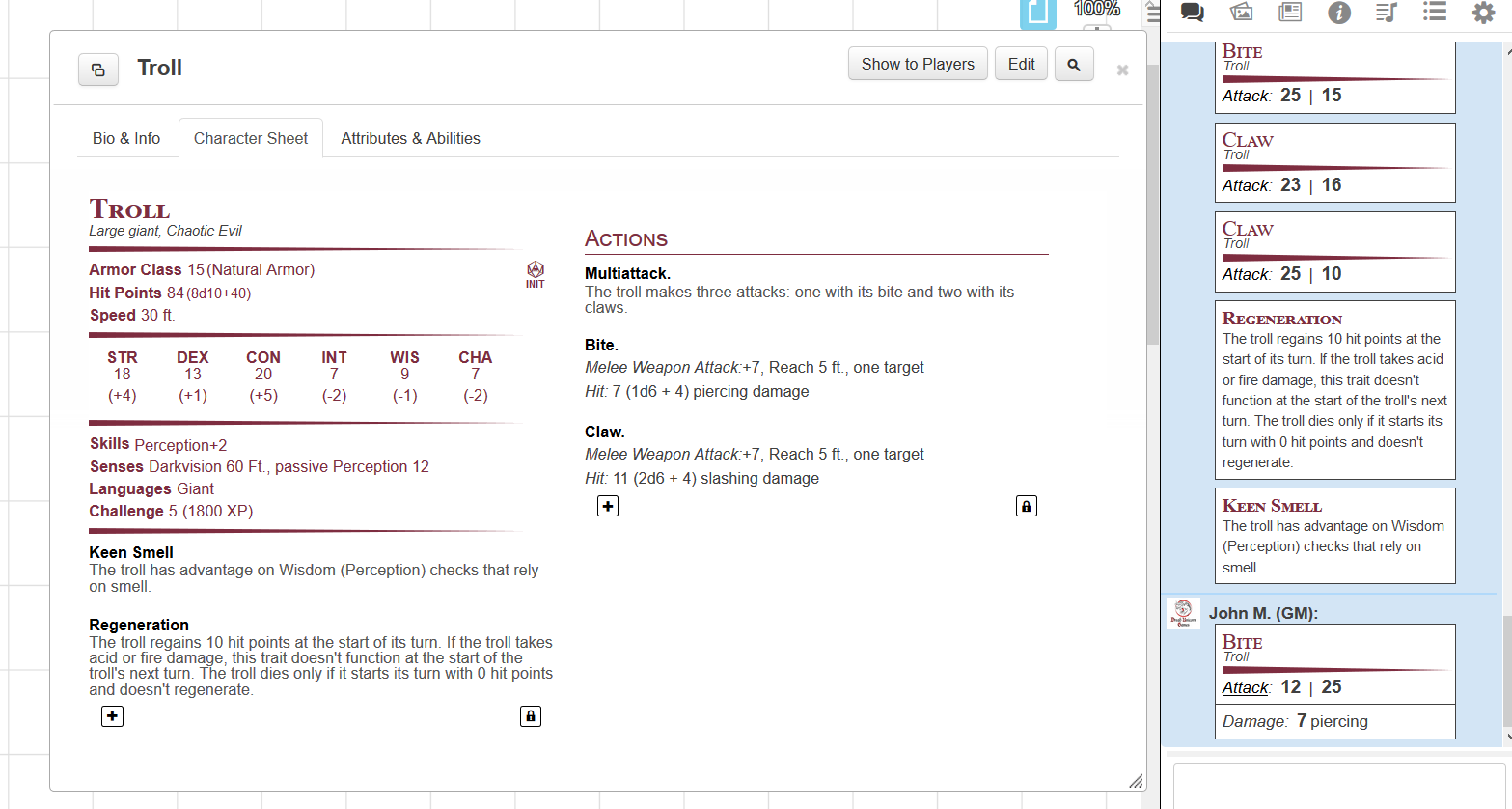
To use it in combat, use the token as normal to track hit points. To attack with your troll, open the troll character sheet, and click on the bite and claw headings. The attacks show up in chat, with all the math done for you. If you have multiple trolls, you just use multiple tokens, but only one troll “character.”
Spending Money
Some games, such as Dungeons and Dragons, come with a default compendium, but you can buy more monster books through Roll20 and get more monsters. Sadly, owning a print monster book does not help get the monsters into your compendium. You must buy the book twice.
DnDBeyond and Beyond20
If you’ve already bought monster books on DnDBeyond, you can use Beyond20 to use the monster stat sheets with Roll20 and not have to buy the same monster book a third time. For D&D, this is exactly what I do, combined with my Minimal Effort, Great Results method for the tokens, above.


Roll20: Maps, Tokens, and Lighting
Also, check out Roll20: Combat Tokens.
Now that people are playing tabletop RPGs online like never before, I thought I’d share my tips and tricks for doing a game on Roll20 using a battle map. I do a battle map for all the non-social (and some of the social) encounters in D&D or 13th Age. Even in investigative games like Ashen Stars I might do one more for the mood of investigating an abandoned space wreck than tactical combat.
I’ll do posts about using Roll20 for investigative and for story telling games in the future. Stay tuned!
There may be better ways to do this, I'm still learning. Sadly, some of the lighting advice doesn’t work on the free version. Here's my setup:
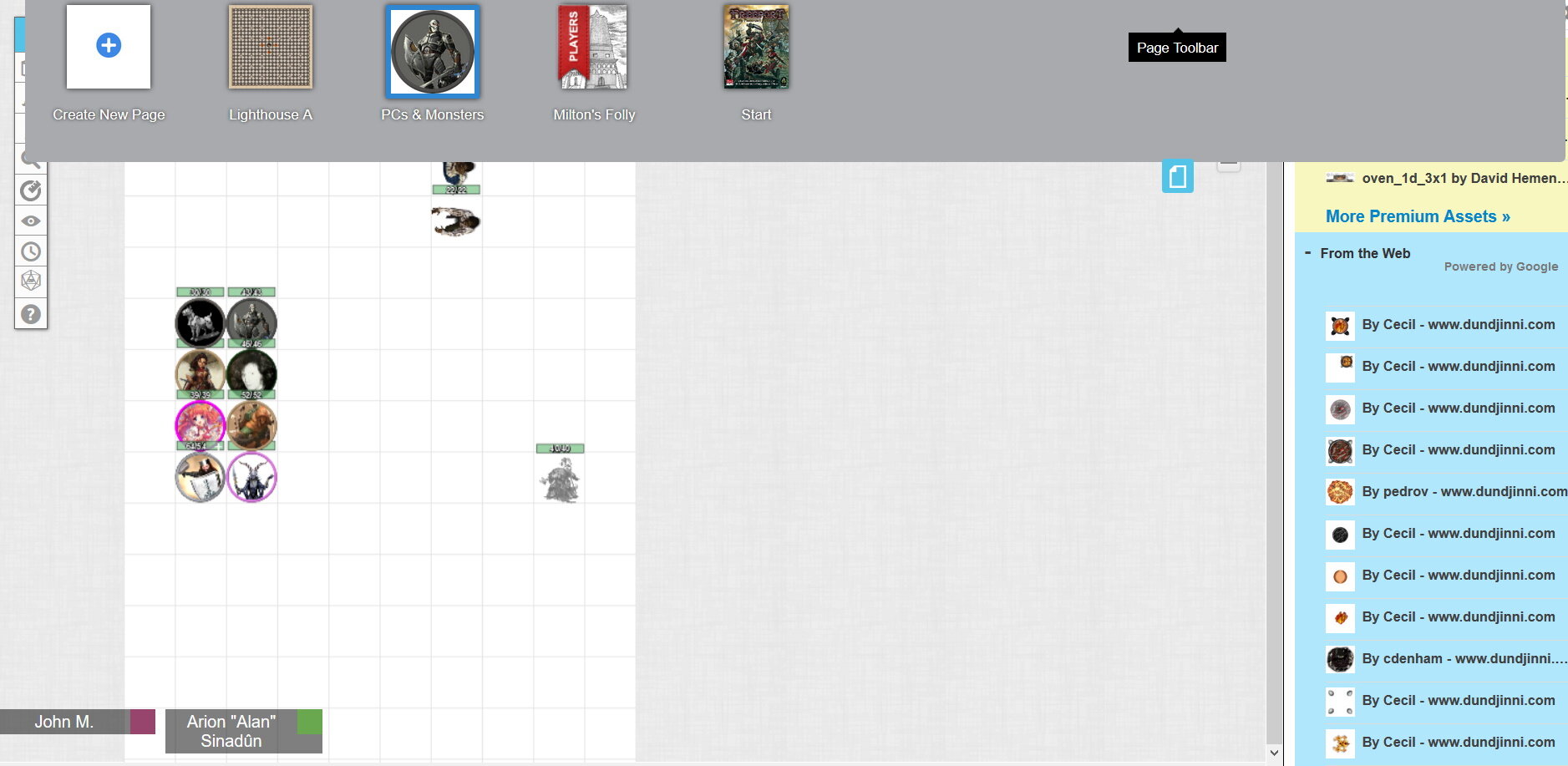
The Secret Map
I have a map only I can see, called "PCs and Monsters." Oh no, you saw it! :)
All the PCs’ tokens are there. When I make a new map, I copy the PC tokens from PCs and Monsters, and paste them into the new map. I place them in a likely location for you to enter the map. I also stick monsters that repeat on multiple maps here. TIP: Copy and Paste with the right mouse button works better for me than using CTRL-C and CTRL-V.
Each token has the "Represents Character" set to the name on their character sheet. I also select the token, and open the character sheet, click edit, and set the default token to the one I just selected. Now they are connected. I only have to do this once.

Sad Warforged
For 5E, each token has its bar 1 (green) set to "hp" and it's bar 2 set to "ac". On the advanced tab I set bar 1 to "see" so everyone can see the hp bar. I can click on a PC’s token to see their AC. Since the token is connected to the character sheet, when a player changes their hp or ac on the sheet, it gets changed on the token.
I also set the "Emits Light" section up so players can see. For darkvision I set that to 60' / 1', which is 60' of dim vision, 1' of full light. A person holding a torch would be 40' / 20'. For an artificer’s tinkering light property I set it to 10' / 5'. For someone without a light source or darkvision, I set it to 1' / 0.1'. This allows the player to see their token, but that’s it unless there is an external light source.
I only check the "All Players See Light" if it's a light spell or the PC is carrying a torch or something. I check "Has Sight" for everyone or players won't see anything!.
If the whole party moves to a new map, I just drag the red "Players" ribbon to that map and I'm done. If one PC goes ahead, I go to that map, pull the PC tokens to somewhere they can't see anything important, put the scout token in the right place, and then move the Players ribbon.
On my nighttime, inside, or underground maps I enable the Advanced Fog of War and check Dim Light Reveals. That lets a PC’s token "remember" the things they've seen before. It uses the token's "Emits Light" radius to track what has been revealed, so it's not perfect. Whatever a player can see by a distant light source is not remembered. The token need to have moved close enough to see it with its own light or darkvision.
I also enable Dynamic Lighting and set Enforce Line of Sight, Only Update on Drop, and Restrict Movement. Now players can't walk through walls. For more information, go here: https://roll20.zendesk.com/hc/en-us/articles/360037258654-Dynamic-Lighting

The Dynamic Lighting Layer
I use the polyline in the Dynamic Lighting layer to mark walls, doors, and other big obstructions. For columns, barrels, statues and the like I use polyline to make an X in the middle of them. I used to draw their circumference, but then players couldn't see the object. The X blocks line of sight, but allows the players to see the object. I use white since my maps tend to be dark. Doors I make in green and add a handle so I can grab them to open them as needed. If I need to close the door later, I drag the door off the visible area. If not, I just delete it.
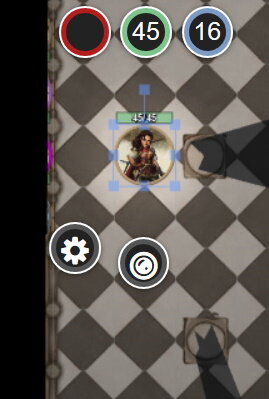
Using the rogue’s token to test lighting
To test out lighting on a map, I select a player token and hit "CNTL-L". This is what the player will see. I drag it around the map and check it out. When I'm done I click the eyeball icon on the left and click "Reset Fog" or the player will see all the “remembered” area from my test.
I can also create a token for a torch on the wall and give have that emits light and set All Players See Light.

A well lit shop.
Here's a warforged from my Eberron Adventurer's League game. They have emits light set to 1' / 0.1' which would normally leave the room black, but the torches light up things nicely.
For outdoor daytime maps I also set Global Illumination. Everything is lit, but objects can still block your line of sight.
How about you? Do you have Roll20 tips and tricks to share?
Are you a Fantasy Grounds or other VTT user who would like to share their tips and tricks on this blog? Send me mail at john at dreadunicorngames dot com.
Next blog: Roll20 combat.
John
Maps from
Immersive Battle Maps: https://www.kickstarter.com/projects/atlasmundi/immersive-battle-maps-for-tabletop-roleplaying-gam
Me, using The Calamus: https://trapstreetstudios.com/theCalamus/
Roll20

When Everything Falls Apart

I recently watched the amazing Korean movie Parasite, and it got me thinking about something that is a ton of fun in games. That point when the PCs plan falls apart. No spoilers, but in Parasite, when things go off the rails, it’s spectacular. I believe this is one of the things audiences are reacting to when they love the movie.
If you haven’t seen it, seek it out. It’s not supernatural or science fiction, but it is an explosion of deception, stealth, surprises, violence, and bad planning. Sound like an adventuring party?
Why it Works
I’m not talking about the situation where things are obviously too difficult for the party to handle. I’m talking about when the party has a plan, the PCs are successfully executing the plan, everyone’s feeling confident, and then it all goes sideways.
In a game of Fiasco, it’s called the Tilt. In The Sun Below: Sleeping Lady it’s when either a mountain starts flying and becomes a moon or an eldritch “god” forces it’s way into the player’s world.
For the full effect it’s best if the characters are already skating on thin ice. Perhaps they are running a con game, sneaking onto a star destroyer, or investigating a creepy ruin. The PCs are in (potentially) hostile territory, but by their wits and skills, they’re succeeding.
Having things fall apart for the party is great fun at the table. All the cool competence and smugness gives way to panic and improvisation.
Setting Up the Tilt
You could just rely on your game system’s rules and wait for a player to flub a roll. Suddenly the merchant sees through the con, a stormtrooper raises the alarm, or the invisible spirit alerts it’s dark master. But, as a game master, you have other tools to make your player’s efforts more likely to fall apart.
When Plans Collide
When the focus all the party’s efforts is in one direction—fooling the merchant and her family, sneaking past the guards on the star destroyer, investigating the clues in the ruin—introduce a third party with their own hidden agenda. A servant in the merchant’s house is stealing food for the monster in a secret room. Droids on the star destroyer are under the control of a thief who needs a big, splashy distraction. A cultist of the dark master in the ruins has a hidden agenda: to awake a different, darker master.
Make sure these third parties work in plain sight of the PCs. Give the PCs opportunities to act, in this and all your other tricks. The players (and you) are the audience, keep the big stuff on stage.
Copycats
Someone thinks, hey, if the PCs are pulling off this caper, how hard could it be?
The PCs run into another group who shouldn’t be there. These outsiders have some cover story (“We got lost?”) but actually are on a similar mission as the PCs.
The outsiders could get into a heated argument with the PCs at the worst possible time. “We’ve been working on this for months. This is our con/infiltration/investigation. Get out before you spoil everything!” “Shhhh!”
This new group just isn’t as good as the party, and if they get caught, it will bring the hammer down on everyone.
The new group has already done something the PCs know to be stupid. Killed the wrong figure, taken the wrong treasure, opened the wrong crypt. Now the PCs must deal with these idiots and fix or cover up the mistake.
Secrets
The more secrets there are, the more likely the PCs haven’t uncovered all of them. Secrets could be social (the merchant has a secret twin and they regularly trade places), tactical (the star destroyer is transporting imperial assassins), or physical (the ruins are infested with traps).
It’s All Fine
Sometimes your players will take your surprises and roll with them. That’s fine. If it happens every time, just increase the difficulty. If they never succeed on their plans, back off a bit; let things go right for once.
Most of all, watch your table. Are they having the time of their lives scrambling when it all falls apart? Or is it frustrating them? Mix it up so they have fun but never know what will happen next.
And get ready for that next tilt.

D&D Adventurer’s League
I’m new to the Dungeons and Dragons Adventurer’s League, and guess what? I’m having fun. In my hometown of Spokane, WA, there are AL games all over the area. Most Sunday afternoons you can find me at Merlyn’s Comics Games and Books.
Gaming in the RAW
There are some rules to make organized play work. If you are the DM you must run the game using Fifth Edition Rules As Written (RAW) and run the adventure pretty much as written. While you are encouraged to improvise a bit to make the game fun for everyone, you must run AL adventures from the DM’s Guild or adventures from the hardback books from Wizards.
You can use third party materials that stick to the SRD, such as 5E Condition Cards and Fantasy Backpack Cards.
If you are a player you must use point-buy for attributes, stick to official material (the list of books does not include new material presented in Unearthed Arcana), and keep yourself within the gold and magic limits of the season you’re playing in.
Roll for Surprise
When you walk into a game store, library, or wherever your local AL adventures are hosted, expect to be surprised. You won’t know who you are playing with, what adventure you will play in, or even what character you will play (most players have more than one AL characters). For Dungeon Masters, you might have an adventure ready to run, but there might not be enough players to run it. Most Dungeon Masters also have AL characters they can play, so they walk in not knowing if they will DM or play.
AL adventures are based on the tiers of play from Dungeons and Dragons, so you may hear “Tier two table has room for three more!” Players with higher tier characters often create lower tier ones in case all the adventures that day are lower tier.
Hardback Difficulties
Running a long running adventure from a hardback book from Wizards presents some interesting problems you don’t run into when using the AL one-shots from the DM’s Guild. Since you have random players each game, you can’t count on anyone knowing what happened before. You need to end a session at a place you can start with a new group of players next week. Mid-battle cliff hangers probably should be avoided.
Walk Right In
With all the standardization, organized play makes it easy to walk in, sit down, and play with people you may never have met before. It’s the D&D equivalent of bridge night at the Lion’s Club for a previous generation. Everyone I’ve encountered have been quite welcoming, and more than willing to help new players.
From the Dragon’s Mouth
Find out more from the official Adventurers League site.
More Fun
It’s not just D&D. You can play Numenera and other Cypher System games through Cypher Play. The Pathfinder Society is organized play for Pathfinder. For Call of Cthulhu and other Chaosium games we have the Cult of Chaos. 13th Age has the 13th Age Organized Play program. Vampire and other Modiphius games have the Modiphius Organized Play program.
I’m sure there’s a lot of other organized play options out there. Know a good one you’d like to recommend? Leave a link in the comments.
Best of All
It’s great fun. I’ve been surprised at how enjoyable it is. If you’ve ever played games at a convention, it’s like that, every week. For me, it doesn’t hit all the bases of a long running home brewed campaign with a close group, but I know it’s fun because I keep going back.