

Fixing Scarlet Citadel
Before I say terrible things about Scarlet Citadel and why it needs fixing, I need to say Kobold Press does great work. Midgard Worldbook is my favorite 5E world book. Love their monster books, and their pawns. Pirates of Atlantis uses OGL Kobold Press monsters.
Players, read no further. Spoilers ahead!
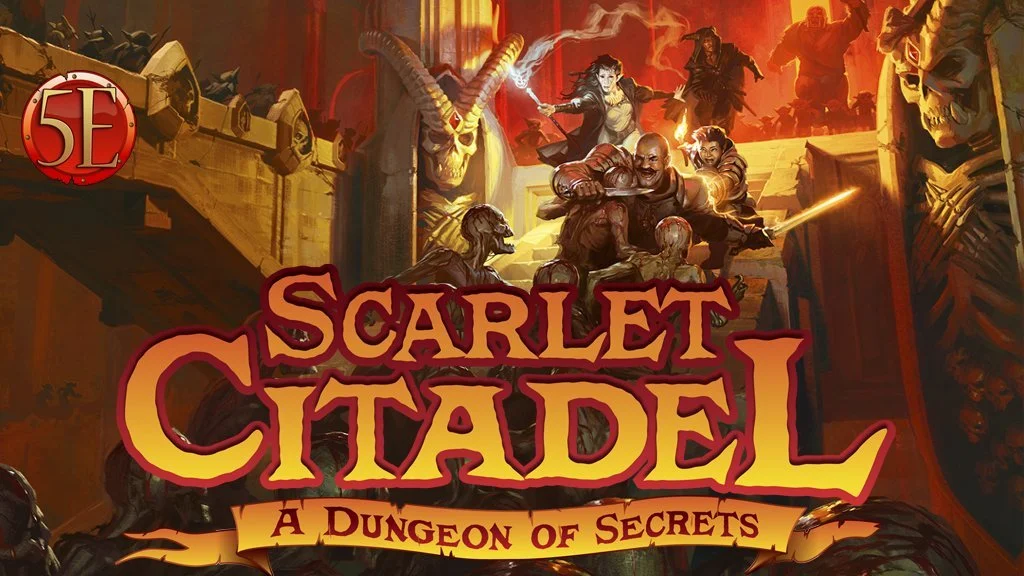
Image from the cover.
There are great things in Scarlet Citadel, things that make it worth saving. Great maps, including an amazing map pack. If you get it, get the map pack! Some amazing locations and encounters. If your group only cares about encounters and doesn’t need motivation or story, you are good to go.
What to fix?
Motivation. There is only one reason for your PCs to enter the Scarlet Citadel as written, and that is loot. While the loot is OKish, it’s not great or even good as a motivator. The danger in this dungeon crawl is high, very high. There are many places where the book tells you how to kill PCs, and it’s not kidding. High risk, medium loot, zero motivation, story, or long term tension. If you have other adventures and allow your PCs to go elsewhere, they should.
There is no threat to the surrounding lands, no one asking for help, and the most boring villain (Gellert the Gruesome) I’ve ever seen. You could replace him with a turnip and the adventure wouldn’t change. He does nothing, threatens nothing, and is a passive lump. All the level bosses are supposed to report to him, but to what purpose? They all have their own unconnected projects that don’t feed into his work. If the PCs abandon Scarlet Citadel, the world would not be harmed in any way. Instead of high stakes, there are no stakes.
Any dungeon crawl can become a dungeon grind, despite the great encounters. Many players start to pine for the wider world. The book does recommend sending the PCs on occasional side quests, with no suggestions as to what they might be.
My Fixes
Consider these example fixes, you can probably improve on them to fit your table.
Ley Lines
A villain has to be up to something that makes your players care about thwarting them. Mike Shea, over in his Sly Flourish YouTube videos about preping for Scarlet Citadel sessions, ran into the motivation problem and came up with one answer: change the ley lines that are described throughout the book to actually have a purpose. Let the players know that Gellert is binding them up in such a way as to fuel his magic at the risk of creating a catastrophic event that would cause the surrounding lands to turn into something like the Western Wastes of Midgard. The stakes? Replacing civilization with uninhabitable ruins and Cthulhuish-Kaiju. Great motivation.
Many of the set piece encounters in the dungeon should be tied to the ley line madness, so it gives a reason for the PCs to do those set pieces. I stole this from Mike, and you can too.
MacGuffin
To get the ball rolling I wanted a MacGuffin deep down in the dungeon for the PCs to quest for. I asked the PCs what they could be looking for, and before you knew it they were searching for an ancient elven waffle maker made of mithril. If you want something more serious, maybe come up with it yourself, or at least don’t ask my players. Once that was settled, I had the alchemical furnace make syrup as well as oozes, and we were off to the races.

Syrup and Ooze Furnace.
My PCs call themselves the Waffle Stompers.
Mixing It Up
To break up the dungeon crawl, I’m sprinkling in adventures in the Shadow Realms from Tales from the Shadows (adventures) and the Book of Ebon Tides (dark fey setting). These Kobold Press short adventures are fun and come complete with motivation. And the Shadow Realms is amazing.
Back in Scarlet Citadel, I noticed down in the ruins of the dwarven barracks, the trollkin were mercenaries and organized as a military unit. That gave me the opportunity to have Gellert order then to sack the town the PCs stay in, Redtower. Time for a mass battle! I wrote all about it here.
Patrons

Dacka Dola, daughter of Baba Yaga
A patron is always nice, two nicer. These give your campaign people that care if the PCs succeed and can lend help, especially with intelligence. I had an uneasy alliance of elves from the summer lands and the shadow realms send them off for the waffle iron.
My side adventures to the Shadow Realms introduced followers of Baba Yaga, so to explain the fight to save the lands from ley line apocalypse, I created a daughter of Baba Yaga who communicates through a magic mail pouch. “You’ve got mail.”
A Dungeon of Secrets
The subtitle of Scarlet Citadel is A Dungeon of Secrets. And there is a lot of interesting history and secrets sprinkled throughout the book, but no obvious way for the players to uncover them. I do the same thing Mike Shea does, I look ahead, note down the fun secrets, and then dole them out whenever the PCs are doing something that might reveal them: reading a book or old inscription, interrogating a prisoner, getting advice from a patron, and so on.
Some games call these floating clues, in Cypher System they are called keys, but no matter what you call them, they are information your PCs can learn whenever they go looking for information. Sometimes I just volunteer the information. For example when the trollkins tried to surrender they called out “We know things about Scarlet Citadel that you don’t. We’ll tell you if you let us withdraw in peace.”
Zobek
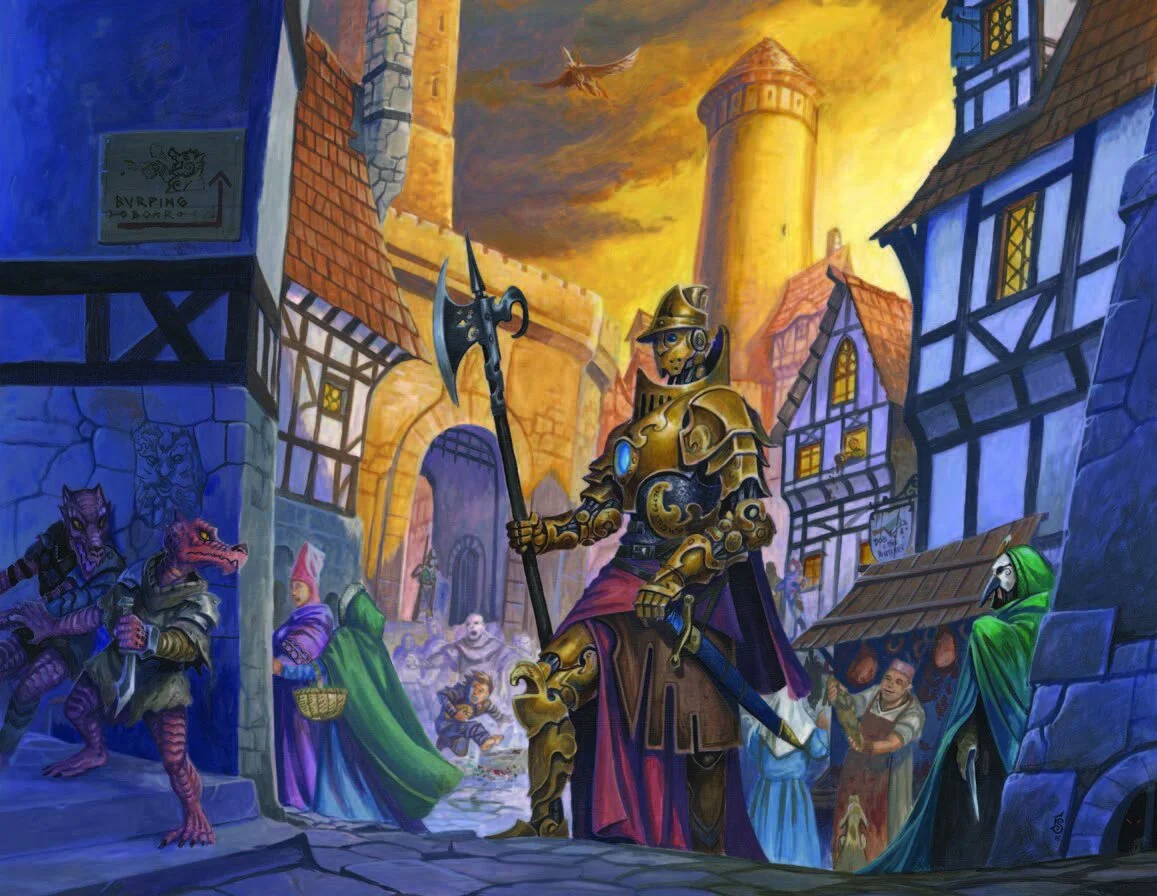
Zobek, the Clockwork City
Zobek is a cool city with revolution, gearforged, and shadow fey, has its own book, and is close to Scarlet Citadel, so I’m bringing that in as well. My elven patrons meet there.
Scarlet Citadel by Kobold Press is a dungeon crawl adventure for 5E D&D that spans 10 levels of play. The adventure includes a town setting, a multi-level dungeon, new monsters, spells, items, and traps, and a map folio with poster maps and overlays. It is set in the Midgard campaign setting, but can be adapted to any fantasy world.
You can copy these fixes, or use them as inspiration for your own. Our Scarlet Citadel game became a lot more fun once I decided to fix it. Have you tried Scarlet Citadel? How did it go?

Conquer Your Enemies with Kingdoms and Warfare
Mixing it Up Time!
I’m running Kobold Press’ Scarlet Citadel (5E D&D) for one of my groups. I’m also a sucker for big fantasy battles, so mixed in MCDM’s Kingdoms and Warfare. Highly recommended!

The Battle of Redtower
Kingdoms and Warfare by MCDM is a D&D 5E supplement that allows players to run their own domain and go to war against various enemies. It introduces new rules for domain intrigue and warfare, as well as new action-oriented monsters, magic items, and a complete adventure.
Scarlet Citadel by Kobold Press is a dungeon crawl adventure for 5E D&D that spans 10 levels of play. The adventure includes a town setting, a multi-level dungeon, new monsters, spells, items, and traps, and a map folio with poster maps and overlays. It is set in the Midgard campaign setting, but can be adapted to any fantasy world. It’s both a great and highly flawed adventure, but that’s for the Fixing Scarlet Citadel post here.

The books
Many DMs prefer to keep the big battles as narrative backdrop and just describe them while player characters do PC things. Some of us like to play to see what happens. I’m in the later group, but I don’t want a six hour Avalon Hill style battle, I want something abstract and with concepts easy for a 5E player to grasp.
That’s Kingdoms and Warfare’s sweet spot.
I only used the Warfare chapter, and hand-waved the Kingdom part. Might use that later.
Deep inside the ruins of Scarlet Citadel a group of trollkin mercenaries hang out in the ruins of an old dwarven barracks, basically doing nothing but waiting for the PCs to come and fight them. However, according to the book, they long to be out and about assaulting good folk, raiding, and being warlike jerks.
So after my PCs had trashed the upper levels of the dungeon, I had the boss (Gellert the Gruesome) send the trollkins out to raid the town the PCs had set up shop in, Redtower. A small town with a wooden wall and a nice big red tower.
MCDM didn’t provide trollkin units (trollkin being a Kobold Press creation), but not to worry. I took hobgoblin units and added regeneration and changed their name. Done. And used the trained owlbear unit from the Special Unit Deck. The battlefield is not a map, but an abstraction, but it does support walls and towers. And mud. I used mud for the small stream by Redtower.
Since this was our first Warfare game, each player only controlled one unit. At least until round three when the cavalry (the Knights of Khors for you Midgard fans) showed up. We started with just archers and infantry, including some peasant levies bolstered by druid magic.
Every PC uses extra powers from their class to buff their unit. Our fighter gave extra damage to their infantry. The warlock gave a wand of acid (great vs. regenerating foes) to their unit. The bard made the enemy afraid, and so on.
My trollkins assaulted the walls, my owl bears turned from infantry to calvary for one round and attacked the flank, but alas, the PCs held the line. Attacks use a d20, and are very swingy. A string of bad rolls on my part put the baddies on the back foot. In hindsight I could have added harpies to the mix, but that’s hindsight for you. While the PCs’ peasant levy was mauled, the trollkins ended up loosing at the end of round 3, and retreated on round 4. .
Then we cut to the PCs who had come to challenge the trollkin leaders face to face. That combat took place after the battle at our table, but simultaneously with it in the fiction. At the end of round 3, the trollkins know they lost the battle and the PCs get huge morale boosts with extra actions. A trollkin shaman raised their hands “We fought with honor, but we lost. Allow us to withdraw to the northlands and never trouble you again.”
The PCs agreed, and ended game night with a double victory.
If that sounds fun to you, check out Kingdoms and Warfare. You can add it to your campaign. You could add it to Pirates of Atlantis, maybe on Earthforge Isle! Kingdoms and Warfare is meant for 5E, but you could use it for any fantasy d20 game, like Pathfinder or 13th Age, with little or no work.
More about Scarlet Citadel soon.
You can get Kingdoms and Warfare here.
Have you ever run a mass fantasy battle in the middle of a roleplaying game? What rules did you use? How did it work out?

D&D Adventurer’s League

I’m new to the Dungeons and Dragons Adventurer’s League, and guess what? I’m having fun. In my hometown of Spokane, WA, there are AL games all over the area. Most Sunday afternoons you can find me at Merlyn’s Comics Games and Books.
Gaming in the RAW
There are some rules to make organized play work. If you are the DM you must run the game using Fifth Edition Rules As Written (RAW) and run the adventure pretty much as written. While you are encouraged to improvise a bit to make the game fun for everyone, you must run AL adventures from the DM’s Guild or adventures from the hardback books from Wizards.
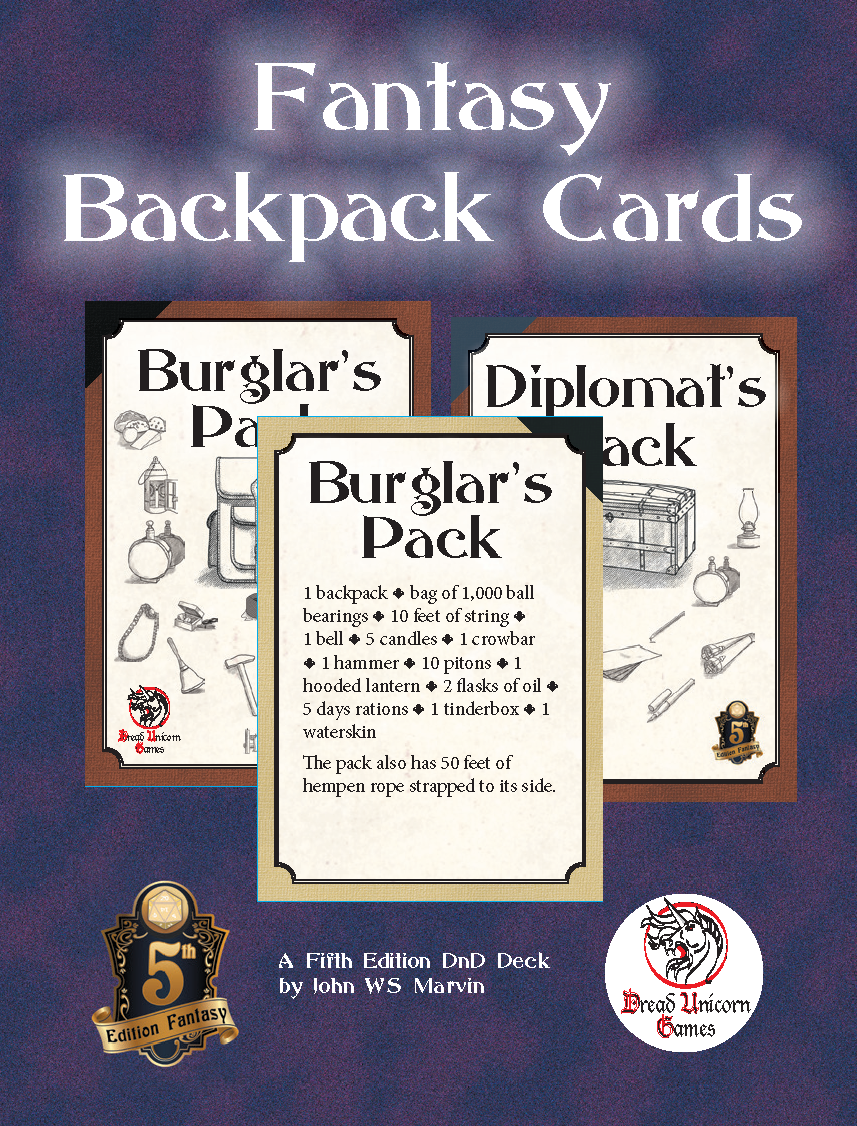
You can use third party materials that stick to the SRD, such as 5E Condition Cards and Fantasy Backpack Cards.
If you are a player you must use point-buy for attributes, stick to official material (the list of books does not include new material presented in Unearthed Arcana), and keep yourself within the gold and magic limits of the season you’re playing in.
Roll for Surprise
When you walk into a game store, library, or wherever your local AL adventures are hosted, expect to be surprised. You won’t know who you are playing with, what adventure you will play in, or even what character you will play (most players have more than one AL characters). For Dungeon Masters, you might have an adventure ready to run, but there might not be enough players to run it. Most Dungeon Masters also have AL characters they can play, so they walk in not knowing if they will DM or play.
AL adventures are based on the tiers of play from Dungeons and Dragons, so you may hear “Tier two table has room for three more!” Players with higher tier characters often create lower tier ones in case all the adventures that day are lower tier.
Hardback Difficulties
Running a long running adventure from a hardback book from Wizards presents some interesting problems you don’t run into when using the AL one-shots from the DM’s Guild. Since you have random players each game, you can’t count on anyone knowing what happened before. You need to end a session at a place you can start with a new group of players next week. Mid-battle cliff hangers probably should be avoided.
Walk Right In
With all the standardization, organized play makes it easy to walk in, sit down, and play with people you may never have met before. It’s the D&D equivalent of bridge night at the Lion’s Club for a previous generation. Everyone I’ve encountered have been quite welcoming, and more than willing to help new players.
From the Dragon’s Mouth
Find out more from the official Adventurers League site.
More Fun
It’s not just D&D. You can play Numenera and other Cypher System games through Cypher Play. The Pathfinder Society is organized play for Pathfinder. For Call of Cthulhu and other Chaosium games we have the Cult of Chaos. 13th Age has the 13th Age Organized Play program. Vampire and other Modiphius games have the Modiphius Organized Play program.
I’m sure there’s a lot of other organized play options out there. Know a good one you’d like to recommend? Leave a link in the comments.
Best of All
It’s great fun. I’ve been surprised at how enjoyable it is. If you’ve ever played games at a convention, it’s like that, every week. For me, it doesn’t hit all the bases of a long running home brewed campaign with a close group, but I know it’s fun because I keep going back.

Mutating the Mind Flayer

Fun Fact
The term Mind Flayer is not in the SRD, it is the intellectual property of Wizards of the Coast. Which means nothing unless you want to publish your version professionally outside of the Dungeon Master's Guild.
The 13th Age RPG calls its squid-head the Soul Flenser. I'll call my version the Tarsiss, in case this ends up in a future project.
Inspirations
Besides the mind flayer, the khepri: bugs that lived on human bodies from Perdido Street Station and of course, Mi-go brain cylinders.
Mind Flayer
Everyone, from D&D players to Stranger Things fans, loves a mind flayer. Here's the first mind flayer I ever saw, from the original Dungeons and Dragons white box supplement II Blackmoor by Dave Arneson. 1975!
Mutation Station
Let's mix it up, creating a new creature, inspired by the mind flayer -- one that players won't know all about. For this example, let's use the Cypher System, as stat blocks are easy. If we like it we can make a 5th Edition or a 13th Age version. (Edit: the 13th Age version is here.)
What do I like about mind flayers I want to keep?
- Squid head, humanoid body
- Super smart
- Mental attack
- Eats brains
The Tarsiss
I love the fact that these creatures have humanoid bodies and squid heads. My creatures (the Tarsiss) are squidlings that take a human body, cut off the useless head, and replace the head with their own squid like body. They are super smart, use bizarre technology, and are practiced in dimensional travel. When not using weird tech weapons, they have a psychic attack.
And of course, they eat brains. They don't mind canned food, so they keep humanoid brains alive in weird devices that look like fat thermoses with ports for connecting to other weird devices. Captives in these brain-jars can be made to run machinery. Imagine the fun when the players find a Tarsiss outpost staffed by human brains in jars!
Tarsiss
Level 7 (21)
Armor 2 (force field, works against Intellect attacks as well)
Lightning gun: 7 damage, long range, (depletion 1 in 1d6) level 7 artifact
Psychic blast: Short range Intellect attack that does 7 damage (ignores armor) and causes target to make a Might Defense roll or take 5 Speed damage.
GM Intrusion: The tarsiss attacks up to five targets within short range with its psychic blast attack.
Danger: This creature is more dangerous than a typical 7th level creature. That's the way we like it. Tone it down if you and your players prefer easy fights.

