

Evil Minions are the Best Minions
The fantasy: Conan wades through a sea of cultists, taking them down and looking good. He must take them down, because their shear numbers will overwhelm him if he doesn’t.
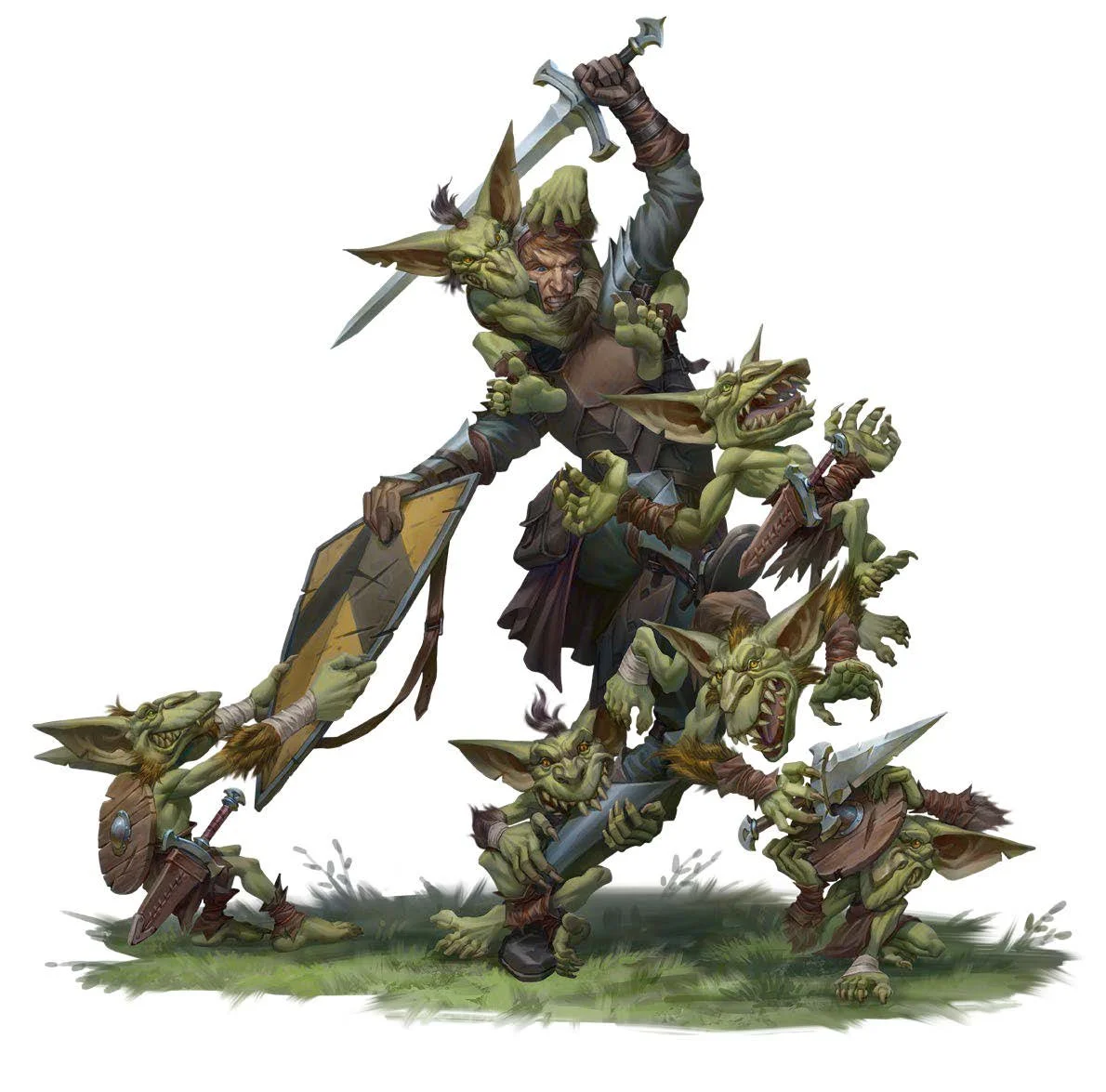
Goblin Minions
Flea, Mortals! delivers that fantasy with minions. I’ll tell you how to use them. First I’ll explain why they are needed.
5E has a game design concept called bounded accuracy that was supposed deliver that fantasy. It doesn’t work.
Try It, You’ll Hate It
Throw a dozen low CR creatures into one of your combat encounters vs. a level 8 party. Say the standard orc, 1/2 CR, 15 hp, +5 to hit, does 9 damage. Your twilight cleric is giving everyone an average of 11 temporary hit points per turn. And is concentrating on spirit guardians, maybe upcast to 4th level to do an average of 14 (7 on a save) points of damage to all nearby enemies each round.
So you roll a dozen saving throws, miss most, and the orcs try and hit. The fighter in plate and shield has AC 20, and has found one of the many ways to get the shield spell, just in case AC 25 is called for. And is likely to have more temporary hit points than the orc’s damage output, should they ever hit.
Lots of bookkeeping for the GM, negligible effect except for slowing the encounter to a crawl and boring everyone. Great job!
Flee, Mortals! to the Rescue!
You can see Flee, Mortals! minion rules in the free preview, so you can check it out before you buy. I like that.
These minions are different than those in 4th Edtion, or the mooks in 13th Age, but the goal is the same. To support the fantasy of jumping into hoards of foes, and fighting hard to take them down before their numbers overwhelm you.
Group Attacks: Less Work, More Threat
Minions have group attacks, where the DM rolls one die for a group. Saves time. The more minions in the group, the more dangerous the attack. A group of 5 CR 4 mummy rotwraps have +10 to hit and do 20 damage plus some special effects. This may get the PC’s attention.
One Point of Damage
One point is all it takes to drop a minion. Touch one and they go down. But look at the sample. The Goblin Minion (called the Goblin Lackey in the book) has 6, not 1, hit points. What’s up with that?
Overkill
The DM uses the listed hit points to see if multiple minions die from one attack. If a goblin minion with 6 hp takes 7 points of damage, there is one point left over. If there is a nearby other goblin minion, that one dies! If the first minion took 13 points, the first 6 would kill the first, the 2nd 6 would kill a second, and the 1 left over would take down a third. There’s the fantasy.
Save for No Damage (Sometimes)
What about half damage from spirit guardians or fireball? If half damage is equal to or greater than their hit points, they go down. If not, they take zero damage. A goblin minion who would take 6 or more damage on a successful save is just dead, no reason to roll.
Shockingly, fire giant minions have more hit points than goblin minions. Minion hit points scale.
Use ‘em!
I like these minions. They deliver the fantasy, are less work, and most of my players like them.
Most. I have seen players who dislike minions for not behaving like standard (Wizards of the Coast) monsters.
Have you tried these minions? Or other 5E minion rules? How did it work out?

Fun Monsters for 5E from Flee, Mortals!
Flee, Mortals! is the new monster book for 5th Edition Dungeons and Dragons by MCDM. The monsters are amazing, super fun to use, but they required me to engage my brain in new ways to use. Which I didn’t do the first times I used them. So learn from my mistakes.

This is a high-crunch book made for tactical combat. Which adds some complexity to the DM’s plate. For me, the increase in fun makes it worth it. I will say 13th Age, which is D&D adjacent, has monsters that are just as fun as those in Flee, Mortals! but are easier to run.
There’s a free preview, I’ll use monsters from the preview so you can follow along if you don’t have the full book.
Note: If you’ve watched Matt Colville play D&D on YouTube, you probably noticed two things: 1. Matt is infectiously gleeful in monster combat and would be a blast to play with. 2. Matt is blissfully unconcerned with the finer points of Fifth Edition D&D and regularly mixes in rules from previous editions and his homebrew inventions.
If the latter had you worried that this book wouldn’t work well with 5th Edition D&D, fear not. Matt has people for 5E compatibility. Like James Introcaso, the lead designer. James and company have given us a real 5E product. This is by far my favorite 5E monster book.
Bonus Actions and Reactions
As a player in 5E, you are probably used to cool bonus actions and reactions for your PC. As a DM, you know that few monsters get bonus actions and almost none get reactions outside of the global attack of opportunity. This book turns that on it’s head. Almost all Flee Mortals! monsters have one of these, and many have both.
What’s cool about this is that monsters aren’t boring piles of hit points. They do things, not just their single attack action.
In this post, I’ll look how deal with this slight bump in complexity.
Bonus Actions
Bonus actions aren’t hard, I just had to train myself to look for them. They are right there on the stat block I’m looking at while I’m running the monster. Some bonus actions are better used before the monster’s attack, others after. Look at the actions and bonus actions together and decide what will happen in what order.
About half the monsters here have bonus actions, so look.
Check out the goblin assassin, they get the bonus action sneak.
Sneak. The assassin takes the hide action.
Other bonus actions in the book are fun things like stay down.
Stay Down. The knave kicks one prone creature within 5 feet of them. The target must succeed on a DC 14 Constitution saving throw or their speed is reduced to 0 until the end of their next turn.
Reactions
Reactions are where I messed up at first. As a DM, I’m used to looking at the monsters defenses and hit points while it’s a PC’s turn. I often ignore the rest of the stat block. No, no, no! Look for reactions. More importantly, monster A might want to use their reaction while a PC attacks monster B.
What I do now is list out the reactions of all the monsters in a battle in one place. Copy and paste from the PDF, and have it there so I have all the reactions for an entire combat encounter.
If you look at the reaction of goblin queen Bargnot, she has No Dying!
No Dying! When a willing creature Queen Bargnot can see within 30 feet of her is reduced to 0 hit points, she can choose to have them reduced to 1 hit point instead.
If the target is a goblin warrior, it doesn’t help to be looking at the warrior’s stat block when they get hit. The reaction you might want is in the queen’s stat block. That’s why I keep my list of reactions for all the monsters in the fight.
Other reactions in the book include the charming reptilian escape.
Reptilian Escape (1/Day). If the scaletooth fails a Strength or Dexterity saving throw, they lose their tail and succeed instead. They regrow their tail when they finish a long rest.
Steal This Hack!
Once you get used to this, letting most monsters have bonus actions and reactions is a lot of fun. It also makes the creature an interesting opponent for the players. So next time you make your own monster, give it a bonus action, a reaction, or both. If you can’t think of great new ones, Flee, Mortals! has a lot to steal.
Next time, I’ll go into minions, a great monster type in Flee, Mortals!
Happy gaming!

Mutating the Mind Flayer

Fun Fact
The term Mind Flayer is not in the SRD, it is the intellectual property of Wizards of the Coast. Which means nothing unless you want to publish your version professionally outside of the Dungeon Master's Guild.
The 13th Age RPG calls its squid-head the Soul Flenser. I'll call my version the Tarsiss, in case this ends up in a future project.
Inspirations
Besides the mind flayer, the khepri: bugs that lived on human bodies from Perdido Street Station and of course, Mi-go brain cylinders.
Mind Flayer
Everyone, from D&D players to Stranger Things fans, loves a mind flayer. Here's the first mind flayer I ever saw, from the original Dungeons and Dragons white box supplement II Blackmoor by Dave Arneson. 1975!
Mutation Station
Let's mix it up, creating a new creature, inspired by the mind flayer -- one that players won't know all about. For this example, let's use the Cypher System, as stat blocks are easy. If we like it we can make a 5th Edition or a 13th Age version. (Edit: the 13th Age version is here.)
What do I like about mind flayers I want to keep?
- Squid head, humanoid body
- Super smart
- Mental attack
- Eats brains
The Tarsiss
I love the fact that these creatures have humanoid bodies and squid heads. My creatures (the Tarsiss) are squidlings that take a human body, cut off the useless head, and replace the head with their own squid like body. They are super smart, use bizarre technology, and are practiced in dimensional travel. When not using weird tech weapons, they have a psychic attack.
And of course, they eat brains. They don't mind canned food, so they keep humanoid brains alive in weird devices that look like fat thermoses with ports for connecting to other weird devices. Captives in these brain-jars can be made to run machinery. Imagine the fun when the players find a Tarsiss outpost staffed by human brains in jars!
Tarsiss
Level 7 (21)
Armor 2 (force field, works against Intellect attacks as well)
Lightning gun: 7 damage, long range, (depletion 1 in 1d6) level 7 artifact
Psychic blast: Short range Intellect attack that does 7 damage (ignores armor) and causes target to make a Might Defense roll or take 5 Speed damage.
GM Intrusion: The tarsiss attacks up to five targets within short range with its psychic blast attack.
Danger: This creature is more dangerous than a typical 7th level creature. That's the way we like it. Tone it down if you and your players prefer easy fights.


Time After Time
You know the Time Loop story? Where the protagonists are stuck repeating the same events over and over? You may remember it from Groundhog Day, Star Trek, or Dark Matter. It's everywhere. I wanted to run a time loop session for my Predation group, and make it fun. I've seen a bunch of these, but the one that really made me want to do this in a roleplaying game was Dark Matter's All the Time in the World. Instead of focusing on one or two characters who knew they were time-looping, it started with one and added a character each loop until the whole gang was in on the secret. Perfect for a roleplaying group.

"I'm Going to Mess with Your Agency."
For many games, messing with player agency is the worst thing a GM can do. So of course I wanted to do it.
I started out announcing I was going to do it before we got going. I did this to let them know this will be a different session and that I was going to do commit a terrible GM sin. 4 out of my 5 players were fine with this announcement. The 5th gave me a baleful stare. "This better be good."
The Setup
I started with the newest edition to our gaming group, and told her she was gesturing wildly and talking nonsense, then told the heavy of the group "You can't stand her raving so you hold her off the ground and clamp your hand over her mouth. Now you can hear the others decide what to do."
As the rest of the group decided what to do about the strange sleeping aliens (think shape-shifting mind flayers who ride dinosaurs) and the shoggoth who was advancing, I sprung the first TPK. A secret door popped open, an arm came out holding a gun that shot a black hole into the chamber with the PCs. The black hole errupted with terrible damage, sucked the PCs to it and then let them fall down a giant hole and into the maws of a hungry shoggoth. Everyone dies.

Click
I run the same scene again and this time let the new player go, telling her she's been stuck in this loop and died over and over. "What do you do different this time?" I let her know she can attempt to convince one other PC the truth. I let the other players know they have no memory. My players are great, so those who have no memory ham it up, telling her to "calm down and take a chill pill."
She convinces another PC, and they steal the black hole gun and throw the mind flayery creature to the shoggoth.
Then the way out gets blocked by a giant plug and the shoggoths eat everyone. TPK.
Click
I randomly choose another PC to remember. Now there are 3, and they know the secret door is about to open. Old squid head loses his black hole projector and the whole group runs out before the plug closes. The party sees strange transdimensional beings ripping apart the high tech lab they were in last session. Everyone shrugs and runs out and hears one of the strange creatures say "Ut oh." Then everyone dies in a thermonuclear explosion as the fusion reactor gets torn up and goes boom.
Click
We start with the secret door, throw the squid-head to the shoggoth, run past the plug, and drive off the creatures ripping apart the reactor. In the jungle, there is an ambush by mind flayery creatures riding upgraded Utah raptors. TPK.

Click
I had one more time loop ready to go, but reading the table I could see enough was enough. They used the black hole projector on the shoggoths and found a secret subway out of the area and I ended the loop. We had some more fun, but the time looping came to an end.
Takeaways
I asked the players if was fun or frustrating. "Both."
"That was really fun! Frustrating to die again and again, sure. But the pace... was absolutely perfect. Great job with the distracting glimmer of hope that we might actually escape!"
and
"I thoroughly enjoyed it! It was almost a riddle we had to solve. Or do trial and error - as we did."
As a GM I loved it. So many TPKs! ;) I won't use this again this campaign. Maybe in a time travel game like TimeWatch it might work multiple times, but in a normal campaign I think once and done is great.