
Surprise!
Almost every roleplaying game that supports combat scenes has a rule for surprise. The surprised side gets some disadvantage, usually for the first round. Today I’m talking about when the player characters get surprised by the GM’s characters (NPCs or GMCs depending on your system), not the other way around.
 Why bother with surprise? How does it translate into fun at your table?
- The default kind of fun is a more challenging combat. This is a great way to stress the PCs, and is particularly fun if the players are getting just a little too cocky. How long has it been since the players sweated the outcome of a combat? Standing there with targets on their faces while the opposition gets free shots is sure to get their attention.
- Surprise can help in world building. Maybe here in drow territory, drow have ambush points set up all over the place. You can tilt the odds of whatever surprise mechanics your system has to make it favor the drow in these encounters. As the players venture deep underground, drow ambushes become part of their world. “We go north, we need to be extra careful for drow surprises.”
- Surprise can help in shared world building. If the dice dictate the PCs are surprised, you can ask the players “Why are you surprised?” They can come up with all sorts of explanations you would never think of: “I’m so tired. Henrik’s ghost stories didn’t let me sleep last night.”
- Surprise can help build story. An antagonist might run ahead of the PCs, helping potential adversaries set up ambushes. Maybe it’s because they feel the PCs have cheated them. The GM can leave clues such as “this is the third ambush in a row that has the hallmarks of a Dr. Wild setup. The doctor sure seems to have it in for you.”
- Avoiding surprise by roleplaying can be rewarding. The players may meet someone who knows about the ambush ahead. If the players make friends, they find out about it. If the players are all murder-hobos, they’ll never learn that information.
- Avoiding surprise can be a good use of resources. Maybe use of a magic spell can reveal the ambush ahead. In a game like 13th Age, spending an icon boon could have icon send a message about the ambush. In a 5E type of game, a PC that is part of a faction may get the info as a faction favore. In a GUMSHOE game, players can spend their Sense Trouble points. The players can feel very good that they avoided walking into that trap, by spending a resource wisely to avoid it.
- In some systems, surprising the PCs can end up giving them resources. In Numenera and other Cypher System games, the GM can just declare the party is surprised as part of a group-wide GM Intrusion. Each PC then gets an experience point.
How have you used combat surprises to make your game more fun?
Dread Expectations
Darcy Ross does Superheros, Cypher Style
http://www.youtube.com/watch?v=x28u4MHpbeo
We did a one shot of Cypher System Supers. I think everyone knew a lot more about comics than I did, but we all had a great time. Great group, great GM.
Follow Darcy on Gnome Stew, among other places.
And don't forget, our Gods and Icons Kickstarter is still going!
Secret Sun Below Sale
A clever backer pointed out that it's cheaper to buy the Sun Below adventures for Numenera by backing the Gods and Icons Kickstarter at the $1.00 level and adding the Sun Below titles as Add-Ons. Yes, they are right. The print versions include shipping, so yes. I made a sale so secret, even I didn't know about it!
"Sale" ends April 15th, 5:09 PM PST. Go forth and save!
Who Wants a Cypher-Kiss?
Good News! CypherCaster issue 5 is Out!
Cypher Caster Magazine, issue 5. With ton of great content, including and interview with Bruce R. Cordell, Shanna Germain, and Dennis Detwiller.
Plus an instant adventure by yours truly, Kiss of Death! Kiss of Death, a Numenera adventure, which takes place in Branu's Kiss, a watery world floating in space found in Into the Night from Monte Cook Games.
You see Numenera fans, I haven't forgotten you.
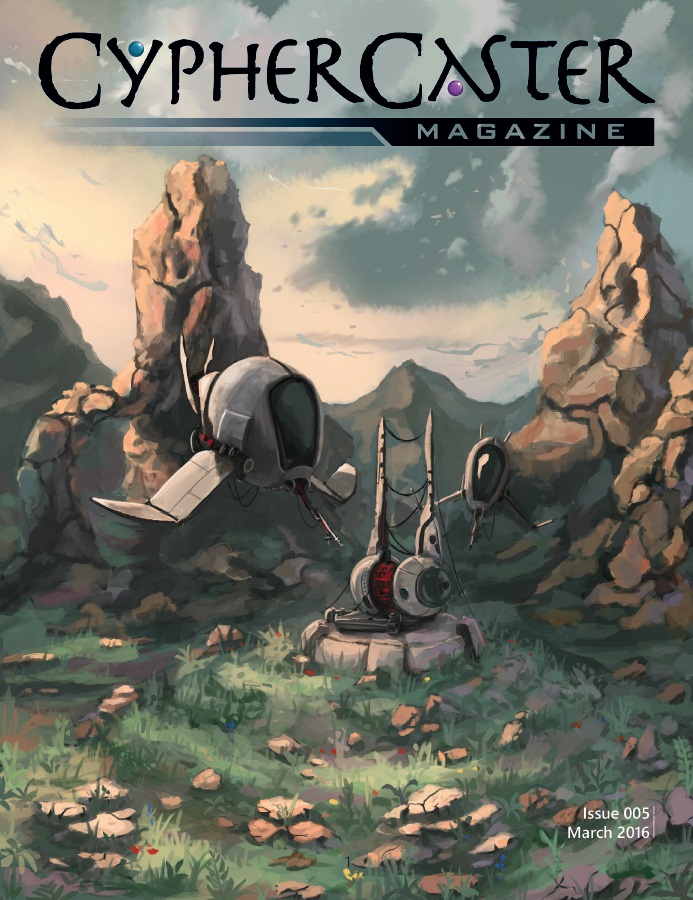
Plus an article on cypher limits by Marc Plourde, another Into the Night instant adventure, this one by James Walls, and a Strange recursion by Rustin Coones & Scott Robinson.
Check it out at DriveThruRPG.
Spotlight Cards
 Index cards are a GM's best friend. Remember the Hipster PDA?
I hate forgetting to give each player time in the spotlight. Therefore, I love having an index card for each player. I shuffle them before the game, and then flip the deck so I can see the top PC card.
Index cards are a GM's best friend. Remember the Hipster PDA?
I hate forgetting to give each player time in the spotlight. Therefore, I love having an index card for each player. I shuffle them before the game, and then flip the deck so I can see the top PC card.
On the left I put the information from the game system I need to be able to improv, things from the player's character sheet. I don't need numbers, just the background bits that help in roleplaying.
On the right side of the card I put the stuff the player loves to do in game with this PC. Play with his pet bear, drink at her regular watering hole, flirt with their favorite NPC, and so on.
I finish the left side with a question to myself. Has this PC gotten the spotlight yet? If not, I give them the spotlight ASAP, then put this card on the bottom of the deck and make sure the next PC gets a spotlight moment.
What's a spotlight moment? When you let the PC shine, make them the star of a scene. If they have a favorite action, like pick pocketing, flirting, or flying, I let them go for it. Action scene or pure roleplay, I make sure the character gets center stage.
Here's some examples. You can probably improve on these because no one knows your players better than you.
 This is the Cypher System card. I have another question to myself: Has the PC had a GMI (Game Master Intrusion) yet? I'm talking a GM Intrustion that gives them experience points. The card helps me remember. GM Instrusions are fun, and players love the XP that comes with them.

 This is the 13th Age card. When I'm working on a spotlight moment, I need the PC's One Unique Thing, their Icon Relationships, and their Backgrounds. Under the notes I might include favorite icon spirits and agents from past icon relationship rolls.

 Here's the 5E card. What's important for spotlighting a 5E character might include the PC's background, trait, ideal, bond, and flaw.

 Here's a generic GUMSHOE card. Drive and Occupation give me a handle for spotlight scenes.
I thought about doing a card for each GUMSHOE game, but realistically, I'd do them as needed for the games I'm running. On the right side I'd definitely list any sources of stability if they are used in this system, species for Ashen Stars, and so on...

It's easy enough to make your own for your favorite game system. They help me, maybe they'll help you.
A Plague of Ones, Part II The Bad and the Ugly
Now it Gets Bad.
Now it Gets Ugly.
 In Numenera, The Strange, and all other Cypher System games, the rule is: roll a one, the GM gets a "free" GM Intrusion with no experience point award. Ones are supposed to happen. 5% of the time.
But if you game enough, you'll be sure to run into the dreaded plague of ones. So many ones, what's a GM to do? A lot depends on what's going on in an encounter.
Last time we talked about the good side, when everyone is still having fun, despite the plague of ones. Now let's look at the harder problem, where the ones are wrecking your game.
 A Plague of Ones in an Encounter that is No Longer Interesting
Combat
The cypher system is made for fast, exciting combat. But if the PCs just keep missing and are running out of pool points, what do you do? (For a more general solution, see End With a Bang.)
Adding typical combat intrusions (creature/artifact/environment) will slow down combat. But there's yet another one sitting there on the table, taunting you. We're assuming the combat is not spiraling down the TPK drain (see below), so why not try a different kind of intrusion?
If the foes flee, combat ends, and you can move to a more interesting scene. Next time the NPCs will be better prepared for the PCs (+1 level for attacks? Return in greater numbers? Find a higher level friend?). An iron door or a force screen could stop the party from pursuing and prolonging the pain. The foes might jump through a secret door and lock it behind them. Perhaps the foes can wave some treasure, say a cypher or artifact, at the PCs as they vanish. So long, suckers!
Or, give a typical combat intrusion a silver lining that helps bring the dragging combat to a close. The artifact sword slipped out of the PC's hand and flew across the room, but it also cleaved through a statue revealing hidden cyphers (that are perfect for ending the fight) within. A creature careens into the PC, knocking them both across the floor, but put itself in a vulnerable position for a different PC. Thanks Nojo! And sorry about the concussion...
Environmental (climbing, crafting, and so on...)
It's not any fun anymore, so end it. Maybe give some damage for doing something dangerous like climbing, then narrate how the rest of the party got the PC over the wall. The item in the workshop broke, the PC needs new parts, so try again another session. End it and jump to an exciting scene. The workshop's doors fly off their hinges and in comes a hulking steam powered automaton!
Social
Same thing, wrap it up and move on. Give the PC one last insult, and show the party the door. If this is a critical plot point, an NPC can whisper to a different PC to arrange a private meeting later. "The king will never listen to you now, but the prisoners in the vineyards still need you. Meet me in the park at midnight..."
A Plague of Ones in an Encounter that Threatens to Ruin the Session
Oh noes. Too many sessions like this can kill a campaign. At least you can blame the dice.
Combat
 All these ones are pointing in one direction: TPK. Move to capture or let the PCs retreat. An intrusion could set off a trap that imprisons the PC, followed by an ultimatum for a party surrender. The PC could be mind controlled. A larger trap is sprung, and the way out is blocked while more foes join in the battle. "Surrender!"
 Or nudge the party into fleeing. Describe how the tide has turned against them, and the foes are trying to encircle the PCs. A friendly NPC could try and hold off the foes. "Fly, you fools!" Drop the PC down the damage track and just let them know "You still have time to flee."
Dropping a PC down the damage track encourages them to flee as it makes the player feel vulnerable.
Environmental (climbing, crafting, and so on...)
It's hard to see how this kind of failure would kill a session, but if the players keep hitting their head on the wall, help them move on. Leave the scene and narrate to something fun. The wall collapsed, the workshop blew up, and a week later the party reaches the baron's tower (or whatever the next fun scene is).
Social
It's sad their social strategies have failed, but they did. So move on and narrate them to something exciting. If you succeed here at the tower, those back home might change their minds. But first things first. Like those giant clockwork worms heading your way. What do you do?
Move On
You see a common thread in all of these suggestions? If it's not fun, cut the scene and move on. Sometimes groups will get stuck trying the same thing over and over again, waiting for the dice to save them. Help the players move on, and everyone will benefit.
It's a game. It's supposed to be fun. So when it's not, move on.
A Plague of Ones, Part I
Too many Ones in a Cypher System Game? -- It's All Good
In Numenera, The Strange, and all other Cypher System games, the rule is: roll a one, and the GM gets a "free" GM Intrusion with no experience point award. Ones are supposed to happen. 5% of the time.
But if you game enough, you'll be sure to run into the dreaded plague of ones. So many ones, what's a GM to do? A lot depends on what's going on in an encounter.
Subjectively, more ones than is normal feels like a lot more. If the group's been rolling 10% ones instead of 5%, they're sure to notice. And claim that 25% of their rolls are ones! And since rpgs are entertainment, it's the perception that counts.
A Plague of Ones in a Fun Encounter
This is the easy case. Everyone's having a good time. People are laughing at all the ones showing up. (For when the Fun-O-Meter flatlines, see Part II: The Bad and the Ugly). The biggest problem is coming up with new and entertaining GM Intrusions.
Go with, or against, the theme of the game. Numenera intrusions should be high-weird. Intrusions in The Strange often work with the theme of the recursion. Playing a horror game? More horror!
Combat
 OMG, another GM Intrusion, what can I do? Try another kind of GM Intrusion. You've been using creature intrusions? Great, now try a cypher or artifact intrusion. Or have the floor fall in, gravity reverse, objects turn into bubbles. Another foe shows up. A dead foe gets back up, always a table-pleaser. Or have the PC spring a trap.
There's nothing wrong with going back to creature intrusions, just sprinkle some other types in between.
Environmental (climbing, crafting, and so on...)
The poor nano has rolled three ones in a row trying to climb that wall? OK, falling is good to start with, but then think outside the box. Itchy insects have a hive right where the nano puts his hand. A passerby spots them, and wants to talk. The PC gets to the top, but falls over the other side. At least they're with the party now.
Crafting? They made something, but not what they set out to make. Perhaps it will work as intended, but have side effects, like being loud when the PCs want to be stealthy, or dripping oil on the Prince's favorite carpet, and so on.
Social
 Perhaps you started with a social faux pas or two, now what? The PC is already looking like an idiot, move on. The PC could convince an NPC to do something, but not at all what the character intended. Communication breakdown! Has the slip of the tongue implied a marriage proposal? Was the party trying to hide their true motives? Oops, they just gave them away.
Next Time
Next time we'll look at the harder problem when people are rolling ones and the players are not having fun. Attention is flagging or maybe even people are no longer willing to engage. What will you do?
Cypher System Creature: Child of Golthnor
The Child of Golthnor is found in The Sun Below: Sleeping Lady. For more on this horror, and it's parents, see the adventure. Without the adventure, just gloss over it's parentage.
 This eldritch horror is designed as an extreme challenge to any tier party, from tier one to tier six. Need a transdimensional boss fight? The child is here to help. Stats are presented in three groups, separated by /s. The first stat is for tiers 1 and 2. The second for tiers 3 and 4. The last for tiers 5 and 6.
Child of Golthnor 6/8/10 (18/24/30)
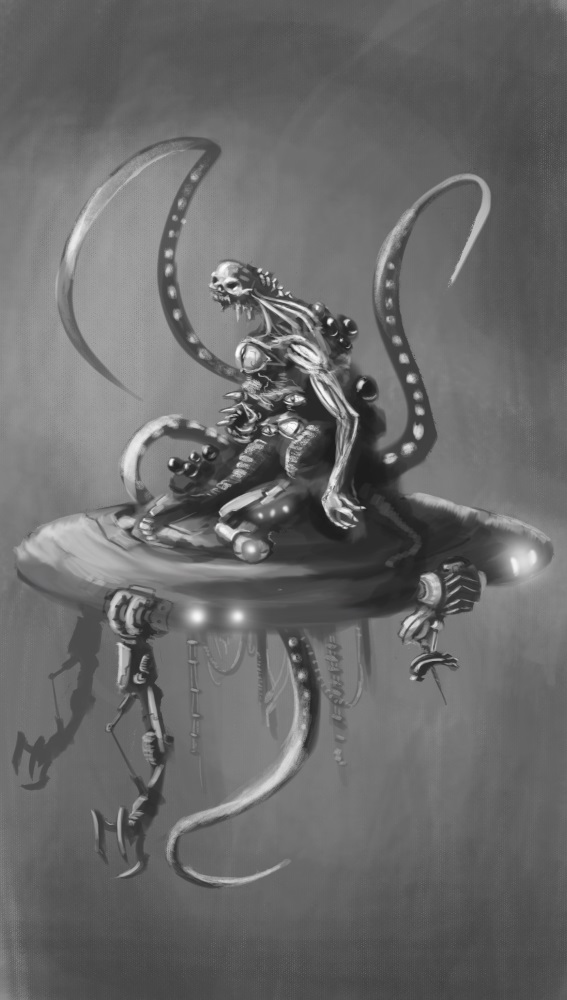
This transdimensional child of a synite and Golthnor is a sanity-blasting monstrosity. It usually stays invisible, but once it attacks, it shows its true form: a 16 foot (5 m) synite saucer covered in weeping red eyes and lipless drooling mouths. Atop the saucer is a writhing mass of purple trunks and tendrils, some ending in eyes, others in fanged maws.
The first Child of Golthnor the PCs meet has a lumpy humanoid face that stares out in horror from this mass of corruption, whispering, “Help me,” in a dozen languages, including Truth. Perhaps this is a face the PCs have met before in happier circumstances.
Motive: Open the door between worlds and let Golthnor in. Seek out esoteries that deal with transdimensional entities. Eat mass quantities of fresh meat.
Environment: Any, especially near a portal to other dimensions.
Health: 18/30/42
Damage Inflicted: 6/8/10
Armor: 3/10/25 vs. normal physical weapons; 1/3/6 vs. numenera weapons and esoteries.
Movement: Short (flying)
Modifications: Speed defense 8/10/10 when invisible; 5/7/9 when visible. Those in thrall to Golthnor are immune to the Child’s sanity blasting attacks.
Combat: When invisible, approaching within 100 feet (30 m) causes an Intellect attack that does 3/4/5 points of Intellect damage if not resisted. To physically attack, the Child must become visible.
When visible, looking at it the first time causes an Intellect attack that does 6/12/18 points of Intellect damage.
A Child of Golthnor attacks twice per round, with a bite and a constricting trunk.
Bite: 7/9/11 points of damage
Twisted jaws clamp down on your flesh and grind back and forth. Will the pain ever stop?
Trunk: 11/15/19 points of damage from crushing and blood drain. Target must escape the next round to avoid automatic crushing and blood drain.
You can’t breath and it feels like your ribcage is about to pop. Dozens of mouths burrow into your wounds and suck. Your head spins as your blood is drained. The trunk holds on, obviously unsated.
Interaction: Will only assist those in thrall to Golthnor.
Use: This creature is great for defending a portal that Golthnor is trying to open.
Loot: The saucer yields 1d6 squirming bio-mechanical cyphers.
GM Intrusion: A mass of tendrils reaches for the face of someone in immediate range, level 8/10/10. If it hits, it forces the target’s mouth open, and a wriggling mass of pus with worm-like appendages slides down the victim’s throat. Move down one step on the damage track and gain the Gibbering descriptor until Golthnor is defeated (use Mad if you don't have The Sun Below: Sleeping Lady).
Options: In a Cypher System horror game where you are using shock levels, the Child of Golthnor counts as mind-bending. Any encounter that ends up with a Child of Golthnor is a great excuse for using Horror Mode.
In a recursion of The Strange, a Child of Golthnor may be a mad-science child of a robot and a planetovore.
More: Follow the link for more information on The Sun Below: Sleeping Lady.
New! Sign Up Now for the Dread Unicorn Games Newsletter!
Subscribe now! The Dread Unicorn is starting a newsletter. Keep up to date with gaming news, special offers, new creatures, items, and GM advice.

Instant Adventures, Part III -- GM Intrusions
Let's return to the subject of Instant Adventures. In part I we took them apart and saw how to build our own. In part II we had an example using Numenera, complete with toadling queens. Today let's talk about GM Intrusions. You need to have GM Intrusions for your players to get xp and to keep the game interesting. We want to be sure to use GM Intrusions in our own Instant Adventures.
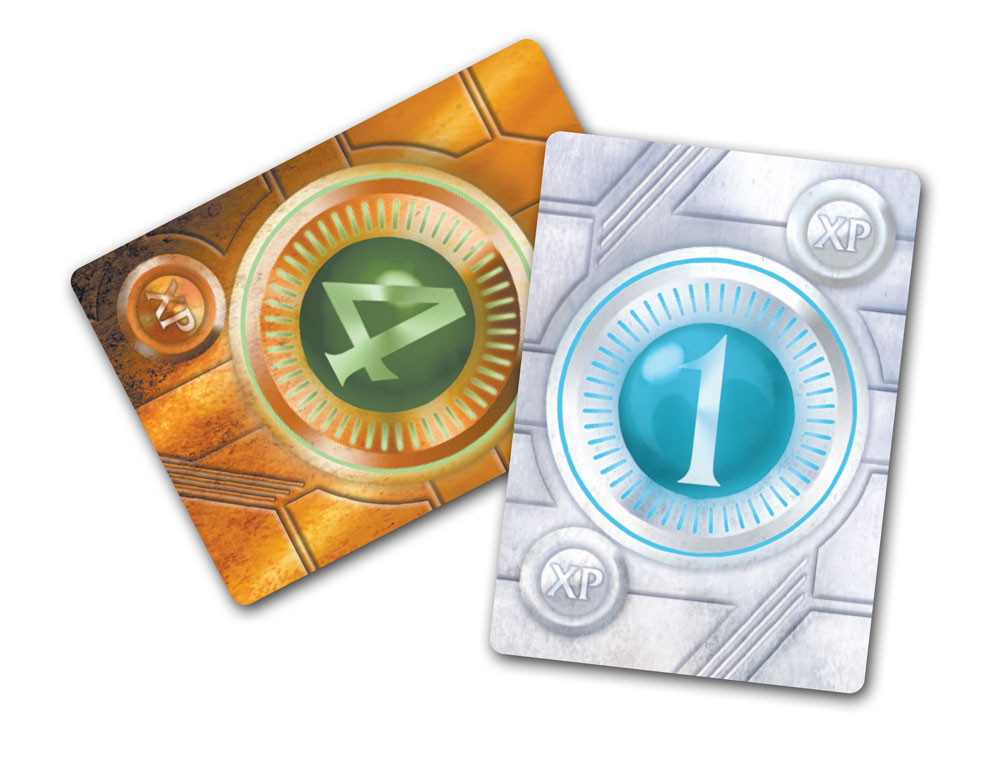
Many GMs new to the cypher system say they forget to do GM Intrusions. Hint: pass out physical objects for xp when you do a GM Intrusion. Use cards, poker chips, dragon tears, whatever. The deck/pile of xp objects in front of you will remind you to keep on doing it.
Monte Cook Games sells xp decks; I like them, but anything will do.
Almost all creatures for Cypher System games come with a built in GM Intrusions. (All of the creatures from Dread Unicorn Games' Cypher System books do.) I like to start combat with a GM Intrusion. It shows off a cool ability and I can do it again if the players roll 1s.
Now if you just made up a bunch of creatures, like my toadlings in the example Instant Adventure, you can make up GM Intrusions for them. Let's go!
- Margrs and Nibovian Wives are from the Core book, and already have GM Intrusions in their callouts. See pages 244 and 249. The Nibovian Wife's GM Intrusion is an escape, which is great for avoiding combat, particularly if time is running short.
- Toadling GM Intrusion: a swarm frenzies, attacking at 2 levels higher (6) and doing 12 points of damage.
- Toadling Queen GM Intrusion: She spits a glob of acidic poison at a character's face. Level 6 attack for 4 points of ambient damage, plus the character has to make a Level 6 Might defense check or take another 4 points of poison damage.
- Toadling King GM Intrusion: He hops into the air and lands on a character. This is a level 7 attack which does 5 points of ambient damage and dazes them for one round.
Note: these attack GM Intrusions are extra attacks, so the creature can follow up with it's normal attack.
Now, let's make up some social GM Intrusions:
- Uncle Liskal GM Intrusion: a character in Liskal's chamber must make a level 6 Intellect defense roll or for the next 28 hours refer to the AI as "Uncle Liskal" and feel compelled to impress the machine. "When Uncle Liskal hears how I dealt with this problem, he'll really be impressed." (Probably not.)
- The Song of Love GM Intrusion: if none of the male characters are falling for Klaru's charms, use a GM Intrusion to change one of their minds. "Despite you better judgement, there is something about her that makes you throw your caution (and clothing) to the wind."
- Faux pas with the Queen GM Intrusion: the slimy floor is too much for a character, causing them to slip and fall, right onto one of the queen's offspring. The little toadling croaks in pain!
- Jealous King GM Intrusion: If the characters fixed the moon pool to gain the queen's help, she plants a slimy kiss on a character before they go to see the king. He sniffs the character "You've been fooling around with one of my queens! I can smell her on you!"
You get the idea. Things to make the game a little more interesting, to keep the story exciting, and to give everyone at the table a good laugh. And xp.
Sleeping Lady Extras: Horror Mode
As promised, the third extra for The Sun Below: Sleeping Lady is up, and it's all about using Horror Mode during the adventure. If you want to get your Horror Mode on from the Cypher System book while running Sleeping Lady, check it out. (GM's only, spoilers for players.)
What's Horror Mode? It's the tabletop rpg equivalent of the spooky music ramping up in a horror movie. Read about it here.
Planning to Improv: Make Your Own Instant Adventure, Part I
Monte Cook Games has been talking a lot recently about their Instant Adventures. You can even purchase Weird Discoveries: Ten Instant Adventures for Numenera.
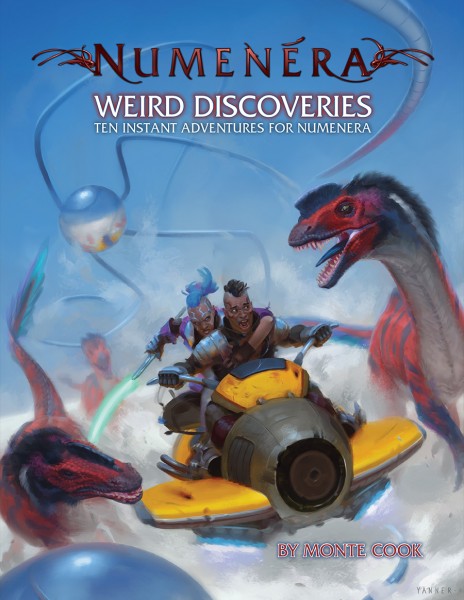 The idea of an instant adventure is you have just enough prepared to let you improv your way to a good game session. Instead of an item, clue, or other plot point attached to place (under the rug is a hidden map), plot points are fluid and can be placed in whatever scene fits your session's pacing. GUMSHOE GMs will note the similarities with floating core clues.
So, what can we steal to make our own instant adventure? In this post I'll look at the building blocks of an instant adventure. In the next, I'll make my own.
Instant adventures can work not just in Numenera, but in any system.
First you have a list of bullet points about what is really going on. The characters won't have a clue about this information at the start of the session. For example, an ancient machine has awoken and is capturing people and "improving" them in tragic ways.
Then a hook (starting point): The guide the PCs are counting on has vanished, as have a number of people.
And and ending (wrap-up): The PCs stop the machine and maybe have rescued a few of the people, including the guide.
Next you come up with two to four floating plot points, or keys. A key can be a clue, knowledge, evidence (say in a murder mystery), an item, or something that "summons" a creature. A person who knows where the vanished people went. A device that will fix a sparking sphere. An item that makes the machine think the PCs don't need improvement.
Next, seven to twelve nodes. These are people or places. You can sketch a graph or map that shows all the nodes and which keys might be at any node. Any key could show up at a number of nodes. In play, the GM picks one based on the session, pacing, and what has hooked the player's interest. The players really really like this stupid rock in front of the glowing house? Then it's not a stupid rock, it's a key!
People can have information or items. They can sometimes be opponents. Places can have items, clues, weird numenera, and/or creatures.
Note which key(s) might be with this node. Nodes can point to other nodes. Some nodes can be bottlenecks, the PCs must get past this node to continue the session.
Example node: A deep well with a sparking sphere at the bottom. Next to the sphere is a door that leads to the rest of the session, but won't open until the PCs repair the sphere. If the item that makes the machine think they don't need improvement is here, the PCs must remove it from the sphere and take it with them. Past the door is the dancing reptile woman.
You can tie your instant adventure into your campaign as extra credit if you with.
Then run and enjoy. Let the keys show up when it feels right for the pacing and whatever lunacy your players are up to.
Next time I'll build a tiny instant adventure.
Going Horror Mode in the Cypher System
For Halloween, I tried out the horror mode rule from the Cypher System. I ran a horror Numenera game down at my Friendly Local Game Shop (Modern Boardshop), where I reskinned an adventure for horror. I used The Nightmare Switch, from the original Numenera Kickstarter, which worked well.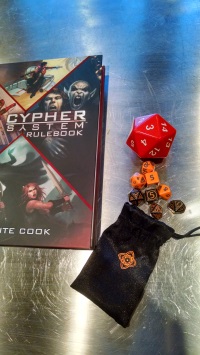 Horror mode changes the way the players' die rolls can create GM Intrusions. Instead of only on a 1, you start off at a 1 or 2, and keep adding to the threat range for the GM Intrusion. Once we got it up to 8, and with six players rolling dice, we had a huge number or GM Intrusions.
The Cypher System book has all the details, but the idea is that GM Intrusions bring on the horror. Once the PCs beat a local horror, or successfully flee from it, you set it back to normal (only a 1 gives a free GM Intrusion).
To help create the right mood, I took a huge red d20, and slapped it down on the table with the 2 up. Then I explained the rule. Every time I upped the chance to get a GM Intrusion, I picked it up and slapped it down with the new number up. I may have chuckled evilly.
So what about when you want the horror to show up? Easy. Just use a normal GM Intrusion, hand out the 2 xp. And add one to the horror die. Slap!
How did it work? It worked great. The players focused on their die rolls, constantly glancing at the big red die in, well, horror.
I'm coming to appreciate when a game designer like Monte Cook uses a core component (GM Intrusions) of their existing system in a new way. This reminds me of why I like how 13th Age designers have come up with new ways to use the escalation die and icon relationship roles. I find this so much better than the old way of slapping on a new mechanic to the side of an existing game. Eventually the system is defined by a collection of non-related mechanics that have been shoved into the game until I find it unplayable.
I can totally see adding horror mode to any cypher system game where I have a horror component. In fact, it would work great in The Sun Below: Sleeping Lady, which has a strong eldritch horror vibe.
I think I know what my next Sleeping Lady Extra will be...
The First Sleeping Lady Extra is up.
GMs, head on over to the Sleeping Lady Extra's page and check it out.
Prisoner of Golthnor!
Players, chill. ;)
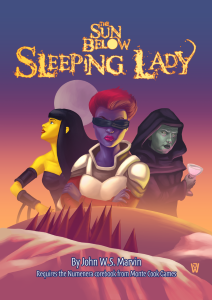
It's Christmas in July! The Sun Below: City on the Edge is On Sale!
It's Christmas in July! From now through July 30th, this title has been marked down by 25%!
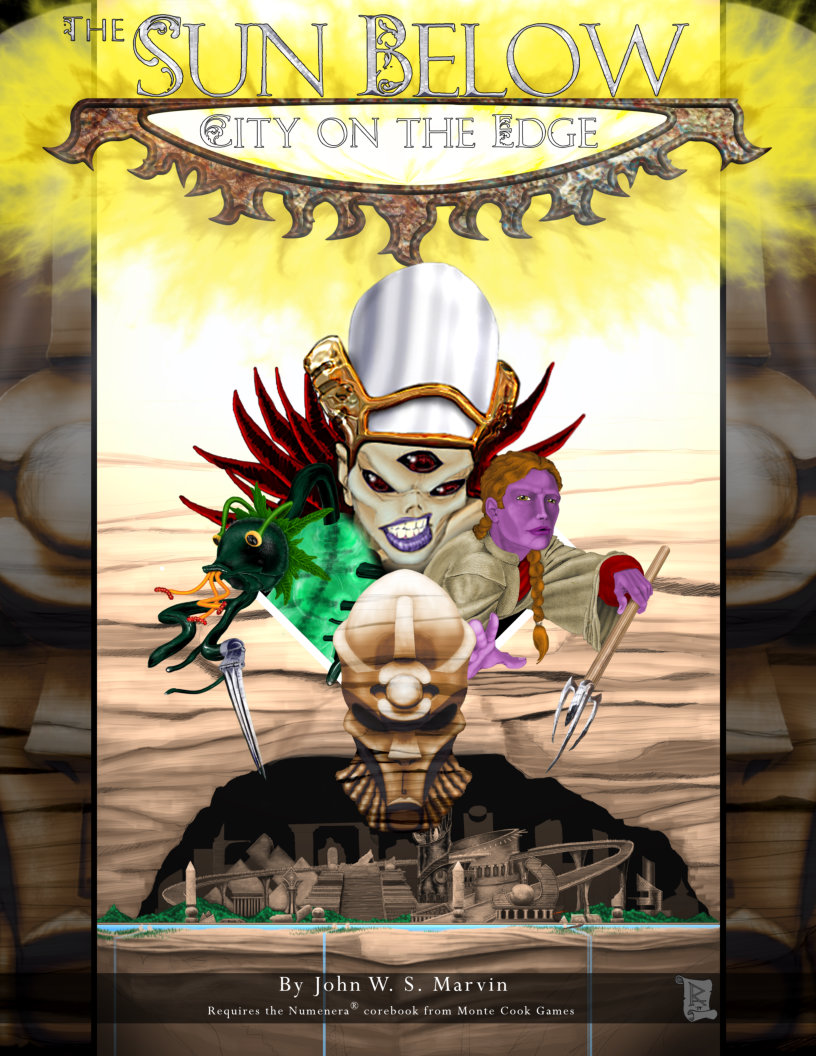 The highly reviewed epic Numenera adventure from Dread Unicorn Games is available at rock bottom prices. Get yours now while the sale lasts.

Horror on the Cypher System Express
I've always enjoyed a great eldritch horror game: Call of Cthulhu or more recently, Trail of Cthulhu. And I really enjoy the Cypher System, the core rules used in Numenera and The Strange. Now, with the publication of the Cypher System Rulebook, I can mix my shuggoths and my GM Intrusions.
So, how does horror work in the Cypher System? First, I should explain a little about how the Cypher System Rulebook works. It's a menu of rules a GM (and players) can chose from to create their own game. Besides horror, there are rules for science fiction, fantasy, modern, and superheros. Within each genre, you get more choices. Lots of optional rules to tailor the game to just the right kind of horror.
The rulebook has a big bestiary of creatures to choose from and the horror section lists the ones that best fit a horror campaign, including Deep Ones and Mi-Go. It also includes 3 horror artifacts, so if you want more, you're going to have to make some yourself.
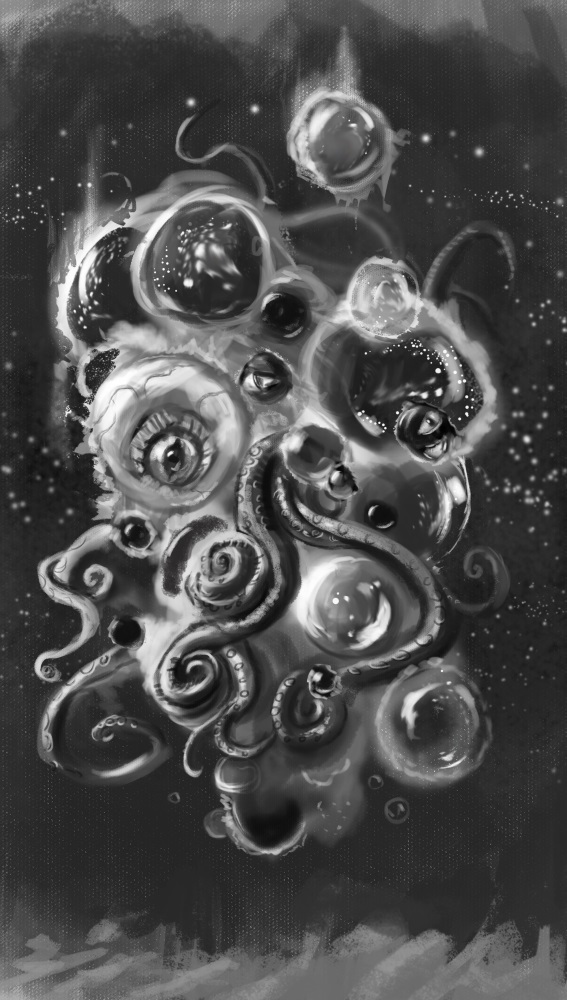
The horror rules are all optional rules. Madness will be familiar to Cthulhu players. Cypher System madness grew out of the madness rules found in In Strange Aeons: Lovecraftian Numenera. In this case madness puts a hurt on your Intellect pool and can even change your descriptor. I do something similar in The Sun Below: Sleeping Lady, which has a seriously eldrtich horror vibe.
Shock is another optional rule, more for short term effects like losing control of your character and running away or sitting down to sob rather than fight. Trail of Cthulhu players will find it very similar to Stability losses. Different mechanics, but going for the same effect.
Combine both Madness and Shock if you want a game like Trail of Cthulhu, or just Madness if you want a Call of Cthulhuish experience.
I've saved the most interesting for last. Horror Mode. Horror mode is a great way to ramp up tension, as the range for a GM Intrusion (the dice fail kind, not the 2xp kind) goes up to a 1-2 on a d20 roll. Then 1-3. And so on. You can get to 1-10 fairly quickly. Each GM Intrusion brings new horror AND widens the GM Intrusion range by one.
After the horror mode is over, you reset the GM Intrusion range to 1. Until the next time...
Which has me thinking of a Cypher Cthulhu adventure. I'm sure my players would love it!