

Lightning Combat

Sometimes in roleplaying games, everyone at the table is so into some epic tactical combat that they never want it to end. I’m not talking about those times.
I’m talking about when you want speed combat along. It might be to improve the pacing of the story, because your players are going to leave in 20 minutes, or that you see everyone’s attention wander when a big combat goes on for more than two or three rounds.
Buff Offense and Initiative, Nerf Defense
This is a great way to keep the combat exciting but stop it from taking forever.
Why Buff the Offense?
If you are going to shorten at 5+ round combat to a 2 or 3 round combat, you want the players to still worry that they might lose. You need to hit them harder and faster.
In games like 5E with death saves, I like to have at least one player have to start making death saves. Nothing focuses players like death saves. I mean, just the name death saves. Also, it allows a healer character to really shine when they save the day.
To buff the offense, you can
Increase the damage the monster does
Increase the chance that the monster will hit the player characters
Add more attacks by the monster
For Cypher System games, start each combat with a GM Intrusion
A simple method is to increase the damage done by 1/3. What’s great about this is that is simple, easy to remember, and while you may need a calculator (like the one on your phone), you can do it on the fly.
The downside is what if you roll bad and the monster never hits? It’s unlikely that the players will feel like a 2 or 3 round combat where they were never touched was an exciting or memorable action scene. How big worry this is depends on the game system (looking at you, Rogue Trader) and the chance for the monster to miss.
If you’re worried that the monster is likely to miss, adding to the monster’s attack chances helps, as does adding another attack.
Initiative
Since we’re about to nerf the defense, you want to make sure your glass cannons get a hit or three in. See that they go early in the initiative order. For a d20 game that might be a +4 to initiative, for a Cypher System game it might be +2 to the initiative difficulty, and for a GUMSHOE game it might be a +2 to the weapon skill (but just in terms of initiative).
Or you can just decide your monster goes first. Simplicity is beauty.
Nerf the Defense
This is how you make the combat go faster. The PCs will be able to bring the monsters down faster and get on with whatever comes next. You can:
Decrease the monster’s hit points
Decrease the monster’s defenses
Monsters could surrender or flee
Steal the escalation die mechanic from 13th Age (for games like 5E where monsters get saving throws, the escalation die can be a penalty to that roll):
The escalation die represents a bonus to attacks as the fight goes on.
At the start of the second round, the GM sets the escalation die at 1. Each PC gains a bonus to attack rolls equal to the current value on the escalation die. Each round, the escalation die advances by +1, to a maximum of +6.
Monsters and NPCs do not add the escalation die bonus to their attacks.
In a 13th Age game, allow players to spend an icon boon to increase the escalation die by one.
A simple method is to decrease the hit points by 1/3. Again, this is simple, easy to do (maybe with a calculator), and you can do it on the fly. A writeup of this for 13th Age by Rob Heinsoo can be found here: https://site.pelgranepress.com/index.php/13th-sage-speeding-combat/
Again, the downside is potential misses. Those lower hit points don’t matter if no one can touch the monster. In a game like 5E, defenses are armor class and saving throws. Lowering some or all defenses by three or four in a d20 game will often stop the misses. In Cypher System, lower the difficulty by one or two. In GUMSHOE, lower the hit threshold by one.
What Works for Me
In d20 games, the +1/3 damage and – 1/3 hit points works well for me, especially on the fly. I will bump the initiative by four.
If I have time, I might lower the defenses of some monsters while lowering the hit points of others, just to mix it up and give different monsters a different feel. Same for offense, I’ll increase the damage for some, and the hit chances for others.
What have you done to encourage Lightning Combat, and how did it work for you?


Scheduling Game Time
We all love to play roleplaying games, so getting together with your friends whenever the itch to play arises is simple and always stress-free. Right?
Well if it is, count yourself lucky. But if not, here are a few suggestions to make finding time for your gaming more fun.
The questions you need to answer are:
When?
How often?
For how long?
When?
This can often be a stumbling block when you have a group of gamers with busy lives. School, work, and family are oh so important, but they can all play havoc with your game time.
One tool that makes it easier is doodle.com. You can set up all the times you can play, and then everyone else can say which of those times they can play.

Not everyone can make every game
Unless everyone has very similar schedules, even with doodle, you might find there is no time when everyone can make it. You may have to find a time when most can make it. You’ll just have to get used to it, because the next game someone else might not be able to make it.
I recommend flexibility here. If someone can make most of the games, that’s good enough for me. If you insist on near perfect attendance, you may be missing out on some great players, and might find your gaming group becomes a group of one. You don’t want that.
Invitations
I use private Facebook events to send out invites and see who is coming. Email, Meetup, and text messages work too. I have a threshold (usually 3) for the number of players who should come. Otherwise we cancel (and sometimes play a board game).

How Often?
Typical gaming groups meet once a week, every other week, or once a month. Ask your players what they want. If some want to play more often than others, most groups go for less often, unless it’s one or two that can’t make every game at a more frequent schedule but could make most.
Consistent Game Times
You don’t want to go through the scheduling process every game, you want to give everyone a day and time they can depend on. That way they clear their schedules for gaming, their families and friends get used that schedule, and you have a great default. Just send out your invites and see who is coming.
For How Long?
Once folks are out of school, I find most games run 3 – 4 hours. Before graduation, games can go on very long indeed. Keep the coffee flowing.
I propose an end time and see what the reaction is. If one person must leave early, the rest of the party can continue. Sometimes I go over, sometimes I cut it short, all depending on what’s going on in the game now. About to start something big that requires time and concentration? Best not start it when folks are getting sleepy. In the middle of a major scene and everyone is engaged? Keep on keeping on.
Leave a Comment
Got other suggestions? Please leave a comment so others can achieve gaming enlightenment through your sage wisdom and advice!
Inspired Inspiration in 5E
 Inspiration is one of my favorite parts of Fifth Edition Dungeons and Dragons. It works great as written, but I'm going to steal an idea from Lex Starwalker and show how to use inspiration for group storytelling.
Normally, you can spend inspiration to gain advantage to an attack, saving throw, or ability check. That still works.
Inspiration is one of my favorite parts of Fifth Edition Dungeons and Dragons. It works great as written, but I'm going to steal an idea from Lex Starwalker and show how to use inspiration for group storytelling.
Normally, you can spend inspiration to gain advantage to an attack, saving throw, or ability check. That still works.
However, you can also spend inspiration to make up something in the game world. It might be a detail that works with your background or skills. It could be a clue, a secret passage, or a one use item like a level-appropriate potion or a scroll.
For example, Qua the cleric is down on spells, but has inspiration. "I'm spending my inspiration to search that pile of skulls and find a potion of greater healing."
Or Kay the paladin is desperate to find the Lady Vonya. "I spend my inspiration and look at the track and find a clue." At this point, as the GM, you improvise a clue, "It's a scrap of parchment. In Lady Vonya's hand it reads 'we leave the Black Tower, our captors driving us west. Ahead lie the glass caverns. If any shall find this, send help.'"
Or Troik the bard just want another spotlight moment. "I'm spending my inspiration to have the farmers in from their fields for a local holiday. The village is full of people in good cheer. If only a very handsome someone just happened by to provide it. I tune up my lute."
Obviously, it's up to the GM to stop player abuse. Advantage is a great boon, but not a wish (or even a fireball). Spending inspiration might push over an apple cart during a chase scene, but will not push a combatant off a cliff.
Ask yourself:
- Is it overpowered, like the effects of a powerful spell? Or something small, along the lines of a cantrip?
- Does it break the story? If you are just starting a three session murder mystery, inspiration can't give away the culprit. It could point to information "Barkeep Barlo hears all sorts of things..."
- Does it take the fun out of the adventure? Some players try to play it safe all the time. And you want thrills, so don't let the players nurf the exciting bits.
- Does it open up a new fun avenue for adventure? Don't be afraid to improvise and go with player ideas that make the game fun. Sure, you had your own fun encounter directly ahead of them, but if they say they found a secret passage, improvise something fun in the passage. If they never see your planned encounter, you can reuse it in a future adventure.
 The cool thing about this for players is that it gives them a chance to improvise outside of their character powers. They get to do a little shared world-building.
And for the GM, it's another way for your players to surprise you, forcing you to improvise and keep the fun going. I don't know about you, but I like to be surprised by my players.
Have you tried something like this? How does it work for you?
Don’t forget to visit our 5E Kickstarter: The Gods Have Spoken.
Spotlight Cards
 Index cards are a GM's best friend. Remember the Hipster PDA?
I hate forgetting to give each player time in the spotlight. Therefore, I love having an index card for each player. I shuffle them before the game, and then flip the deck so I can see the top PC card.
Index cards are a GM's best friend. Remember the Hipster PDA?
I hate forgetting to give each player time in the spotlight. Therefore, I love having an index card for each player. I shuffle them before the game, and then flip the deck so I can see the top PC card.
On the left I put the information from the game system I need to be able to improv, things from the player's character sheet. I don't need numbers, just the background bits that help in roleplaying.
On the right side of the card I put the stuff the player loves to do in game with this PC. Play with his pet bear, drink at her regular watering hole, flirt with their favorite NPC, and so on.
I finish the left side with a question to myself. Has this PC gotten the spotlight yet? If not, I give them the spotlight ASAP, then put this card on the bottom of the deck and make sure the next PC gets a spotlight moment.
What's a spotlight moment? When you let the PC shine, make them the star of a scene. If they have a favorite action, like pick pocketing, flirting, or flying, I let them go for it. Action scene or pure roleplay, I make sure the character gets center stage.
Here's some examples. You can probably improve on these because no one knows your players better than you.
 This is the Cypher System card. I have another question to myself: Has the PC had a GMI (Game Master Intrusion) yet? I'm talking a GM Intrustion that gives them experience points. The card helps me remember. GM Instrusions are fun, and players love the XP that comes with them.

 This is the 13th Age card. When I'm working on a spotlight moment, I need the PC's One Unique Thing, their Icon Relationships, and their Backgrounds. Under the notes I might include favorite icon spirits and agents from past icon relationship rolls.

 Here's the 5E card. What's important for spotlighting a 5E character might include the PC's background, trait, ideal, bond, and flaw.

 Here's a generic GUMSHOE card. Drive and Occupation give me a handle for spotlight scenes.
I thought about doing a card for each GUMSHOE game, but realistically, I'd do them as needed for the games I'm running. On the right side I'd definitely list any sources of stability if they are used in this system, species for Ashen Stars, and so on...

It's easy enough to make your own for your favorite game system. They help me, maybe they'll help you.
Icon Options: Learning from Organized Play
 At my FLGS, I'm GMing 13th Age Organized Play, second season, set in the Dragon Empire of the core book. My home campaign is 13th Age with my own setting. For my day job, I'm working on Gods and Icons. 13th Age immersion therapy!
If you're a 13th Age GM, I encourage you to sign up for this program. I'm finding a lot of cool things in the Organized Play, including Icon Options. (Have you heard the rumors of Organized Play for Numenera? I have, and I want to believe!)
At my FLGS, I'm GMing 13th Age Organized Play, second season, set in the Dragon Empire of the core book. My home campaign is 13th Age with my own setting. For my day job, I'm working on Gods and Icons. 13th Age immersion therapy!
If you're a 13th Age GM, I encourage you to sign up for this program. I'm finding a lot of cool things in the Organized Play, including Icon Options. (Have you heard the rumors of Organized Play for Numenera? I have, and I want to believe!)
Icon Options are bits of background that only come into play if some of the players have a relationship with that icon. They don't have to roll a 5 or a 6, they just need a relationship.
For example, in the first adventure, Night of Deadly Stars, the players are hired by Hosford Merrywife. She changes based on what relationships the players have with the icons. Relationship with the Archmage? Hosford's a failed wizard who can give +1 to skill checks that use magical solutions. Elfqueen? Hosford's part elf. Not half, just a bit, but she can give the party +1 to spot things.
When the party runs into bandits, if they have a relationship with the Empeor, the bandits are imperial deserters. Knowing imperial tactics gives the PCs +1 to attacks. If the Diabolist is important (defined by having PCs have a relationship with her), then the bandits are planning a sacrifice to appease a demon. The PCs would do fine...
The adventure never lists options for all 13 icons, but moves around, so most will be hit. After listing a few with interesting ideas, it's often followed by "Icon Option: Other Icons." Back to the bandit example, the bandits have looted a caravan that belonged to servants of the other icon. They might have fine elven threads, dwarven ale, and so on.
I love this concept. The players are adventuring in a world where the icons they picked are the important ones. And not just on a 5 or a 6.
I am so stealing this.
Going Horror Mode in the Cypher System
For Halloween, I tried out the horror mode rule from the Cypher System. I ran a horror Numenera game down at my Friendly Local Game Shop (Modern Boardshop), where I reskinned an adventure for horror. I used The Nightmare Switch, from the original Numenera Kickstarter, which worked well.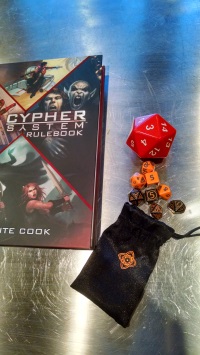 Horror mode changes the way the players' die rolls can create GM Intrusions. Instead of only on a 1, you start off at a 1 or 2, and keep adding to the threat range for the GM Intrusion. Once we got it up to 8, and with six players rolling dice, we had a huge number or GM Intrusions.
The Cypher System book has all the details, but the idea is that GM Intrusions bring on the horror. Once the PCs beat a local horror, or successfully flee from it, you set it back to normal (only a 1 gives a free GM Intrusion).
To help create the right mood, I took a huge red d20, and slapped it down on the table with the 2 up. Then I explained the rule. Every time I upped the chance to get a GM Intrusion, I picked it up and slapped it down with the new number up. I may have chuckled evilly.
So what about when you want the horror to show up? Easy. Just use a normal GM Intrusion, hand out the 2 xp. And add one to the horror die. Slap!
How did it work? It worked great. The players focused on their die rolls, constantly glancing at the big red die in, well, horror.
I'm coming to appreciate when a game designer like Monte Cook uses a core component (GM Intrusions) of their existing system in a new way. This reminds me of why I like how 13th Age designers have come up with new ways to use the escalation die and icon relationship roles. I find this so much better than the old way of slapping on a new mechanic to the side of an existing game. Eventually the system is defined by a collection of non-related mechanics that have been shoved into the game until I find it unplayable.
I can totally see adding horror mode to any cypher system game where I have a horror component. In fact, it would work great in The Sun Below: Sleeping Lady, which has a strong eldritch horror vibe.
I think I know what my next Sleeping Lady Extra will be...
Run Away! or Always Win? Game Masters' Roundtable of Doom #6
 This month's topic comes to us courtesy of Lex Starwalker:
At one end of the spectrum is the style and belief that the PCs should be able to overcome any challenge that comes their way, that challenges should be “appropriate”. On the other end of the spectrum is the style and belief that the world should be realistic, that every fight shouldn’t be able to be won, and that one of the requisite skills of the game is knowing when to fight and when to run.
This month's topic comes to us courtesy of Lex Starwalker:
At one end of the spectrum is the style and belief that the PCs should be able to overcome any challenge that comes their way, that challenges should be “appropriate”. On the other end of the spectrum is the style and belief that the world should be realistic, that every fight shouldn’t be able to be won, and that one of the requisite skills of the game is knowing when to fight and when to run.
Where do you, as a GM, fall on this spectrum, and why? Should the PCs always be able to win?
Games should be fun. That's kind of the point, isn't it?
While you might think a constant stream of "winable" encounters would be fun, I haven't found that to be true. Why is that?
My guess it that it's too predictable. The only challenge becomes how well you win, not if. Why not play on autopilot?
In a great story you always see the protagonist on the brink of defeat. And sometimes they lose. I'm looking at you, George RR Martin!
A great gaming experience can do do the same.
Defeat can be in combat, intrigue, or social. The risk of defeat wakes up the player behind the character, gets the adrenaline flowing, and creates a memorable session.
At the same time, setting up a trap where the PCs will be killed no matter what they do isn't likely to be fun either. Remember the discussion around TPKs?
 So in a combat encounter where the PCs are overmatched, I'll always leave a way out. It might not be obvious at first, but they can always retreat. 13th Age has a rule that lets the PCs always retreat from any fight, but if they do, they suffer a story defeat. The kidnapped victim gets sacrificed, the cultists summon their demon, the nice alchemist who used to sell healing potions to the PCs just got his shop burned down.
Intrigue defeats tend to be temporary and the PCs can just keep on going, perhaps on a different playing field. Your faction is down, the opponent's is up, but tomorrow is another day.
Social defeats are similar. Games like Hillfolk have rules that force a PC to accept defeats every so often. How the character deals with the defeat becomes part of the story.
The Game Masters’ Roundtable of Doom is a meeting of the minds of tabletop RPG bloggers and GMs. We endeavor to transcend a particular system or game and discuss topics that are relevant to GMs and players of all roleplaying games.
See what the other Doom Heads have to say:
How can you submit topics or become a participant blogger? by emailing gamemastersjourney@gmail.com
Game Masters' Roundtable of Doom #4. TPK Anyone?
 This month's musical question is:
There is a wide spectrum of lethality in RPGs, and there are GMs who fall on every possible point within it. These range from GMs who run campaigns where PCs can never die to the other extreme—GMs who delight in killing PCs. Where do you fall on this spectrum? How lethal are your games and why? How do you handle PC death if and when it happens?
This month's musical question is:
There is a wide spectrum of lethality in RPGs, and there are GMs who fall on every possible point within it. These range from GMs who run campaigns where PCs can never die to the other extreme—GMs who delight in killing PCs. Where do you fall on this spectrum? How lethal are your games and why? How do you handle PC death if and when it happens?
As fun as it is to kill PCs, I don't do it often. A few deaths a campaign, and that's gritty for me. I don't kill them enough. I used to kill them too much. Now it's rare. And that really bothers me.
So I maim them.
Of course, every system is different. In Call of Cthulhu or Dark Heresy players expect very bad things to happen. I maim them a lot. In one Dark Heresy game I had a group of killers break into the PCs bedrooms and burn the characters with plasma rifles. The PCs woke up screaming and melting.
But no deaths. Eyeballs melted out of skulls? Check. Limbs exploded in fatty flames? Check. Players freaking out? Check.
I miss that game.
 I really miss Warhammer Fantasy Roleplay v2, now out of print. Those crit tables were to a maimer's dream come true. Luckily you can see the same kind of terrible effects in FFG's 40k books. Limbs gone, faces burned off, eyes melted (didn't I mention that already?), and more.
Besides maiming, one-shotting NPCs allies helps create a sense of threat. The players know they are tougher than an NPC, but when they see their ally transformed into a stain on the floor in the blink of an eye, it does set the mood. And when you get to the maiming, the player doesn't feel so bad.
A Song of Ice and Fire RPG is another maimer's playground. When my character (see, I don't always GM!) wouldn't yield, and my captors held my hand down on a stump, you can't say I didn't know what was coming. Jamie isn't the only lackhand in Westeros.
In games like Numenera, it's more about exploring a weird and dangerous world, and the system gives the PCs control over how they manage that danger. I knock them down and they find a way to get back up. Somebody always pulls out just the right cypher.
The Numenera core book includes a rule for maiming instead of death: Lasting or Permanent Damage as a Death Replacement. In place of a good maiming I often mutate the PCs. Love those mutants. And those knights who like to hunt them down!
D&D and similar games have mechanics to always keep the players ahead of the monsters. Even a hard fight doesn't have a significant chance of death if you follow the guidelines. These games are about heroes, and maiming them doesn't stick in a high magic story. I at least want the replacement bits to look alien and frightful. Kind of takes the fun out it when some cleric chants and the hand grows back, no scars or nothing!
If you want gritty stories, then exceed the safety limits. Use threats of a higher level than normal.
I appreciate 13th Age's battle building advice: "We've provided balanced monsters so that you can choose interesting ways to make most all battles unfair..." Then it goes on to list entertaining ways to make things unfair to the players, and encourages you to use them in every single battle. You've got to cheat a bit to maim and kill.
 I also like something else from 13th Age: the Meaningful Death Rule (stolen from 7th Sea): Bad dice can't kill you, only named villains can fully slay a PC. Nameless monsters can only put you in a coma, carry you back to their master, who is of course a named villain, and prepare you for sacrifice. Scary stuff, but this provides plenty of opportunity for daring rescues.
Hillfolk and other story heavy games might have very little or no violence. Player death might only happen if everyone at the table agrees it makes a better story.
Of course, Fiasco can be a bloodbath, but people expect that. Fiasco is also always a one shot, not a campaign, and players are more accepting of death when they know their is no next game to worry about.
For me, it comes down to the story we're collectively telling at the table. Ask your players, what kind of story do they want?
And check out this post on Run Away or Always Win.
The Game Masters’ Roundtable of Doom is a meeting of the minds of tabletop RPG bloggers and GMs. We endeavor to transcend a particular system or game and discuss topics that are relevant to GMs and players of all roleplaying games.
If you’d like to submit a topic for our future discussions, or if you’re a blogger who’d like to participate in the Game Master’s Roundtable of Doom, send an email to Lex Starwalker at gamemastersjourney@gmail.com.
This month's topic comes to us courtesy of Lex Starwalker.
The rest of the Roundtable has great things to say about player death. Read on!
Marc Plourde - The Mortality of the Situation at http://inspstrikes.blogspot.com/2015/04/nuts-bolts-27-game-masters-roundtable.html
James August Walls - Dead and Loving It - My Evening as a DCC Player at http://ilive4crits.blogspot.com/
Scott Robinson - Lethality and the RPG as a Relativistic Game at http://strangeenc.blogspot.com/2015/04/lethality-and-rpg-as-game.html
Lex Starwalker - How Lethal Are Your Campaigns? at http://www.starwalkerstudios.com/blog/2015/4/6/game-masters-roundtable-of-doom-4-how-lethal-are-your-campaigns
John Clayton Fatality! at http://blog.filesandrecords.com/2015/04/fatality/
Peter Smits - PCs and the killing thereof at http://planeataryexpress.blogspot.com/2015/04/pcs-and-killing-there-of.html
Arnold K. at http://goblinpunch.blogspot.com/
Evan Franke - To be or not to be . . . a Killer GM at http://asageamonghisbooks.blogspot.com/2015/04/game-masters-roundtable-of-doom-4-to-be.html
Stealing the Weird: Putting Numenera Creatures into your 13th Age Game
Sometimes it's nice to shake the players up a bit. They know the game a little too well and are becoming hard to surprise. One trick is to look at your bookshelf and steal something from a very different game and stick it in the one you are running now.
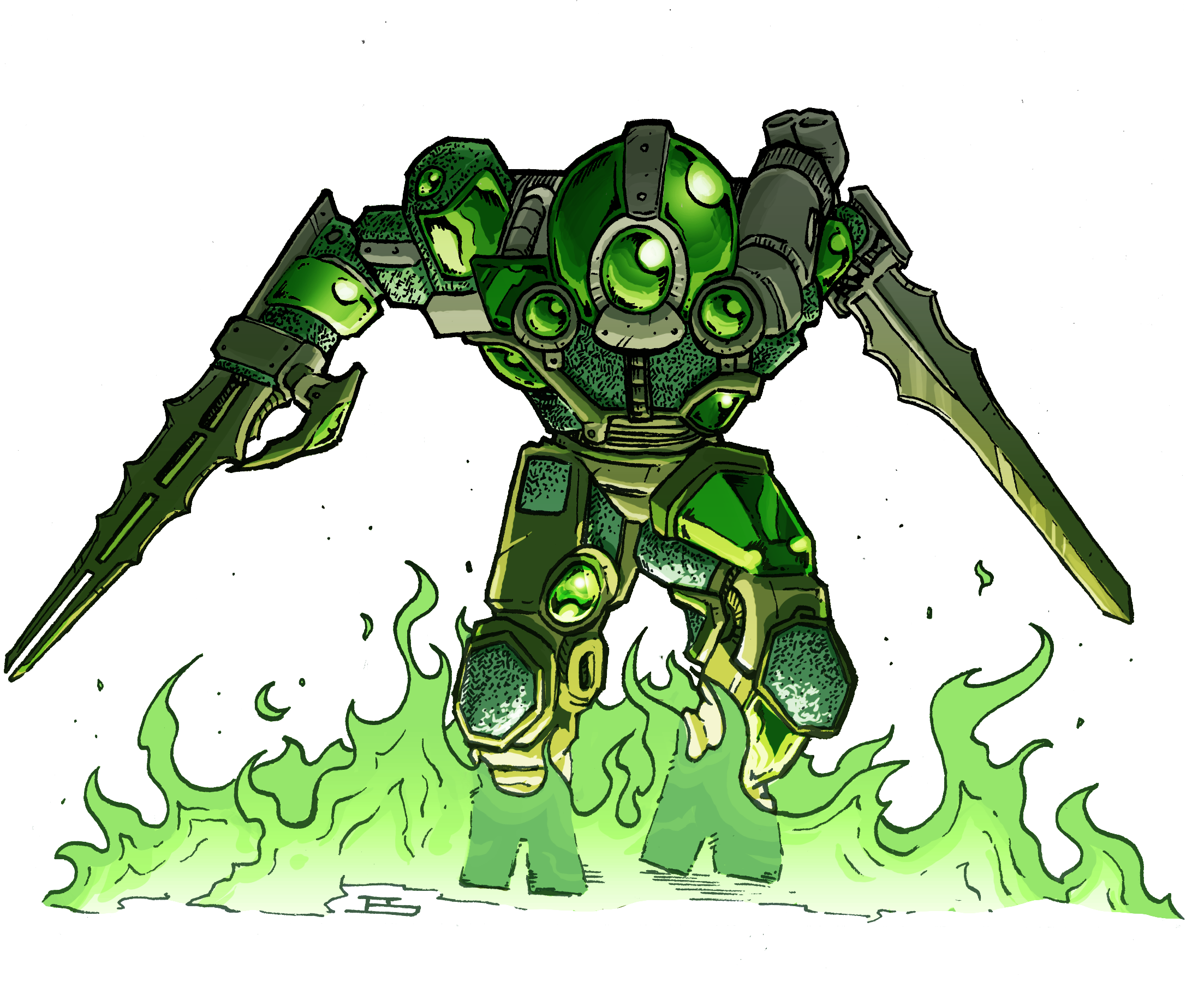
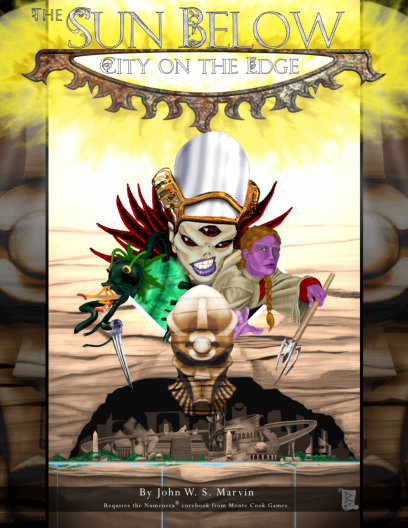
As an example, I'll steal a Numenera creature, and 13th Ageify it. I'll take one of mine, the Pyronic Sentry, which first appeared in The Sun Below: City on the Edge, but you can see it here. You can do this with any two game systems.
This is a challenging creature for beginning Numenera parties, so let's make it a challenge for a 2nd level 13th Age party. We'll make it a large 4th level monster. It looks large and it's doing double damage, which is what large monsters do.
It's obviously a construct, perhaps one of the Dwarf King's artificers went over the deep end and sold these to the highest bidder. Or was forced to make them against her will...
Reading the modifications, we'll make it invulnerable to heat, and vulnerable to cold.
Now, let's look at it's GM Intrusion: it can teleport a PC to directly in front of it. Which is nice, because it's always standing in a fire or lava, and then it hits it for extra damage. A GM Intrusion typically only happens once a battle, so we'll go with limited use, once a battle.
Check out DIY Monsters section in the 13th Age Core book.
Pyronic Sentry
A pyronic sentry is an armored construct whose color changes to match the flames it finds itself in. It looks like an eight foot tall armored man with long blades for hands. It is always found standing in fire, lava, or some other superheated environment. To engage a pyronic sentry, one must enter its fiery environ. As a construct it follows orders to guard a place or a thing.
Large 4th level wrecker [construct]
Initiative: +7
Invulnerable: magical and mundane heat and fire; Vulnerable: cold
Sizzling Sword Hands +9 vs. AC -- 20 damage
Natural even hit: +16 heat damage
R: Come Play: +9 vs. MD -- 24 damage
Hit or Miss: Nearby target is teleported directly in front of the pyronic sentry, taking 16 heat damage from the environment the sentry is standing in.
Limited Use: 1/battle.
Fiery environs: At the start of the pyronic sentry's turn, each enemy engaged with it or otherwise standing in the fire/lava takes 14 fire damage.
Nastier Specials
Some Like it Hot: A character must make a hard save (16+) to leave the fiery environs.
AC 20
PD 18 HP 108
MD 14
Blogger's Roundtable of Doom: The Montage
It's time again for the Blogger's Roundtable of Doom! Last time we talked about how to encourage roleplaying. This time our question is: What is a favorite mechanic or idea you've encountered in an RPG that you think would work well in other games? Please explain the mechanic/idea, tell us a bit about the game it comes from, and give some ideas of how it could be used in other games.
THE MONTAGE
I'm going with the montage. I first encountered the montage in 13th Age's Organized Play adventures. At the start of every session, the GM tells the players where they are going, and then has the players go around the table, each player describing a challenge the group encountered, and the next player describing how their character overcame the challenge. No dice, just pure roleplaying.
So the players tell the story of how they get to an important scene, and then the normal 13th Age rules take over and everyone plays out that scene. I love this, as it gets everyone's creative juices flowing and creates an exciting shared story that is part of the adventure.
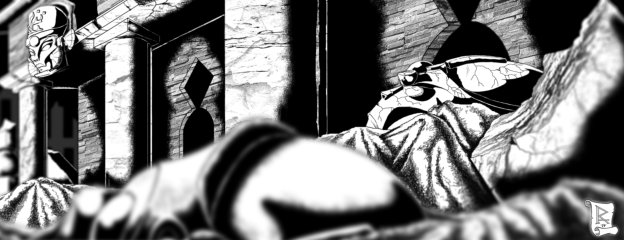
Here is an excerpt from my Numenera adventure The Sun Below: City on the Edge. The goal of the montage is to narrate a prison break by the PCs. Since they have lost all their equipment, I let them pick up cyphers as they go around the table. After the montage, they may encounter a hostile patrol, so I want them to gear up appropriately.
Prison Break
For the escape, the goal is not to go into details with maps and die rolling, but to give a sense of time passing as the characters make their getaway.
The characters are fleeing in an underground labyrinth of tunnels full of ancient machinery. In this scene, the players will help decide what obstacles they face, and what they must do to overcome them.
If the characters search for weapons at any point, they find pipes and bits of metal they can use as clubs.
Pick a player to start with, then go around the table. Each player will describe an exciting problem the group encounters. The next player will describe how their character solves the problem in a cinematic fashion. The GM narrates the solution back to the group, with the character as the hero, and has the hero find a cypher in the process. The player then comes up with a new problem and the next player in turn comes up with the solution. Keep going until every player has created and solved a problem.
For example, the first player says, “We run around a corner and find a bottomless chasm blocking our way.”
The next player describes how their character got the group past the difficulty. (No die rolls needed.)
For example, the player could say, “We find a storeroom full of long transparent tubes, wide enough to crawl through. We lay one over the chasm and go on.”
You then narrate that back to the group, making the character the hero and add a cypher.
Amazing. What looked like just part of the wall turned out to be the door to a storeroom, and you found it. You single-handedly lift a long clear tube up and place it across the chasm. You even find some machinery on both sides to brace it with, so it won’t roll. All the other characters get across.
You go last. As you crawl across the chasm in the clear tube, and notice something glittering on a shelf three feet below the far ledge. It’s a cypher.
Then give them a cypher. Consider cyphers that might help the characters escape from a patrol, such as a force screen projector.
Now the player who described the solution and found the cypher describes a new obstacle to the party’s escape. You keep going around the table. Once every player has had a chance to make up a challenge to overcome and a solution, the montage is over.
What are the other Blogger's of DOOM stealing from other roleplaying games? Let's see!
James Walls takes on the Player Turn from Mouseguard. I love Mouseguard, and this is an excellent post!
Marc Plourde is such a showoff, he blogs about 5 things to steal, and then adds 2 more. Great stuff.
Scott Robinson steals location aspects from FATE. Hmmm, I'm going to have to try this myself...
Lex Starwalker is behind all this madness: Now, he's taken the Cypher System's GM Intrusion, and intruded it into D&D 5th edition. Is nothing sacred?
John Clayton finds backstories that have fallen off the back of a lorry. Prince of Shadows aproved!